
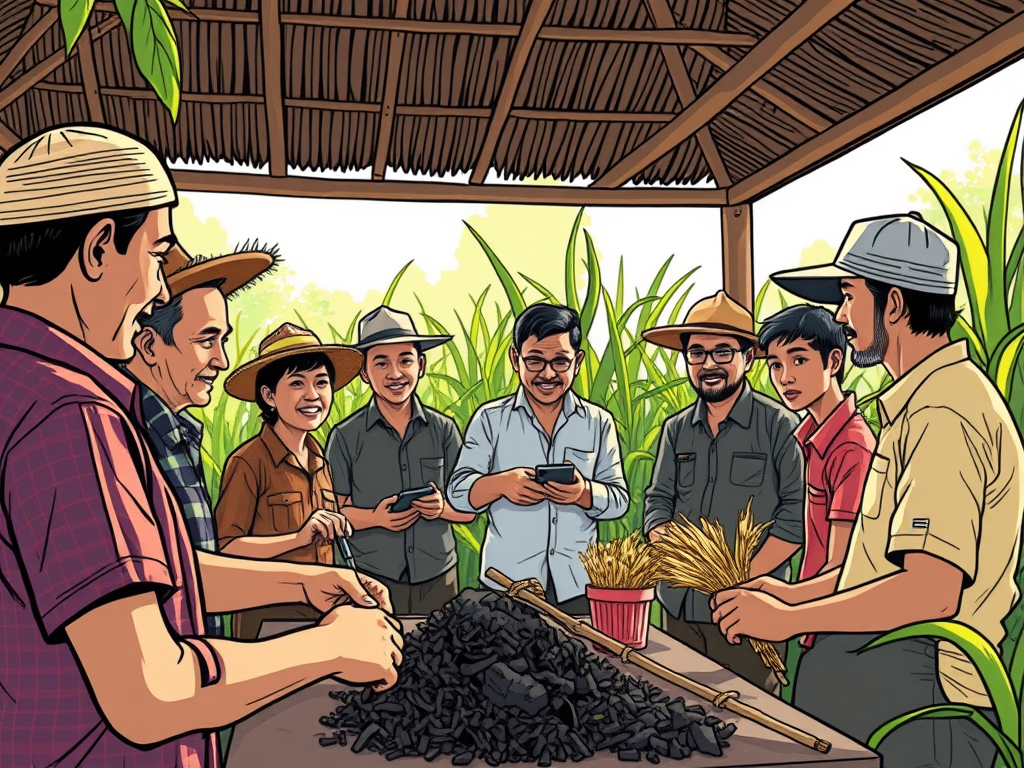
For a field where innovation often stems from global research hubs, a recent community service program in Indonesia highlights how local initiatives can offer sustainable solutions with a direct impact. Lecturers from Universitas Negeri Manado (Unima), led by Miftahul Jannah, M.Si, are transforming agricultural waste into a valuable resource for local farmers, demonstrating the practical application of biocharBiochar is a carbon-rich material created from biomass decomposition in low-oxygen conditions. It has important applications in environmental remediation, soil improvement, agriculture, carbon sequestration, energy storage, and sustainable materials, promoting efficiency and reducing waste in various contexts while addressing climate change challenges. More in a real-world setting.
The initiative focuses on Bolaang Mongondow, where farmers have traditionally burned or discarded rice straw waste after harvest. This practice not only pollutes the air but also depletes the soil of organic matter. The Unima team’s project introduces a simple yet effective alternative: pyrolysisPyrolysis is a thermochemical process that converts waste biomass into bio-char, bio-oil, and pyro-gas. It offers significant advantages in waste valorization, turning low-value materials into economically valuable resources. Its versatility allows for tailored products based on operational conditions, presenting itself as a cost-effective and efficient More. By heating the rice straw in a controlled environment with limited oxygen, they are able to convert it into biochar. This process locks carbon into a stable, porous material that can be returned to the soil, improving its long-term health.
The project, which received funding from the Directorate of Research and Community Service (DPPM), is more than just a scientific demonstration; it is a collaborative educational effort. The team worked directly with the Diat I Farmer Group, providing hands-on training that empowers them to replicate the process themselves. This knowledge transfer is crucial for ensuring the sustainability of the project beyond the initial program.
The biochar produced from the rice straw serves as a potent soil conditioner. Its unique structure helps to improve soil fertility and quality by enhancing its ability to retain water and essential nutrients. This can lead to increased crop yields and healthier plants, providing a clear economic incentive for farmers to adopt the practice.
This initiative exemplifies how academic research can be translated into tangible, community-based solutions for environmental and agricultural challenges. The enthusiasm shown by the local farmers underscores the significant demand for such practical, eco-friendly innovations within the agricultural sector. By bridging the gap between scientific knowledge and on-the-ground farming practices, the Unima team is contributing to a more resilient and sustainable agricultural future in the region.
SOURCE: Unima Lecturers Process Rice Straw into Biochar for Sustainable Agriculture


Leave a Reply