
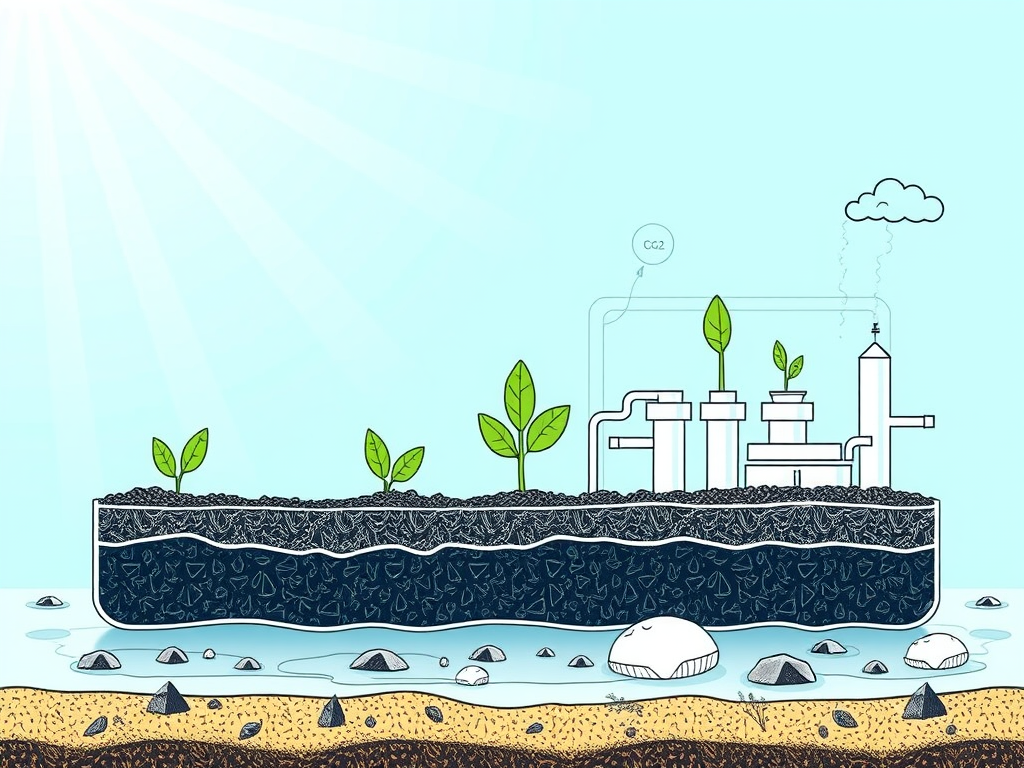
Industrial wastewater, especially from electroplating, poses a significant threat to environmental and human health. Current treatment methods are often energy-intensive and generate hazardous waste, contributing to global carbon emissions. In Communications Materials, Xu et al., present an innovative solution using a combination of biocharBiochar is a carbon-rich material created from biomass decomposition in low-oxygen conditions. It has important applications in environmental remediation, soil improvement, agriculture, carbon sequestration, energy storage, and sustainable materials, promoting efficiency and reducing waste in various contexts while addressing climate change challenges. More, iron, and manganese to efficiently remove toxic metals from electroplating wastewater, significantly reducing greenhouse gas emissions.
The authors developed a novel material that combines iron and manganese particles with biochar. This combination proves to be highly effective in removing pollutants. The biochar forms a graphitic layer that prevents iron from losing its effectiveness and enhances electron transfer, making the iron 24 times more efficient than traditional iron-based materials. Simultaneously, the manganese oxides undergo a lattice expansion of 0.02 Å, which improves their capacity to trap toxic metals.
The process also stabilizes pollutants by forming strong chemical bonds between carbon, iron, and manganese. This stabilization eliminates the need for additional costly and carbon-intensive stabilization before disposal, streamlining the treatment process.
Compared to conventional methods, this new approach dramatically reduces greenhouse gas emissions by 71.8% to 89.7%. It also decreases CO₂ production to only 2.1% to 3.5% of that produced by other iron-based methods. This research offers a sustainable alternative for industrial wastewater treatment, addressing a critical environmental challenge.
SOURCE: Xu, Z., Zhang, Y., Graham, N. J. D., Parikh, S. J., Xu, X., Cao, X., … & Tsang, D. C. W. (2025). Reducing environmental burden of electroplating wastewater treatment by ternary cooperation of zero-valence iron, manganese, and graphitic biochar. Communications Materials, 6(1), 47.




Leave a Reply