
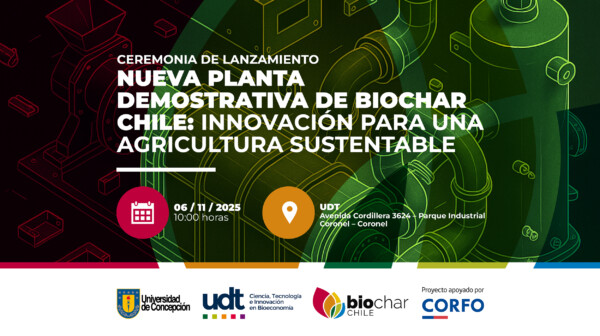
The BiocharBiochar is a carbon-rich material created from biomass decomposition in low-oxygen conditions. It has important applications in environmental remediation, soil improvement, agriculture, carbon sequestration, energy storage, and sustainable materials, promoting efficiency and reducing waste in various contexts while addressing climate change challenges. More Chile Technological Program, led by the Technological Development Unit of the University of Concepción (UDT-UdeC) and supported by Corfo, inaugurated Chile’s first semi-industrial biochar plant on November 6, 2025. This infrastructure marks a decisive step in scaling and validating thermochemical conversion technologies for sustainable agriculture in the country. The demonstration unit processes about 100 kg/h of biomassBiomass is a complex biological organic or non-organic solid product derived from living or recently living organism and available naturally. Various types of wastes such as animal manure, waste paper, sludge and many industrial wastes are also treated as biomass because like natural biomass these More, providing an essential testing ground for converting agro-industrial waste into stable carbon and renewable energy. The launch included representatives from UDT, Corfo, government officials, and partner companies.
A primary challenge for Chile’s agricultural sector is achieving a true circular economy, particularly through the effective valorization of extensive agro-industrial waste. This residual biomass contributes to methane emissions, yet simultaneously, farmers require scalable solutions to improve soil health and enhance resilience to climate change. The industry demanded a localized, proven pathway to address both waste management and soil degradation while creating economic incentives for sustainable practices.
The solution deployed is the new plant’s utilization of advanced thermochemical conversion. This process efficiently transforms residual biomass into high-quality biochar. A critical component is the program’s collaboration with private partners, notably Sherpas, which integrates the project into global finance structures. Sherpas detailed how carbon markets and mechanisms like the Joint Crediting Mechanism (JCM) create the necessary financial incentives, proving local projects can meet global standards and attract investment.
The inauguration yields strong outcomes for the bioeconomy and climate-action agenda in Chile. It strengthens semi-industrial production capacity and validates processes for future industrial scaling. This directly helps farmers by providing biochar to improve soil health, simultaneously enabling carbon sequestration and the reduction of methane emissions from waste streams. By connecting with international carbon finance, the facility demonstrates a model to scale biochar deployment, reaching buyers in markets like Switzerland and Japan.
The alignment of government funding (Corfo), technical research (UDT-UdeC), and carbon market expertise (Sherpas) de-risks the transition from science to industrial scale. Proving the technical process and linking its carbon sequestration outcomes to high-integrity carbon credits is the essential blueprint for unlocking the capital required to elevate biochar as a major global climate solution.


Leave a Reply