
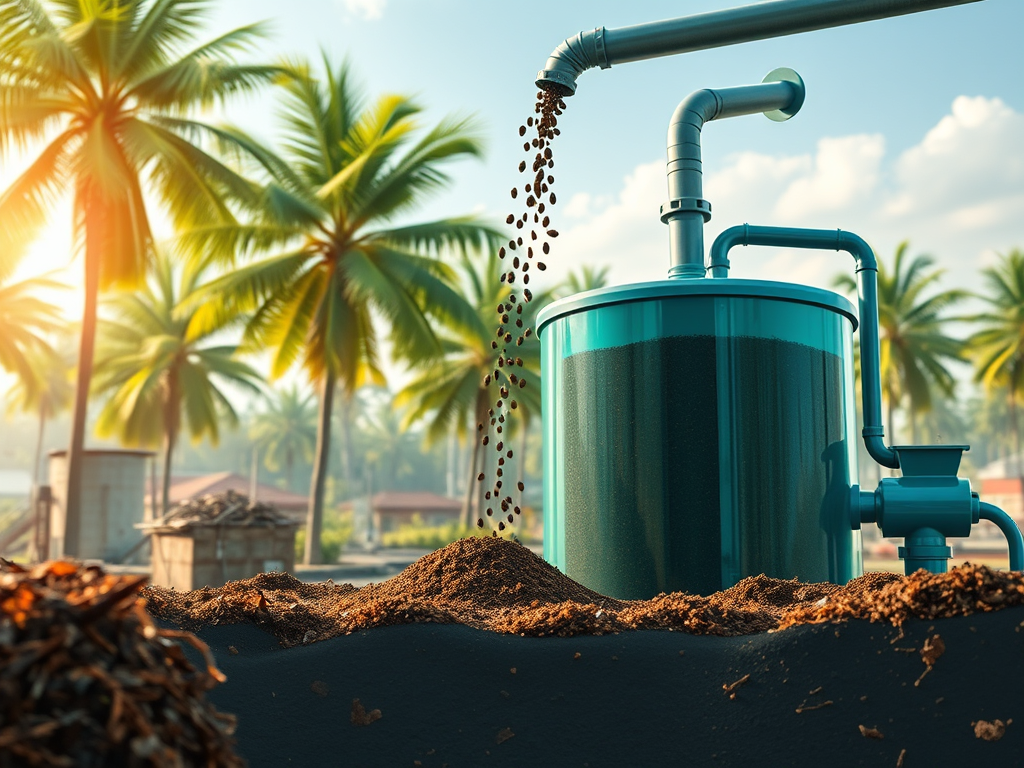
In a recent study published in Fuel, researchers Pui Yan Chang and colleagues explored how adding biocharBiochar is a carbon-rich material created from biomass decomposition in low-oxygen conditions. It has important applications in environmental remediation, soil improvement, agriculture, carbon sequestration, energy storage, and sustainable materials, promoting efficiency and reducing waste in various contexts while addressing climate change challenges. More can improve methane production from palm oil mill effluent (POME) using a combination of Artificial Neural Network (ANN) and Response Surface Methodology (RSM). The study revealed that biochar significantly enhances methane yield, achieving a 104% improvement under optimal conditions, highlighting a cost-effective strategy for boosting biogas production in the palm oil industry.
Anaerobic digestion (AD) is a natural process that converts organic materials like food waste and wastewater into biogas, a renewable energy source. However, the palm oil industry faces challenges such as fluctuating biogas production and low methane yields. To overcome these issues, the researchers investigated the use of biochar in the anaerobic digestion process.
Biochar, a carbon-rich material produced from the thermal decomposition of organic matter, has unique properties that can enhance AD systems. Its large surface area and porosityPorosity of biochar is a key factor in its effectiveness as a soil amendment and its ability to retain water and nutrients. Biochar’s porosity is influenced by feedstock type and pyrolysis temperature, and it plays a crucial role in microbial activity and overall soil health. Biochar More improve microbial activity and the breakdown of organic waste. In this study, biochar was added to POME, a byproduct of palm oil extraction, to optimize methane yield.
The researchers used both Artificial Neural Network (ANN) and Response Surface Methodology (RSM) to analyze the key factors in the AD process, including the feed-to-inoculum (FI) ratio, biochar dosage, and organic loading (OL). ANN, a machine-learning tool, accurately predicted biogas volume and methane yield. RSM was used to optimize the process parameters.
The results showed that biochar significantly increased methane yield. The optimal conditions for methane production were a feed-to-inoculum ratio of 0.615, a biochar dosage of 1.34 g/L, and an organic loading of 4.8 g VS/L. Under these conditions, methane yield improved by 104%.
This study demonstrates the potential of biochar to enhance biogas production from POME. The findings suggest that biochar can be a cost-effective and sustainable solution for improving energy recovery and reducing the environmental impact of palm oil processing.
Source: Chang, P. Y., Chan, Y. J., Arumugasamy, S. K., Wan, Y. K., & Lim, J. W. (2025). Optimisation of anaerobic digestion of palm oil mill effluent with biochar addition: Synergistic application of Artificial neural network and response Surface Methodology. Fuel, 398, 135514.


![Eucalyptus Wood Waste-Derived Biochar Achieves a Ninety-Eight Percent Removal Efficiency for Benzo[ghi]perylene in Vehicle-Wash Wastewater](https://biochartoday.com/wp-content/uploads/2026/10/SCIENCE-BLOGS-2026-2026-10-19T160523.703.jpg)


Leave a Reply