
Key Takeaways
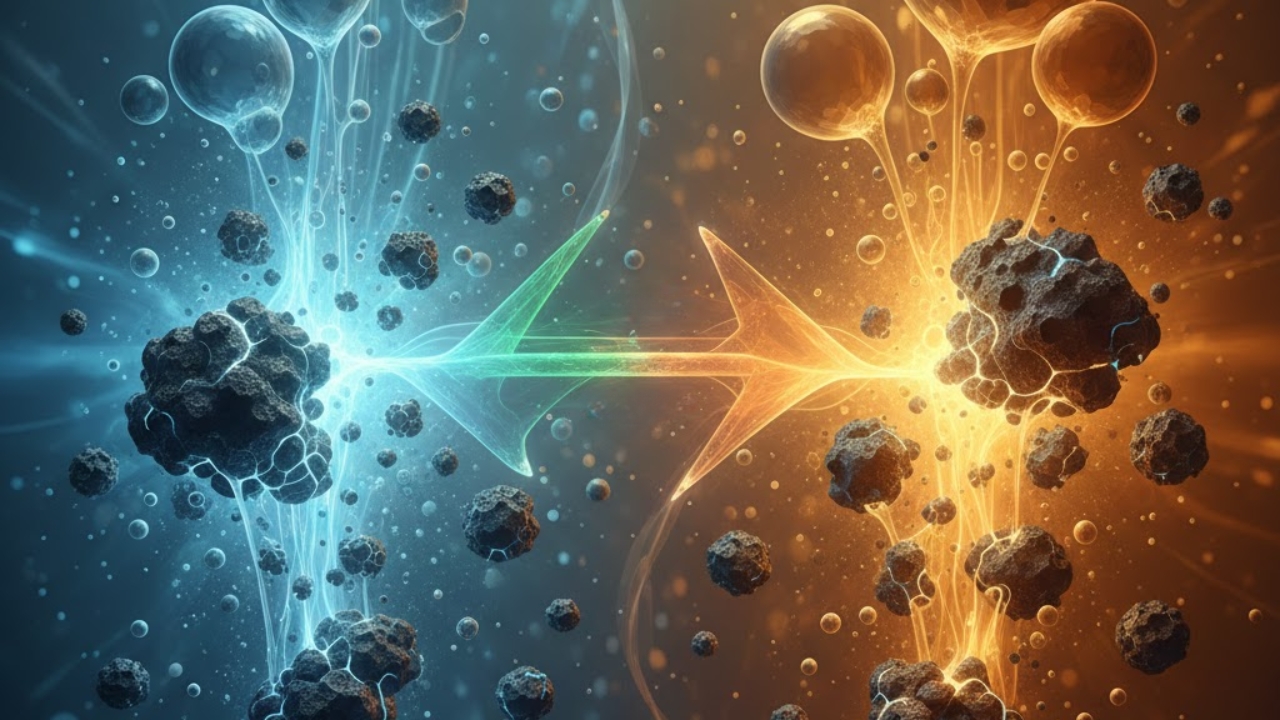
- A system called two-phase anaerobic digestion (TPAD) is used to efficiently convert food waste into two clean fuels: hydrogen (H2) and methane (CH4).
- Adding biocharBiochar is a carbon-rich material created from biomass decomposition in low-oxygen conditions. It has important applications in environmental remediation, soil improvement, agriculture, carbon sequestration, energy storage, and sustainable materials, promoting efficiency and reducing waste in various contexts while addressing climate change challenges. More (a type of charcoalCharcoal is a black, brittle, and porous material produced by heating wood or other organic substances in a low-oxygen environment. It is primarily used as a fuel source for cooking and heating. More made from biomassBiomass is a complex biological organic or non-organic solid product derived from living or recently living organism and available naturally. Various types of wastes such as animal manure, waste paper, sludge and many industrial wastes are also treated as biomass because like natural biomass these More) significantly increases the production of both gases by more than 45% compared to controls.
- Biochar allows the waste treatment system to process a much higher amount of food waste daily (up to 6.0 g VS/(L⋅d)) without failing, which is crucial for large-scale operations.
- The biochar acts like a natural antacid, preventing the system from becoming too acidic when processing large amounts of food waste, maintaining the optimal pH for the microbes.
- Biochar promotes the growth of the specific bacteria and archaea (Clostridiaceae, Methanosarcinaceae, and Methanobacteriaceae) that are essential for breaking down the food waste and producing H2 and CH4.
In a study published in Energy & Environment Nexus, Yusron Sugiarto and colleagues investigated the use of biochar to enhance the production of hydrogen (H2) and methane (CH4) from simulated food waste via a two-phase anaerobic digestion (TPAD) system. TPAD is a promising method for waste treatment and energy recovery because it separates the process into two reactors—one optimized for H2production and the second for CH4 production—thereby improving the overall yields of both valuable gases. Conventional single-phase digestion often struggles with low stability and high CO2 content in the final biogas. This research focused on the challenges of semi-continuous TPAD, particularly process instability under elevated organic loading rates (OLRs) that lead to acid buildup and pH inhibition.
The experiment used a semi-continuous setup of two 5 L continuous stirred tank reactors (CSTRs) in series, simulating the sequential process of hydrogen production (R1) followed by methane production (R2). Pinewood biochar, created by pyrolysisPyrolysis is a thermochemical process that converts waste biomass into bio-char, bio-oil, and pyro-gas. It offers significant advantages in waste valorization, turning low-value materials into economically valuable resources. Its versatility allows for tailored products based on operational conditions, presenting itself as a cost-effective and efficient More at 650∘C, was added to the test reactors at a dose of approximately 15 g/L. The study spanned 100 days, gradually increasing the OLR from 0.5 to 6.0 g VS/(L⋅d) to assess the stability and performance limits of the system with and without biochar.
In the hydrogen production phase (R1), the reactors with biochar consistently demonstrated higher hydrogen production rates (RH) compared to the controls across all OLR stages. For example, by Stage V, the average RH in biochar reactors reached 1,092.1 mL/d, which was 45.7% greater than the controls (749.6 mL/d). Critically, when the OLR was raised to 6.0 g VS/(L⋅d) in Stage VII, the control reactor’s RH declined sharply, indicating system instability, while the biochar-amended reactor maintained a stable H2 output. This stability was directly attributed to biochar’s superior pH buffering capacity. In R1, controls saw the pH drop to an average of 4.8±0.3 during Stage VII, far from the optimal range for hydrogen-producing bacteria, while biochar reactors maintained a favorable pH of 5.4±0.3. The buffering effect is likely due to the biochar’s surface functional groups (carboxyl, hydroxyl) and rich ashAsh is the non-combustible inorganic residue that remains after organic matter, like wood or biomass, is completely burned. It consists mainly of minerals and is different from biochar, which is produced through incomplete combustion. Ash Ash is the residue that remains after the complete More content that contributes alkalinity.
The beneficial effects of biochar continued in the methane production phase (R2). Similar to the first phase, the methane production rate (RM) was consistently higher in the presence of biochar. By Stage V, biochar reactors showed an RM that was 43.6% greater (1,837.5 mL/d) than the controls (1,280.0 mL/d). Under the highest OLR in Stage VII, the control reactor experienced a CH4 production rate decline of 12% (from 1,365.8 to 1,198.3 mL/d) , with a corresponding drop in pH to 5.7. In sharp contrast, the biochar-amended reactor maintained a stable RM near 1,905.2 mL/d and a stable pH of 7.3. This stability is essential, as the control’s failure at 6.0 g VS/(L⋅d) shows that without the biochar, stable operation was limited to 4.0 g VS/(L⋅d).
The stabilization of the system by biochar was closely linked to its impact on the microbial communities. In the hydrogen reactor (R1), biochar dramatically increased the relative abundance of the key hydrogen-producing bacteria Clostridiaceae to 92.6% during continuous operation, nearly double the control’s abundance of 54.2%. Clostridiaceae are crucial for breaking down food waste into acetic and butyric acids, which are precursors for H2. In the methane reactor (R2), biochar enriched the growth of key methanogenic archaea: Methanosarcinaceae (reaching 50.8% abundance) and Methanobacteriaceae (reaching 26.5% abundance). These species are vital for converting the acidic products of R1 into CH4.
This enrichment suggests that biochar not only buffers the system against the volatile fatty acid (VFA) accumulation that causes acidification but also promotes interspecies electron transfer (IET). Biochar acts as a conductive matrix, facilitating the direct transfer of electrons between the VFA-degrading bacteria (like Clostridiaceae) and the methane-producing archaea (Methanosarcinaceae and Methanobacteriaceae). This robust syntrophic network enhances metabolic resilience, allowing the TPAD system to operate effectively at OLRs comparable to conventional anaerobic digestion without compromising performance or stability. The findings validate biochar as an effective, low-cost additive for scaling up TPAD technology for food waste treatment.
Source: Sugiarto, Y., Sunyoto, N. M. S., Setyawan, H. Y., & Zhang, D. (2025). Enhancing H2 and CH4 production with biochar addition in two-phase anaerobic digestion of food waste. Energy & Environment Nexus, 1(e010).



Leave a Reply