
Key Takeaways
Key Takeaways
- BiocharBiochar is a carbon-rich material created from biomass decomposition in low-oxygen conditions. It has important applications in environmental remediation, soil improvement, agriculture, carbon sequestration, energy storage, and sustainable materials, promoting efficiency and reducing waste in various contexts while addressing climate change challenges. More creates a specialized protective zone in the soil that spans only a few millimeters around each particle
- This tiny environment rapidly becomes less acidic and richer in organic carbon, which helps trap harmful heavy metals.
- Within this microscopic area, the amount of dangerous cadmium that plants can absorb drops by as much as 14 percent.
- Because the soil is healthier near the biochar, wheat plants end up with significantly less toxic metal in their roots and shoots.
- Placing biochar strategically near seeds is more important for protecting crops than simply spreading it across a large field.
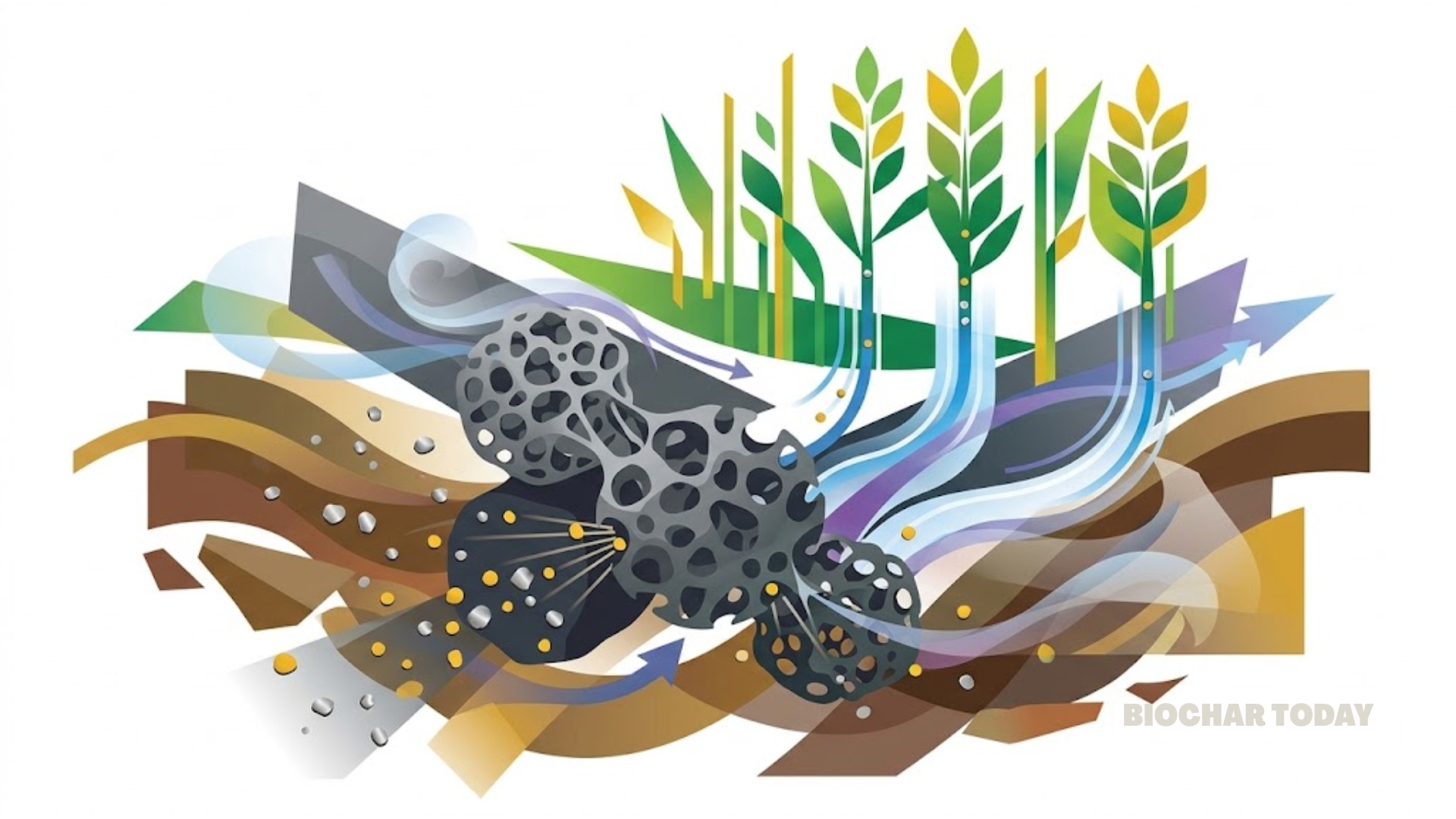
The research, published in the journal Sustainable Carbon Materials by lead author Liqiang Cui and a team of international experts, reveals that the true power of biochar lies in the microscopic world it creates upon contact with the earth. This specialized microenvironment, known as the charosphere, acts as a functional territory similar to the root zone of a plant. While biochar is widely celebrated for its ability to improve soil quality and sequester carbon, this study provides a new geometric framework for understanding how it handles heavy metal contamination. By focusing on the spatial arrangement of chemical variables, the researchers demonstrated that biochar does not just change the bulk soil; it engineers a tiny, reactive buffer that dictates whether toxins like cadmium ever reach the dinner table.
The findings highlight a dramatic transformation occurring within just two millimeters of a biochar particle. In this immediate vicinity, the soil chemistry diverges sharply from the rest of the field, becoming more alkaline and saturated with dissolved organic carbon. These changes are not just incidental; they are the primary drivers of metal immobilization. As the pHpH is a measure of how acidic or alkaline a substance is. A pH of 7 is neutral, while lower pH values indicate acidity and higher values indicate alkalinity. Biochars are normally alkaline and can influence soil pH, often increasing it, which can be beneficial More rises, cadmium precipitates and binds to the oxygen-rich functional groups on the surface of the biochar. The study noted that dissolved organic carbon, which increased by nearly 70 percent in the charosphere, also plays a crucial role by complexing with the metal. Together, these factors effectively lock cadmium in place, preventing it from remaining in the soil solution where it could be easily sucked up by thirsty plant roots.
What makes these results particularly striking is the measurable impact on crop safety. The researchers observed that wheat plants grown in this enriched microenvironment were significantly cleaner than those grown in unamended soil. Because the biochar acted as a high-affinity sorbent, the roots encountered a severely depleted pool of bioavailable cadmium. Consequently, the concentration of the toxic metal in the roots was cut by nearly half in some zones, while the upward translocation to the shoots and leaves—the parts of the plant most likely to enter the food chain—was reduced by more than a quarter. This protective effect was most intense closest to the biochar but extended outward up to eight millimeters, suggesting that the volume of the reactive charosphere can be expanded by simply increasing the application rate.
The study further explored the longevity and mechanism of this immobilization through advanced surface analysis. Using high-resolution imaging and chemical mapping, the team confirmed that cadmium is sequestered through direct interaction with biochar-bound elements like silicon and iron. These interactions form stable surface complexes that resist microbial decay and natural weathering. Interestingly, the researchers found that the stabilization process actually strengthens over time. As the biochar resides in the soil, slow alkaline dissolution and ongoing oxidation create even more binding sites for the metal. This suggests that biochar provides both an immediate shield for young sprouts and a durable, long-term solution for managing contaminated agricultural lands.
Ultimately, the research provides the first quantitative evidence that microscale engineering can successfully decouple toxic metal mobility from plant uptake. It shifts the focus from simply loading soil with biochar to the strategic placement of the material. For farmers and environmental managers, the message is clear: placing biochar within two millimeters of seeds can maximize the stabilization of harmful metals without compromising the supply of essential nutrients. By choosing feedstocks rich in alkaline ashAsh is the non-combustible inorganic residue that remains after organic matter, like wood or biomass, is completely burned. It consists mainly of minerals and is different from biochar, which is produced through incomplete combustion. Ash Ash is the residue that remains after the complete More and silicon, such as wheat straw, it is possible to create a safer and more productive agricultural ecosystem. This tiny microscopic zone represents a giant leap forward in our ability to deliver sustainable ecosystem services in a contaminated world.
Source: Cui, L., Wang, W., Quan, G., Wang, H., Hina, K., Hussain, Q., Liu, Y., & Yan, J. (2026). Biochar-induced charosphere microenvironment modulates soil cadmium bioavailability and wheat uptake. Sustainable Carbon Materials, 2, e004.

Leave a Reply