
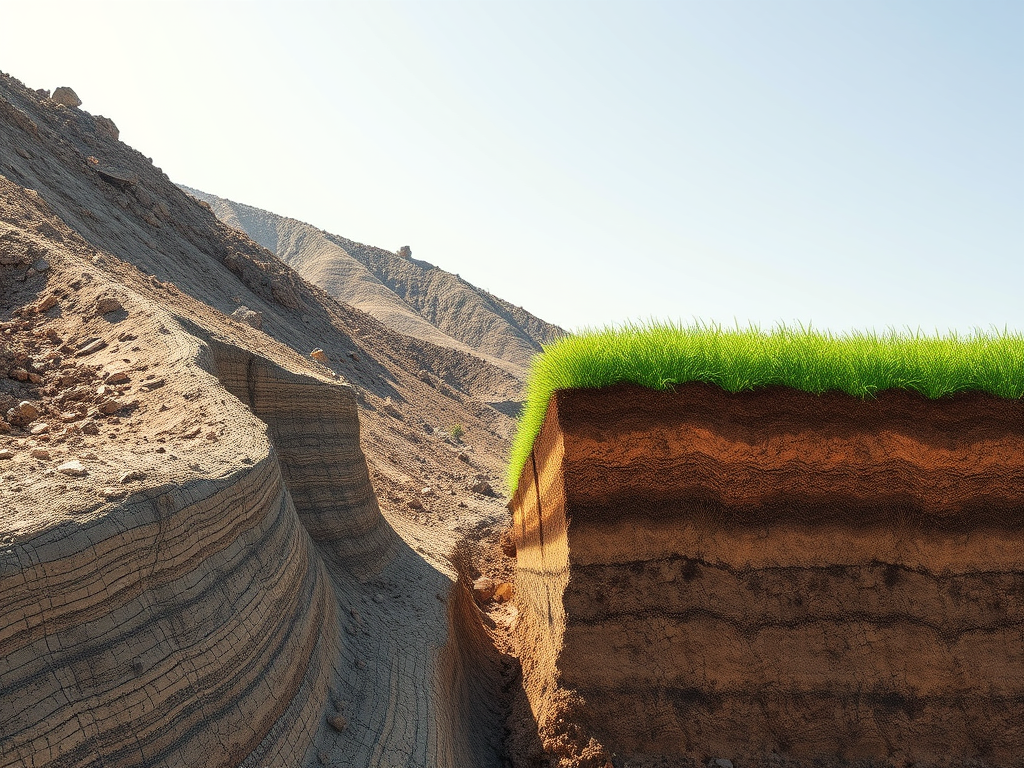
Rill erosion, a significant contributor to soil degradation worldwide, occurs when concentrated water flow scours and transports detached soil particles, particularly on long and steep slopes. This process is a primary mechanism for erosion at the hillslope scale, leading to undesired impacts on soil hydrology and land morphology. Proper soil conservation techniques are crucial to minimize damage to both rural and urban areas. In a recent study published in the International Journal of Sediment Research, Misagh Parhizkar and colleagues investigated the effectiveness of various soil conservation techniques, including polyacrylamide, rice husk biocharBiochar is a carbon-rich material created from biomass decomposition in low-oxygen conditions. It has important applications in environmental remediation, soil improvement, agriculture, carbon sequestration, energy storage, and sustainable materials, promoting efficiency and reducing waste in various contexts while addressing climate change challenges. More, and hydromulching, on deforested hillslopes under simulated rainfall. Their findings offer valuable insights into mitigating erosion and runoff in vulnerable environments.
The researchers conducted experiments on plots (100 cm x 50 cm) with varying longitudinal slopes (10%, 17%, and 28%) in a deforested area of Saravan forest park, Guilan Province, Northern Iran, a region prone to rill erosion due to deforestation and anthropogenic fires. They simulated very intense rainfall (98 mm/h for 30 minutes), which is considered highly erosive for the study area. The goal was to assess how each treatment affected rill morphometry (length and width), surface runoff, and soil loss. The results demonstrated that while polyacrylamide application did not significantly impact surface runoff, soil loss, or rill formation , rice husk biochar and hydromulching proved highly effective. Specifically, these two treatments led to notable decreases in runoff generation and soil loss, ranging from 40% to 55%. They also caused a significant reduction in rill formation, resulting in rill widening and elongation decreases of 45% to 75%. This reduction in rill length due to rice husk biochar is likely due to an improvement in soil aggregate stability from the added organic matter. Hydromulching’s superior effect is attributed to the development of a protective grass cover and dense root system, which intercepts rainfall, reduces overland flow velocity, and enhances soil’s mechanical properties.
The study found a strong association between rill morphometry and soil hydrology, with correlation coefficients greater than 0.78 between hydrological and morphometric variables. Principal Component Analysis (PCA) and Agglomerative Hierarchical Cluster Analysis (AHCA) further highlighted distinct differences in hydrological and morphological responses between untreated (bare) soils and those treated with polyacrylamide on one side, and soils treated with rice husk biochar and hydromulching on the other. This clear discrimination underscores the superior efficacy of biochar and hydromulching in resisting erosion. Furthermore, the researchers developed multiple linear regression (MLR) equations that accurately predicted surface runoff and soil loss with high coefficients of determination (R² > 0.90) under the experimental conditions. These equations serve as practical hydrological tools for land managers and hydrologists, enabling them to estimate flood and erosion hazards in similar deforested areas.
Despite some limitations, such as the plot scale and simulated rainfall, the study’s findings are crucial for identifying suitable soil conservation techniques for specific rainfall intensities and conditions in deforested ecosystems. The anti-erosive effects of hydromulching and rice husk biochar were comparable and should be prioritized as emergency actions for soil conservation, given the high soil losses (up to 10 t/ha) observed under intense rainfall, which could increase with climate change. While hydromulching might have slower initial grass growth in arid environments, organic residues like biochar offer a quicker initial response. This research provides a robust foundation for implementing effective countermeasures against soil degradation and related hazards.
Source: Parhizkar, M., Lucas-Borja, M. E., Filianoti, P. F. G., Tziolas, N., & Zema, D. A. (2025). Variability in rill morphometry, surface runoff and erosion with soil conservation techniques (application of polyacrylamide and rice husk biochar and hydromulching) in deforested hillslopes under simulated rainfall. International Journal of Sediment Research.





Leave a Reply