
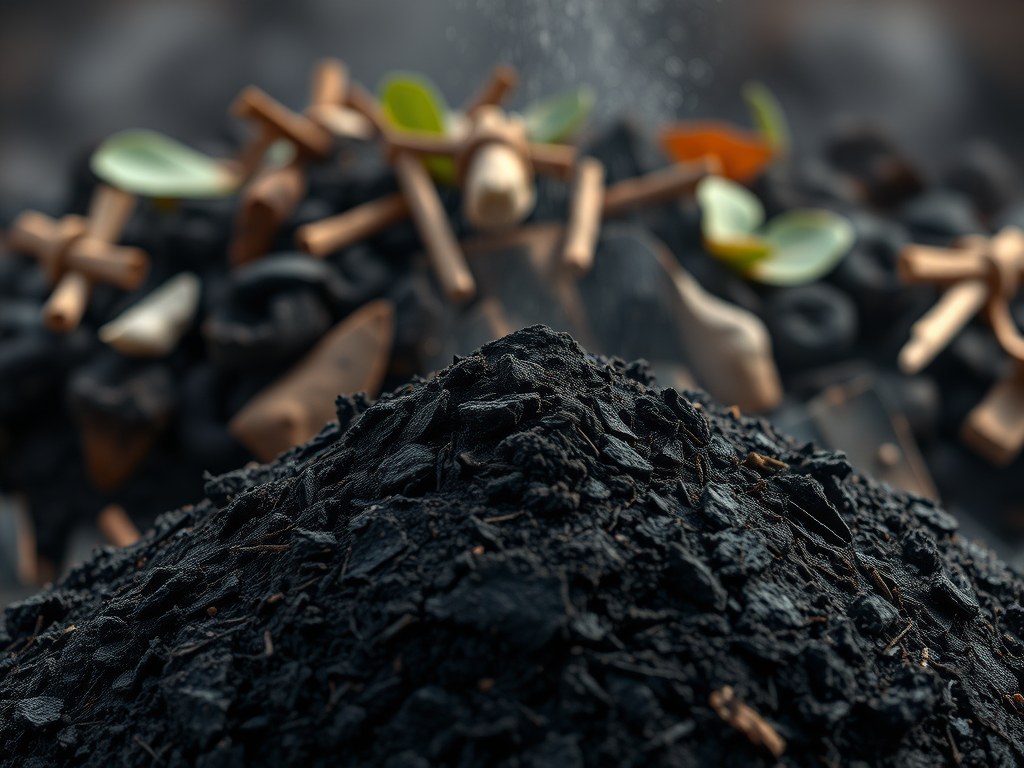
In a world grappling with a mounting waste crisis, a new study offers a compelling solution that transforms a major problem into a powerful environmental tool. Published in the journal Sustainable Food Technology, a review by J. S. Sudarsan and his co-authors explores the immense potential of converting food waste into biocharBiochar is a carbon-rich material created from biomass decomposition in low-oxygen conditions. It has important applications in environmental remediation, soil improvement, agriculture, carbon sequestration, energy storage, and sustainable materials, promoting efficiency and reducing waste in various contexts while addressing climate change challenges. More. With the Food and Agriculture Organization (FAO) estimating that approximately 1.3 billion tons of food are wasted annually, this accounts for a staggering 33% of global food production and releases millions of tons of greenhouse gases (GHGs)Greenhouse gases (GHGs) are gases in the atmosphere that trap heat, contributing to the warming of the planet. Carbon dioxide, methane, and nitrous oxide are examples of greenhouse gases. Biochar helps to mitigate the emission of GHGs through various mechanisms. More. The review argues that traditional waste management techniques like landfilling and incineration are unsustainable due to their significant emissions. Instead, advanced thermal processes like pyrolysisPyrolysis is a thermochemical process that converts waste biomass into bio-char, bio-oil, and pyro-gas. It offers significant advantages in waste valorization, turning low-value materials into economically valuable resources. Its versatility allows for tailored products based on operational conditions, presenting itself as a cost-effective and efficient More and gasificationGasification is a high-temperature, thermochemical process that converts carbon-based materials into a gaseous fuel called syngas and solid by-products. It takes place in an oxygen-deficient environment at temperatures typically above 750°C. Unlike combustion, which fully burns material to produce heat and carbon dioxide (CO2), gasification More present a more environmentally friendly path, converting organic food waste into valuable resources, with biochar being a standout product.
Biochar’s porous structure, high specific surface area, and strong attraction to nonpolar compounds make it an excellent adsorbent for carbon capture. One of the most promising applications of biochar is its ability to act as a sorbent for CO2. A study cited in the review investigated the adsorption of CO2 using food waste biochar (FWBC) and found that biochar activated with KOH had the highest uptake of 2.54 mmol per gram at 25∘C. This was roughly 10 times higher than its N2 uptake, showcasing its superior CO2 adsorption capability and making it a favorable candidate for treating flue gases. The review notes that while biochar’s carbon capture efficiency can be lower than that of conventional adsorbents, its performance can be enhanced through modifications, which may increase costs. The process of activating biochar with chemicals like KOH has been shown to improve its porosityPorosity of biochar is a key factor in its effectiveness as a soil amendment and its ability to retain water and nutrients. Biochar’s porosity is influenced by feedstock type and pyrolysis temperature, and it plays a crucial role in microbial activity and overall soil health. Biochar More, leading to higher CO2 adsorption capacity.
Beyond carbon capture, biochar is a versatile material with applications in energy and catalysis. As a catalyst, biochar can be used to synthesize biodiesel and degrade environmental pollutants. The review highlights a study that used nanostructured calcium oxide (CaO) supported on avocado seed biochar to produce biodiesel from waste cooking oil. The authors also note that biochar can serve as a substitute for fossil fuel-based carbon additives in polymers, with the potential to improve plastic strength and electrical conductivity. Furthermore, biochar’s potential as a fuel is significant, particularly in co-firing facilities where it can be combined with coal to reduce carbon emissions. In steel and iron manufacturing, biochar can partially replace coal and coke, with optimal substitution rates of 40% to 60% in the sintering process to ensure a high-quality product yield of at least 80%.
The production of high-quality biochar requires careful optimization of parameters like temperature, heating rate, and residence timeResidence time refers to the duration that the biomass is heated during the pyrolysis process. The residence time can influence the properties of the biochar produced. More. The review delves into various modeling and optimization techniques, including machine learning and process simulation software like ASPEN Plus. One study cited in the review used the Response Surface Methodology (RSM) to optimize the slow pyrolysis of pomegranate peels . This highlights the importance of tailoring the production process to the specific feedstockFeedstock refers to the raw organic material used to produce biochar. This can include a wide range of materials, such as wood chips, agricultural residues, and animal manure. More to maximize yield and desired properties. The review concludes by emphasizing the need for interdisciplinary collaboration to overcome challenges such as feedstock variability, a lack of standardized quality parameters, and the scarcity of data on large-scale industrial applications.
Source: Sudarsan, J. S., Goel, M., Jahangiri, H., Rout, P. R., Tavakolian, M., Briggs, C., … & Nithiyanantham, S. (2025). Sustainable food waste management: a critical review on biochar production and applications. Sustainable Food Technology, 10.1039/d5fb00087d.



Leave a Reply