
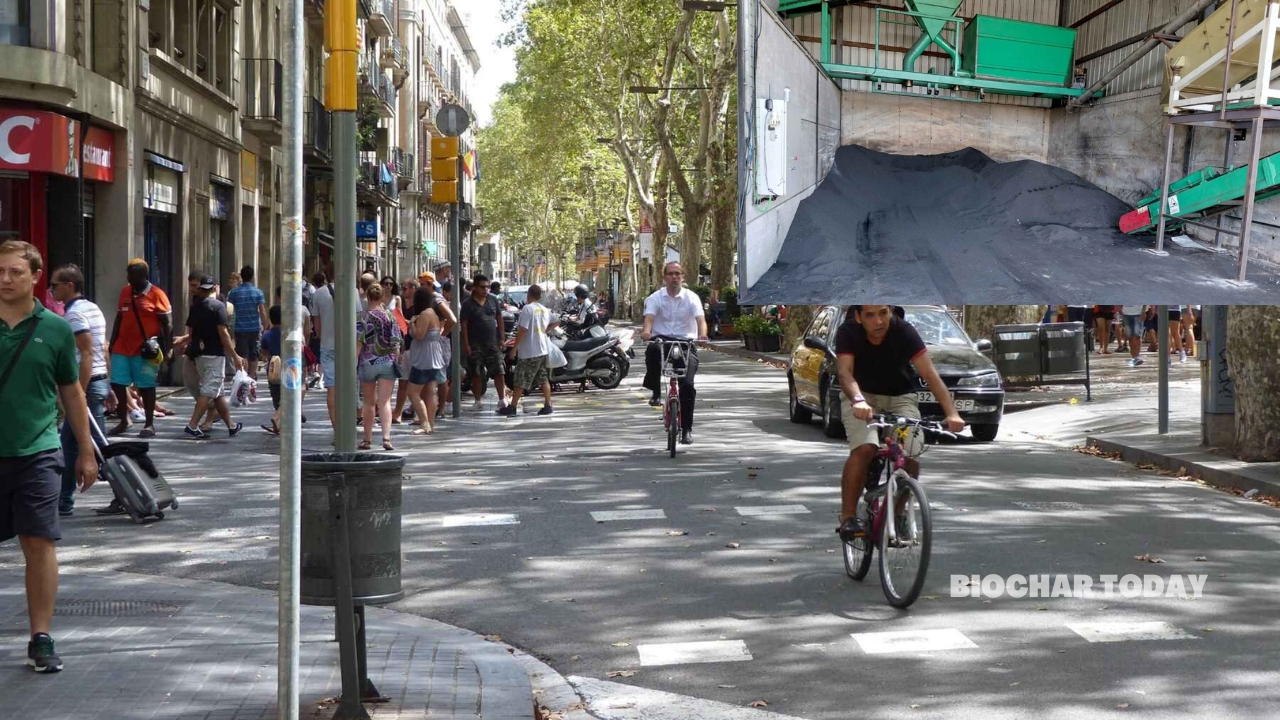
The Barcelona City Council in Spain, operating through its urban innovation agency BIT Habitat, has selected a sustainable paving initiative titled “Biochar” as a winning solution for the city’s future urban development challenge. The public project involves fully replacing traditional mineral limestone filler with a carbon-rich biocharBiochar is a carbon-rich material created from biomass decomposition in low-oxygen conditions. It has important applications in environmental remediation, soil improvement, agriculture, carbon sequestration, energy storage, and sustainable materials, promoting efficiency and reducing waste in various contexts while addressing climate change challenges. More matrix within the superficial, upper asphalt layer of municipal roadways. Slated to turn a city street into an active climate laboratory by 2027, the low-carbon civil engineering project aims to transform ordinary public works into functional carbon sinks by embedding stable organic matter directly into municipal road infrastructure.
Urban public works departments face critical challenges when attempting to reduce the embedded carbon footprint of highly dense metropolitan infrastructure. Conventional bituminous pavement mixes rely heavily on carbon-intensive mineral fillers and asphalt aggregates that generate significant greenhouse gas emissions during extraction, processing, and installation. Furthermore, municipal governments frequently lack proven, structurally sound alternatives that can actively sequester carbon without compromising the mechanical integrity, durability, and safety required to withstand continuous heavy vehicular traffic and volatile urban weather patterns.
To overcome these technical and structural hurdles, a collaborative research consortium—comprising the Andalusian biochar supplier Carboliva, construction firms AMSA and ELSAN, and the Universitat Politècnica de Catalunya—formulated an asphalt mix utilizing biochar derived from olive pits and pine residues. The biomassBiomass is a complex biological organic or non-organic solid product derived from living or recently living organism and available naturally. Various types of wastes such as animal manure, waste paper, sludge and many industrial wastes are also treated as biomass because like natural biomass these More byproducts undergo thermochemical conversion to isolate carbon absorbed during plant growth, preventing its immediate release into the atmosphere. Rigorous laboratory testing conducted by the engineering team demonstrates that the biochar-enriched asphalt maintains equal or superior structural performance compared to traditional pavement, specifically exhibiting enhanced resistance to moisture damage, increased cracking toughness, and optimal thermal stability.
The initial phase of the project has been awarded a €90,000 grant from BIT Habitat, Barcelona de Infraestructuras Municipales, and the Diputación de Barcelona to fund applied research and prototype formulation through September 2026. Projections indicate that substituting traditional filler with biochar will reduce carbon dioxide emissions associated with material manufacturing by 76%, translating to an estimated 75% net reduction in greenhouse gas emissions from the final asphalt surface layer. The real-world performance of the new paving material will be monitored under active municipal traffic conditions starting in 2027 to evaluate its scalability across broader European urban centers.





Leave a Reply