
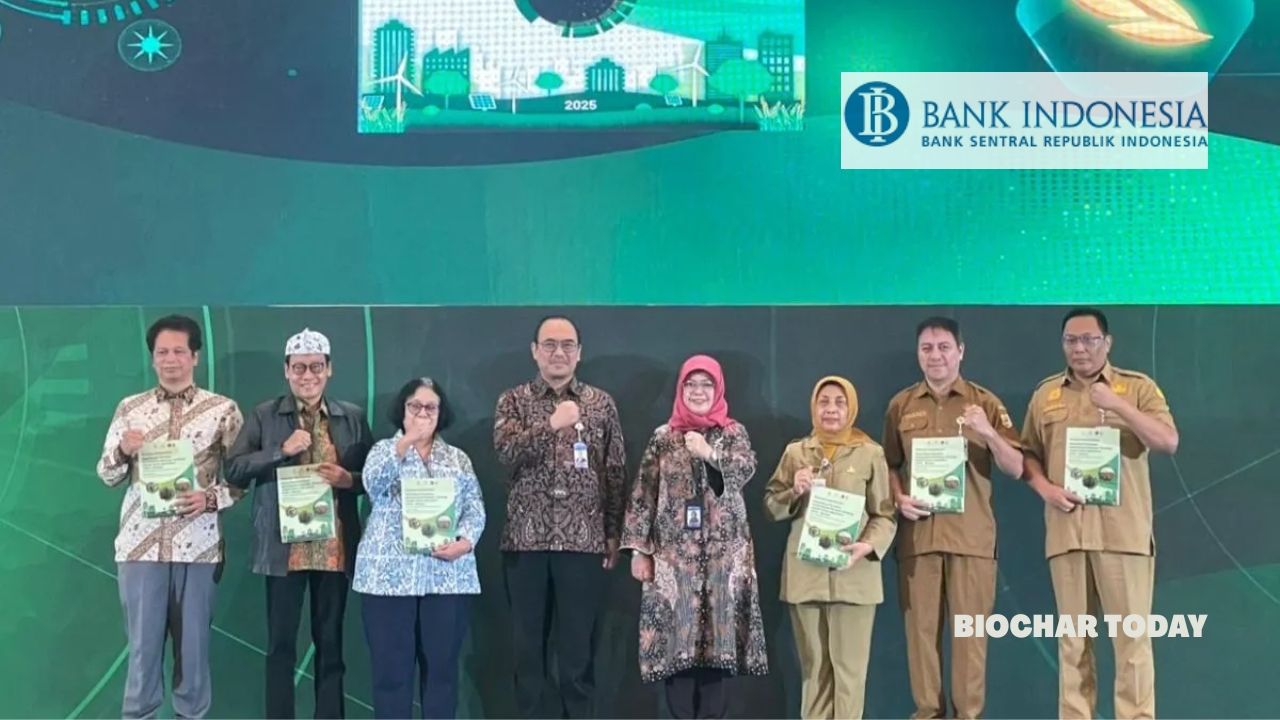
Bank Indonesia, in collaboration with the Coordinating Ministry for Food, the Ministry of Agriculture, and Diponegoro University, has introduced a comprehensive climate-smart agriculture business guide centered on biocharBiochar is a carbon-rich material created from biomass decomposition in low-oxygen conditions. It has important applications in environmental remediation, soil improvement, agriculture, carbon sequestration, energy storage, and sustainable materials, promoting efficiency and reducing waste in various contexts while addressing climate change challenges. More technology. Launched in Semarang, Central Java, this handbook serves as a practical resource for farmers and agribusinesses across Indonesia. The initiative aims to stabilize the national food supply and mitigate the environmental impact of traditional rice cultivation. By formalizing these guidelines, the involved organizations intend to standardize sustainable production methods and integrate green innovation into the country’s broader economic and financial framework.
The primary challenge addressed by this initiative is the dual pressure of climate change and land constraints on Indonesia’s agricultural productivity. Volatile food prices have historically impacted regional economic stability, driving inflation and reducing household purchasing power. Furthermore, conventional farming practices often contribute to greenhouse gas emissions and suffer from inefficiencies in water and fertilizer use. As agricultural land becomes increasingly limited, the sector requires scalable solutions that can rehabilitate soil quality while maintaining the high output necessary for national food security.
To resolve these issues, the new guide details the application of biochar—a carbon-rich material derived from biomassBiomass is a complex biological organic or non-organic solid product derived from living or recently living organism and available naturally. Various types of wastes such as animal manure, waste paper, sludge and many industrial wastes are also treated as biomass because like natural biomass these More waste—within a climate-smart agriculture framework. This technological solution focuses on improving the physical and chemical properties of soil, which enhances the retention of fertilizers and water. The handbook provides actionable instructions for farmer groups to implement these methods, effectively turning agricultural waste into a soil amendmentA soil amendment is any material added to the soil to enhance its physical or chemical properties, improving its suitability for plant growth. Biochar is considered a soil amendment as it can improve soil structure, water retention, nutrient availability, and microbial activity. More that sequesters carbon. By promoting these “green innovations,” the Indonesian government seeks to expand productive farmland and optimize resource inputs through scientific management.
The implementation of these strategies has already yielded measurable outcomes in regional pilot projects. A 2025 pilot program in Grobogan, Central Java, demonstrated a 6.3 percent increase in rice yields following the adoption of biochar-based methods. Beyond productivity gains, the project reported significant improvements in soil health and a reduction in greenhouse gas emissions. These results suggest that the standardized use of biochar can strengthen national food security and improve the welfare of farmers by lowering input costs and stabilizing crop performance against climatic variability.


Leave a Reply