
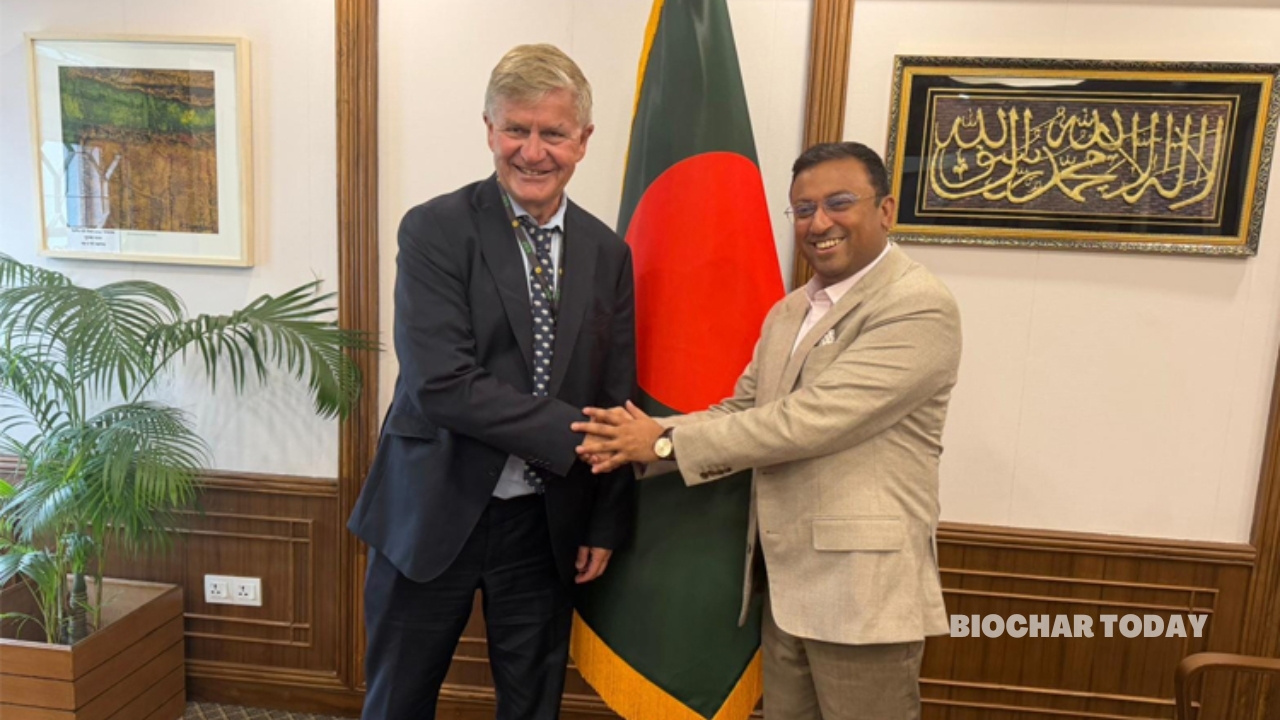
An international climate delegation led by former United Nations Environment Programme Executive Director Erik Solheim and ProClime Chief Executive Officer Kavin Kumar Kandasamy met with the Bangladesh government in Dhaka to discuss expanding green cooperation. The high-level dialogue focused on establishing collaborative frameworks for renewable energy deployment, sustainable development, carbon markets, and biocharBiochar is a carbon-rich material created from biomass decomposition in low-oxygen conditions. It has important applications in environmental remediation, soil improvement, agriculture, carbon sequestration, energy storage, and sustainable materials, promoting efficiency and reducing waste in various contexts while addressing climate change challenges. More deployment within the region. The meeting signals an intentional shift by state officials and international entrepreneurs to strengthen cross-border mechanisms aimed at accelerating green capital deployment and environmental conservation across South Asia.
The core challenge underlying this diplomatic engagement is Bangladesh’s vulnerability to severe climate change impacts paired with the historical difficulty of attracting large-scale, sustainable commercial investments into the domestic green sector. Developing emerging technology sectors, such as biochar infrastructure and localized carbon asset generation, requires sophisticated cross-border financial architectures and transparent monitoring frameworks. Without robust institutional cooperation and access to mature voluntary carbon markets, regional climate-resilient initiatives often struggle to secure the necessary long-term capital required to scale production and transform agricultural waste management effectively.
To resolve these systemic funding and operational bottlenecks, the participants explored targeted strategic solutions centering on coordinated policy integration and international climate entrepreneurship. By leveraging ProClime’s expertise in South Asian carbon markets and climate finance, the partnership aims to develop formal channels that direct green investments toward regional sustainable development projects. The strategy includes aligning state environmental priorities with private carbon asset mechanisms, facilitating advanced technical exchanges, and building robust regulatory baselines to attract international capital to domestic renewable energy and biochar processing systems.
The baseline outcomes of this high-level meeting demonstrate a shared institutional commitment to resilient development and environmentally sustainable investment. Both the international climate delegation and Bangladesh state representatives reaffirmed an explicit interest in formalizing long-term frameworks to co-manage carbon asset portfolios and environmental conservation projects. By establishing direct communication channels among climate entrepreneurs, international leaders, and foreign policy advisers, the consultation positions Bangladesh to enhance its visibility in global carbon credit networks, paving the way for future commercial biochar facility deployments.




Leave a Reply