
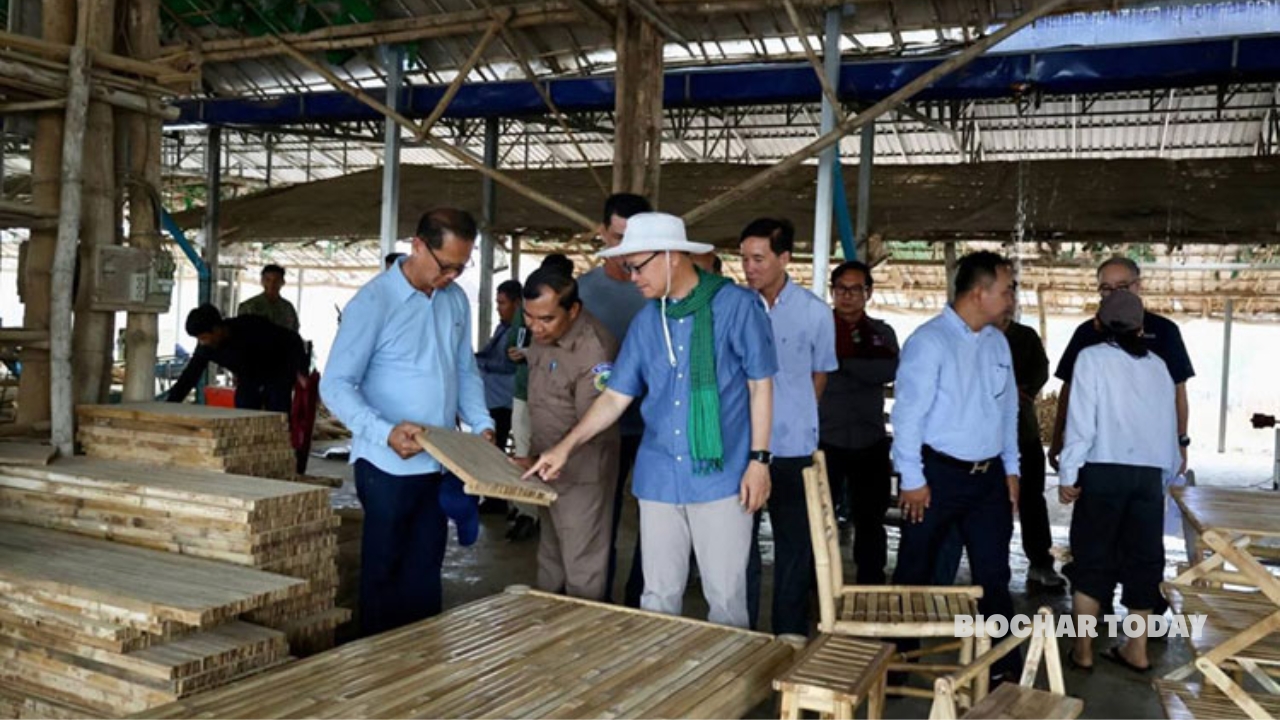
In northeastern Cambodia, a collaborative effort between the Ministry of Environment and Bambusa Global Ventures (BGV) is transforming the economic landscape of the Mondulkiri province through sustainable bamboo management. During a high-level field inspection on February 27, Environment Minister Eang Sophalleth reviewed the progress of BGV’s bamboo-processing initiatives in the Koh Nhek district. The project focuses on empowering local communities within the Keo Seima Wildlife Sanctuary by providing technical training in cultivation and value-added production. By integrating the manufacture of furniture, construction materials, and biocharBiochar is a carbon-rich material created from biomass decomposition in low-oxygen conditions. It has important applications in environmental remediation, soil improvement, agriculture, carbon sequestration, energy storage, and sustainable materials, promoting efficiency and reducing waste in various contexts while addressing climate change challenges. More into a cohesive business model, the partnership aims to enhance rural livelihoods while preserving the region’s natural resources.
The primary challenge addressed by this initiative is the economic instability of rural communities, which often leads to the degradation of protected areas. In the absence of viable legal income sources, residents in the northeastern region have historically relied on illegal logging and wildlife hunting within the Keo Seima Wildlife Sanctuary. This reliance creates a destructive cycle of natural resource depletion and legal vulnerability for local populations. Furthermore, the lack of technical expertise in processing non-timber forest products has historically limited the market value of local resources, preventing communities from achieving the financial stability required to abandon extractive and illegal practices.
To address these systemic issues, BGV has implemented a comprehensive solution centered on vocational training and diversified product development. The firm provides specialized instruction on the cultivation, maintenance, and sustainable harvesting of high-quality Ping Pung bamboo. Beyond raw material collection, the project introduces advanced processing techniques that allow communities to produce commercial-grade goods. A critical component of this technical suite is the production of biochar, which serves as a value-added application for bamboo residues. This approach transforms waste into a marketable commodity, ensuring that every part of the harvested bamboo contributes to the local circular economy.
The outcomes of this project indicate a successful shift toward sustainable community ownership and increased financial resilience. Since BGV began its expanded operations, there has been a measurable diversion of labor from illegal forest activities toward stable employment in bamboo processing and eco-tourism. Local incomes have become more consistent, supported by the production of diversified goods including furniture and biochar. Minister Sophalleth noted that these alternative livelihoods have strengthened law enforcement efforts by reducing the economic incentives for natural-resource crimes. Consequently, the project has established a scalable model for protecting biodiversity through the industrial valorization of sustainable bamboo.





Leave a Reply