
Key Takeaways
- Polystyrene foam reinforced with processed wood waste is 75% stronger than standard versions, making it much better at supporting heavy loads in buildings.
- The addition of finely ground biocharBiochar is a carbon-rich material created from biomass decomposition in low-oxygen conditions. It has important applications in environmental remediation, soil improvement, agriculture, carbon sequestration, energy storage, and sustainable materials, promoting efficiency and reducing waste in various contexts while addressing climate change challenges. More creates 40% more internal air bubbles, which helps the material trap more heat and lowers energy costs.
- Using this eco-friendly additive reduces the material’s heat conduction by 4%, providing a more efficient thermal barrier for homes and offices.
- This production method repurposes forestry waste into high-value insulation, locking carbon away for the long term instead of letting it enter the atmosphere.
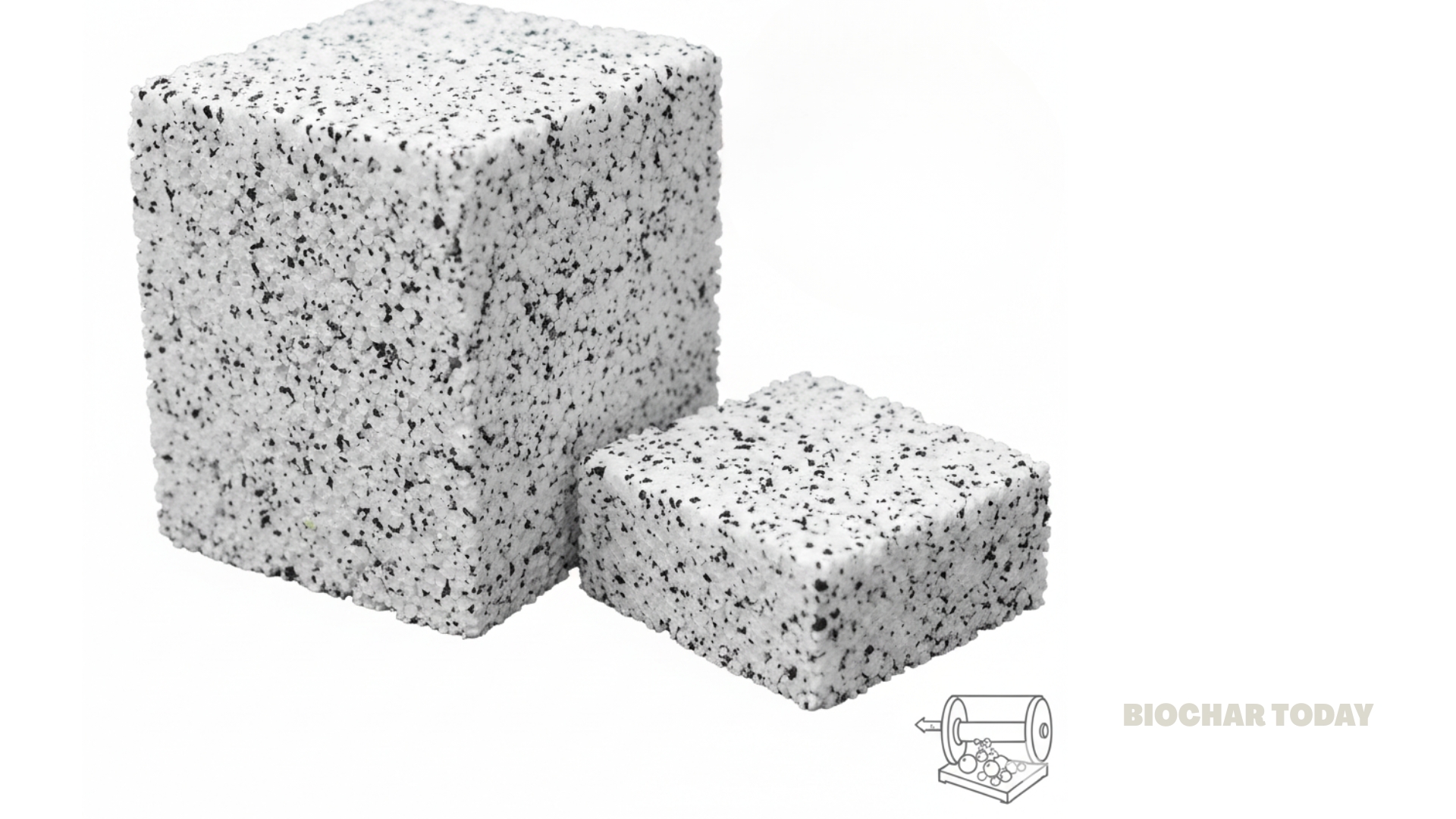
Polystyrene foams are essential for modern building insulation, yet the push for more sustainable and high-performing materials has led researchers to look for renewable alternatives. In a new study published in the Journal of Applied Polymer Science, a research team led by Apurv Gaidhani and Paul Charpentier at the University of Western Ontario explored how ball-milled biochar can significantly enhance the properties of these foams. By using wood-derived biochar from oak and maple sawdust, the team developed a lightweight composite that is stronger and more thermally efficient than pristine polystyrene. This innovation utilizes a continuous extrusion process involving supercritical carbon dioxide, providing a scalable and solvent-free pathway for industrial manufacturing.
The researchers discovered that ball milling—a process of grinding biochar into a fine powder—is the key to unlocking its full potential as a nucleating agent. When unmilled biochar was used, its larger particle size often led to internal defects and irregular structures. However, the ball-milled version featured a much higher surface area, increasing from 33 to 72 square meters per gram. This finer powder created an ideal environment for air bubbles to form, leading to a 40% increase in cell density and much smaller, more uniform internal cells. These refined microstructures are what allow the material to block heat transfer more effectively, resulting in a 4% reduction in thermal conductivity compared to standard foams.
Mechanical performance saw even more dramatic gains, with the ball-milled biochar-reinforced foam exhibiting a 75% increase in specific compressive strength. Advanced imaging techniques, including transmission electron microscopy and micro-computed tomography, confirmed that the biochar particles were perfectly positioned along the air cell walls. This strategic placement allows the carbon-rich particles to act as a structural framework, efficiently distributing loads and preventing the foam from buckling under pressure. At a specific processing pressure of 20.6 MPa, the new composite even outperformed several conventional carbon fillers like flaked graphite in stiffness.
Beyond physical performance, this material offers a significant win for the environment by contributing to carbon sequestration. Because biochar is made from atmospheric carbon captured by trees, embedding it within durable building materials keeps that carbon out of the atmosphere for the life of the building. This research aligns with circular economy goals by upcycling forestry residues into high-performance insulation that can help reduce global building energy consumption—which currently accounts for roughly 35% of total final energy use. By combining improved structural reliability with superior thermal efficiency, these biochar-reinforced foams represent a practical step toward greener, more eco-efficient construction.
Source: Gaidhani, A., Edwards, S., Xu, W. Z., Tribe, L., & Charpentier, P. (2026). Microstructure tuning and performance enhancement of polystyrene foams via ball-milled biochar-induced nucleation in supercritical CO2 assisted extrusion. Journal of Applied Polymer Science, 0(0), e70441.




Leave a Reply