
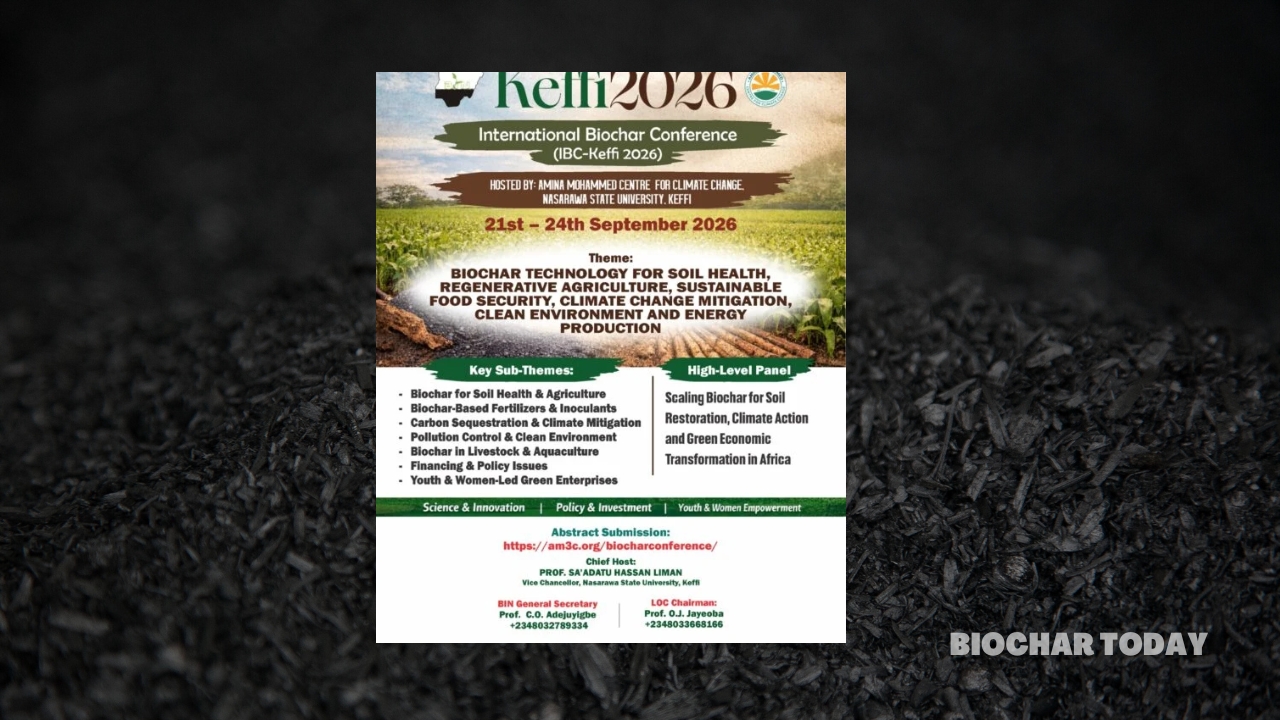
The Amina Mohammed Centre for Climate Change (AM3C) has announced its partnership with Nasarawa State University, Keffi, to host the Keffi 2026 International BiocharBiochar is a carbon-rich material created from biomass decomposition in low-oxygen conditions. It has important applications in environmental remediation, soil improvement, agriculture, carbon sequestration, energy storage, and sustainable materials, promoting efficiency and reducing waste in various contexts while addressing climate change challenges. More Conference. Scheduled to take place in Nigeria from September 21 to September 24, 2026, the event centers on the broad theme of integrating biochar technology to advance soil health, regenerative agriculture, sustainable food security, climate change mitigation, clean environments, and energy production. Organizers have structured the event around seven distinct thematic sub-themes, inviting researchers, policymakers, and industry practitioners to submit abstracts by late June and full papers by late July.
The primary challenge addressed by this initiative is the pressing regional and global need to combat climate emergencies while ensuring economic recovery and social cohesion. In particular, developing economies face the intersecting pressures of degrading soil health, food insecurity, environmental pollution, and a lack of scalable, nature-based technologies. Historically, academic institutions and scientific hubs have struggled to effectively translate complex environmental research into actionable local strategies. AM3C and Nasarawa State University seek to bridge this gap by establishing an institutional framework that drives capacity building and collaborative human resource development.
To resolve these interconnected issues, the organizing partners have designed an interdisciplinary, cross-sectoral event framework that actively engages youth- and women-led green enterprises alongside institutional financiers. By hosting specialized technical sessions, a formal annual general meeting, and dedicated plenaries, the conference establishes a structured forum for stakeholders to present empirical solutions. Sub-themes explicitly cover targeted applications, including biochar-based fertilizers, livestock and aquaculture integration, pollution control, and carbon sequestration finance. This comprehensive methodology ensures that localized research meets international policy and investment frameworks.
The anticipated outcomes of the conference center on the formalization of actionable policy frameworks and increased private-sector investment in green technology across West Africa. By providing scientists, policymakers, and local communities with a unified platform, the event is positioned to cultivate a regional knowledge hub at Nasarawa State University. The collaborative exchange aims to accelerate the deployment of nature-based solutions, directly enhancing soil resilience and supporting long-term sustainable food security. Ultimately, the partnership establishes a scalable model for how academic institutions can drive tangible climate mitigation and green enterprise growth.





Leave a Reply