
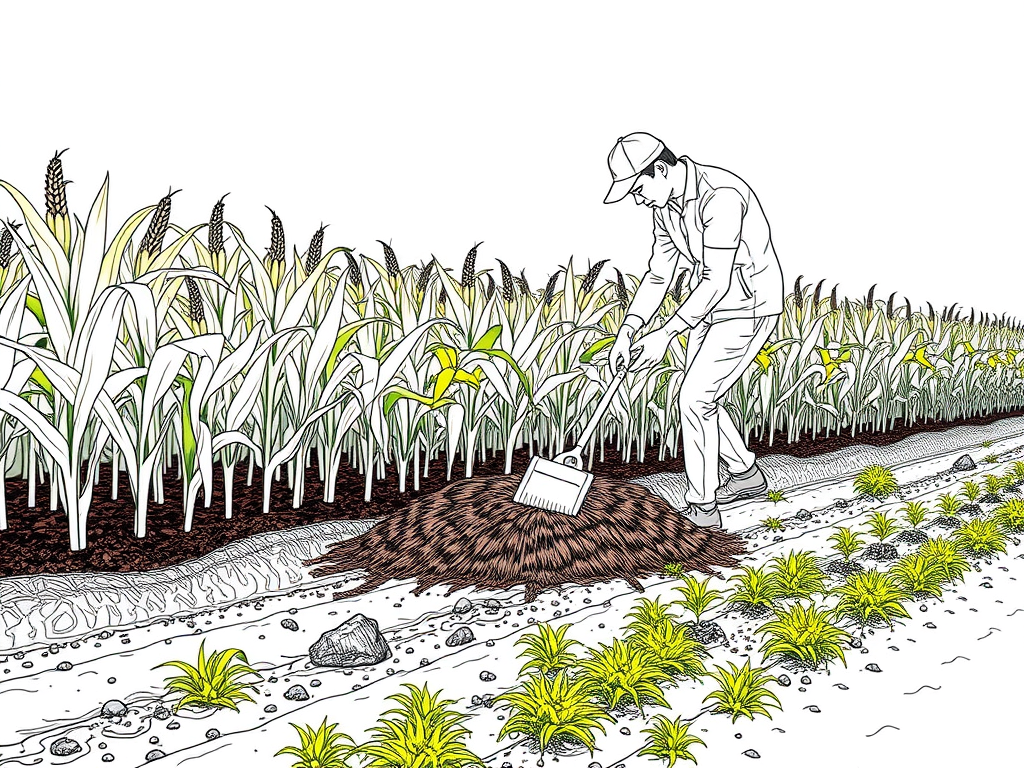
In a study published in Soil & Tillage Research, researchers Sihua Yan, Shaoliang Zhang, Pengke Yan, Zhimiao Wei, Xiaoguang Niu, and Haijun Zhang investigated the long-term effects of biocharBiochar is a carbon-rich material created from biomass decomposition in low-oxygen conditions. It has important applications in environmental remediation, soil improvement, agriculture, carbon sequestration, energy storage, and sustainable materials, promoting efficiency and reducing waste in various contexts while addressing climate change challenges. More on soil carbon sequestration in a Mollisols region of northeast China. The team experimented with two application methods and various amounts of maize-straw-derived biochar over six years of continuous maize cropping. Their findings show that biochar application can significantly enhance soil organic carbon (SOC) and its preservation capacity, particularly with a higher amount of homogeneous application or a lower amount of bottom-concentrated application.
Soil aggregates are a crucial component of the soil-atmosphere carbon cycle, playing a key role in protecting and storing SOC. However, factors like high-intensity cultivation and unbalanced fertilization can degrade soil structure, accelerating the breakdown of aggregates and the loss of organic carbon. Biochar, a carbon-rich amendment, has a porous structure and unique properties that can improve soil structure and promote SOC sequestration. This study focused on two application methods: homogeneous application (HA), where biochar was mixed evenly into the top 20 cm of soil, and bottom-concentrated application (CA), where it was spread on the surface of the plow pan at a 20 cm depth. The researchers applied four different amounts: 0 (CK), 10 (10B), 20 (20B), and 40 Mg ha⁻¹ (40B).
After six years, biochar application at 20B and 40B amounts significantly increased SOC in both HA and CA treatments compared to the control group. The SOC levels in the 40B HA treatment were significantly higher than in the 40B CA treatment. The study found a positive, linear relationship between SOC and the amount of biochar applied in the HA method, while the relationship was a quadratic function for the CA method. This suggests that HA is a more effective method for increasing SOC as the application amount increases. In contrast, biochar application decreased easily-oxidized organic carbon (EOC) in both HA and CA treatments, with significant decreases in EOC observed in the 10B and 20B HA treatments.
Biochar’s positive effect on SOC is attributed to several mechanisms. The biochar itself provides a direct source of carbon to the soil. Its large specific surface area and strong adsorption capacity allow it to form biochar-mineral complexes that resist decomposition by soil microorganisms. Furthermore, biochar increased SOC by promoting root growth and root exudates, which enhance the stability of SOC through interactions with minerals and microbial residues.
The study also investigated how biochar affects the chemical components of organic carbon within soil aggregates. They found that CA increased the hydrophobicity of organic carbon in the smallest aggregate size (< 0.25 mm) by 2-19%. In contrast, HA enhanced the aromatic band stretching of aggregate-OC by 0.8-5%. These changes make the organic carbon more resistant to microbial degradation. The results indicate that HA may increase SOC by affecting the organic carbon in aggregates and its chemical components, while CA’s effect on SOC is more related to its influence on dissolved organic carbon and aggregate-OC.
The researchers concluded that both a low amount of bottom-concentrated application (10 Mg ha⁻¹) and a higher amount of homogeneous application (≥20 Mg ha⁻¹) are effective strategies for enhancing long-term SOC sequestration. These findings provide a valuable foundation for optimizing biochar application methods in intensive cropping systems to improve soil structure and maximize carbon sequestration over the long term.
Source: Yan, S., Zhang, S., Yan, P., Wei, Z., Niu, X., & Zhang, H. (2026). Biochar application increased soil carbon sequestration by altering organic carbon components in aggregates. Soil & Tillage Research, 255, 106795.




Leave a Reply