
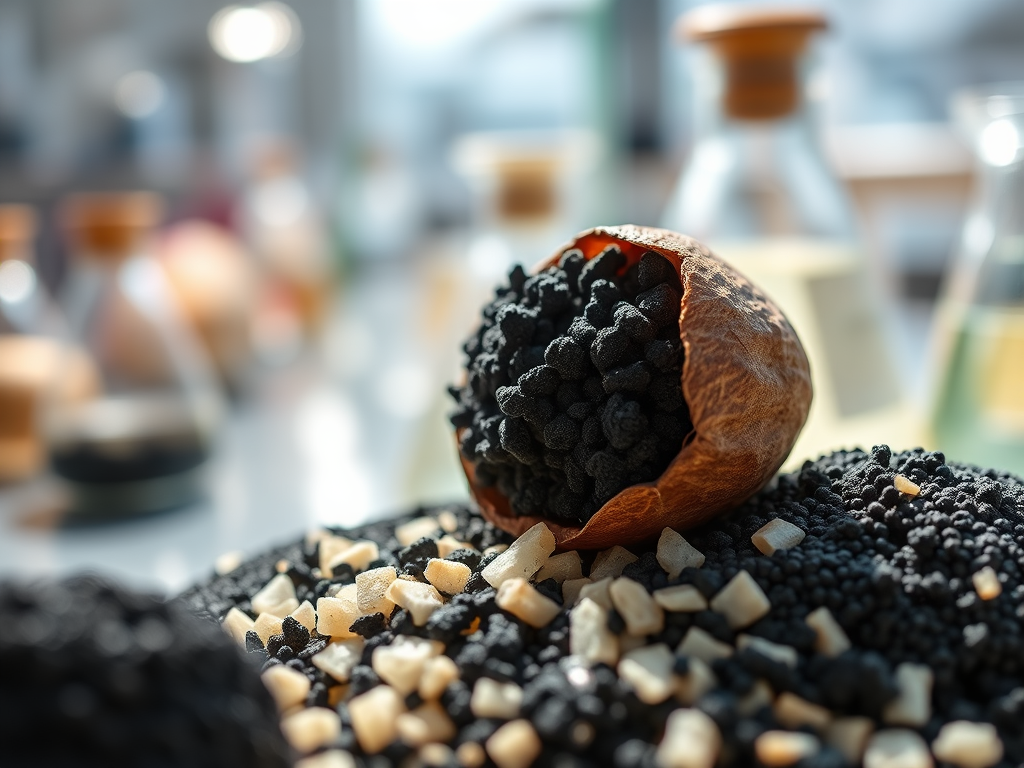
Wastewater rarely contains a single contaminant. Instead, it is a complex mixture of pollutants, such as antibiotics, dyes, and other organic molecules, which leads tocompetitive adsorption that can significantly lower removal efficiency. Developing cost-effective, multi-functional adsorbents to address this real-world problem is crucial. In a study published in the journalEnergy, Ecology and Environment in 2024, Duque-Brito, Lobato-Peralta, Arias, Sebastian, Okoye, and Okolie addressed this challenge by developing a high-surface-area activated carbonActivated carbon is a form of carbon that has been processed to create a vast network of tiny pores, increasing its surface area significantly. This extensive surface area makes activated carbon exceptionally effective at trapping and holding impurities, like a molecular sponge. It is commonly More (AC) from macadamia nutshell (MNS), an abundant agricultural waste. This AC was tested for the simultaneous removal of a binary solution (BS) containing methylene blue (MB), a cationic dye, and amoxicillin (AMX), an ionic antibiotic.
The researchers used a sustainable, one-step chemical activation process with potassium carbonate (K2CO3) to transform the MNS into a highly porous activated carbon. They optimized the production using the Box-Behnken experimental design. The results showed that the activation temperature had the highest influence on both the final yield and the adsorption capacity. The optimal production conditions— 900∘C, 1 hour, and a K2CO3:precursor ratio of 2:1—produced the best sample, termed R2-MNS. This optimal material exhibited a remarkably high specific surface area of 1225 m2/g and a pore volume of 0.801 cm3/g, indicating its potential for high adsorption capacity. The activation time and K2CO3:precursor ratio did not significantly influence the outcome, meaning the production could be optimized to minimize resource and operational costs while maintaining high performance.
The R2-MNS sample demonstrated a superior ability to remove the dual pollutants, achieving a maximum adsorption capacity of 578.925 mg/g from a binary solution with an initial concentration of 800 mg/L. This capacity is notably higher than previously reported values for macadamia nutshell AC used against single pollutants like tetracycline (455.33 mg/g) or methylene blue (up to 444.732 mg/g). The overall maximum removal percentage for the binary solution was 73.72% under optimal conditions.
Evaluation of pHpH is a measure of how acidic or alkaline a substance is. A pH of 7 is neutral, while lower pH values indicate acidity and higher values indicate alkalinity. Biochars are normally alkaline and can influence soil pH, often increasing it, which can be beneficial More showed that optimal overall adsorption occurred at pH 6, achieving a 77.53% removal of BS. Detailed analysis revealed that the removal of the cationic dye, MB, remained nearly 100% across the entire pH range tested (pH 2–12), suggesting that π-π interactions are the dominant adsorption mechanism for MB, which is synergistic and not significantly affected by the presence of the antibiotic. For the ionic antibiotic, AMX, a competitive adsorption or antagonistic effect was observed, especially at pH values above 4.5, where the negatively charged surface of R2-MNS repelled the anionic form of AMX.
Kinetic studies showed that the adsorption process was very fast at the initial stage, with low concentration solutions (50 mg/L and 100 mg/L) reaching equilibrium within the first 2 minutes due to abundant active sites. The experimental data were best described by the pseudo-second-order (PSO) kinetic model, which validates that the predominant interaction mechanism between the R2-MNS and the binary solution is chemisorption. Further isotherm modeling demonstrated that the Khan isotherm best described the relationship between the pollutants and the adsorbent, a model specifically used for bi-adsorbate systems. Thermodynamic results indicated the process was slightly nonspontaneous and exothermic. This work successfully proves that macadamia nutshell can be converted into a valuable, high-capacity activated carbon for the single-stage removal of multiple, complex pollutants.
Source: Duque-Brito, E., Lobato-Peralta, D. R., Arias, D. M., Sebastian, P. J., Okoye, P. U., & Okolie, J. A. (2024). Fast-kinetics adsorption of a binary solution containing cationic and ionic pollutants using high-surface area activated carbon derived from macadamia nutshell. Energy, Ecology and Environment, 9(1), 84–99




Leave a Reply