
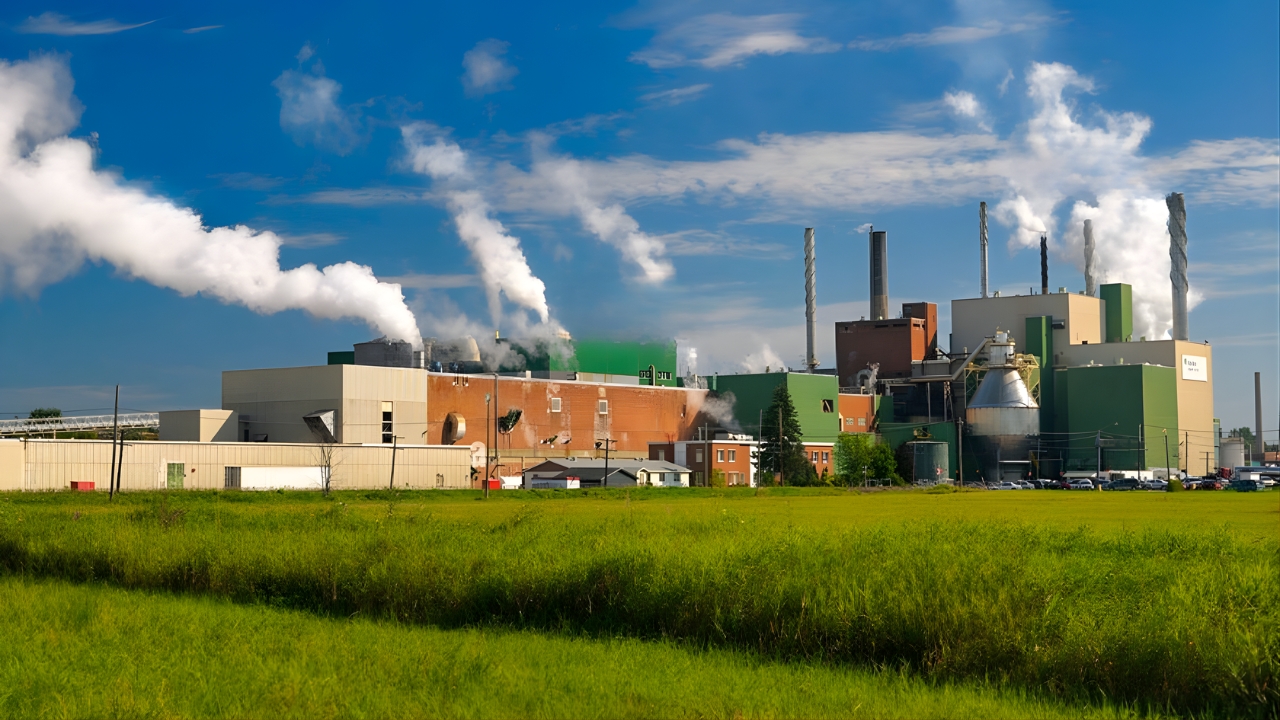
The Canadian province of Quebec is the site of a significant new industrial biocharBiochar is a carbon-rich material created from biomass decomposition in low-oxygen conditions. It has important applications in environmental remediation, soil improvement, agriculture, carbon sequestration, energy storage, and sustainable materials, promoting efficiency and reducing waste in various contexts while addressing climate change challenges. More venture, with the joint-enterprise Evolys, formed by Rio Tinto and Aymium, taking over a former pulp mill in Thurso, Outaouais. This initiative centers on the production of a proprietary material called “biocarbone” (metallurgical biochar) from forestry residues. The primary objective is to substitute fossil coal (anthracite) used in Rio Tinto’s metallurgical complex at Sorel-Tracy. The project, which is targeting an annual production capacity of 50,000 tonnes, represents a critical intersection of industrial decarbonization efforts and the revitalization of regional timber markets in the Laurentides and Outaouais regions.
The key challenge addressed by the Evolys project is two-fold: reducing the high CO2 emissions from Rio Tinto’s metallurgical operations and resolving the persistent issue of low-value wood residue accumulation in Quebec’s forestry sector. Anthracite, currently accounting for two-thirds of the Sorel-Tracy complex’s CO2 output, necessitates a viable, lower-carbon replacement. Simultaneously, since the closure of the previous pulp mill in 2019, regional sawmills and logging companies have struggled to find reliable, local buyers for their low-quality wood, or ‘pulpwood’, often having to transport it long distances, which is a financial burden currently subsidized by the provincial government.
Evolys’s solution involves retrofitting the former pulp mill site to process diverse forest residues—including logs, wood chips, and construction debris—into a specialized “metallurgical biocarbone.” This material is manufactured using a process involving a large dryer and a reactor to concentrate the carbon in the wood fibers, followed by a densification line to create biochar granules. The resulting product is engineered to act as a reducing agent, replacing anthracite to purify iron and titanium ore. This process establishes a critical new demand channel for the region’s forestry residues, with Evolys committing to purchase the majority of its biomassBiomass is a complex biological organic or non-organic solid product derived from living or recently living organism and available naturally. Various types of wastes such as animal manure, waste paper, sludge and many industrial wastes are also treated as biomass because like natural biomass these More within Quebec.
The outcomes of this venture are expected to be substantial. For Rio Tinto, the adoption of biocarbone offers a direct pathway to significantly decarbonize the Sorel-Tracy complex by eliminating the need for fossil anthracite. For the Quebec forestry industry, the project creates a desperately needed market for low-grade wood, which previously accounted for up to 20% of some sawmill revenues. While questions remain regarding the exact volume and pricing structure for these purchases, the project promises to modernize the supply chain and provide economic stability to local forest harvesters and processors, potentially offsetting the end of provincial transport subsidies scheduled for 2026.
Significant value is created when the biochar industry focuses on high-impact industrial applications, such as metallurgical reduction, that directly substitute fossil-based inputs. Such projects, which require significant capital investment and technical specialization, can simultaneously address corporate decarbonization mandates and solve acute regional economic problems related to biomass waste streams. For organizations in the biochar industry, this case underscores the advantage of developing tailored, high-value biochar products (“biocarbone”) over general commodities to secure large, long-term industrial contracts.



Leave a Reply