
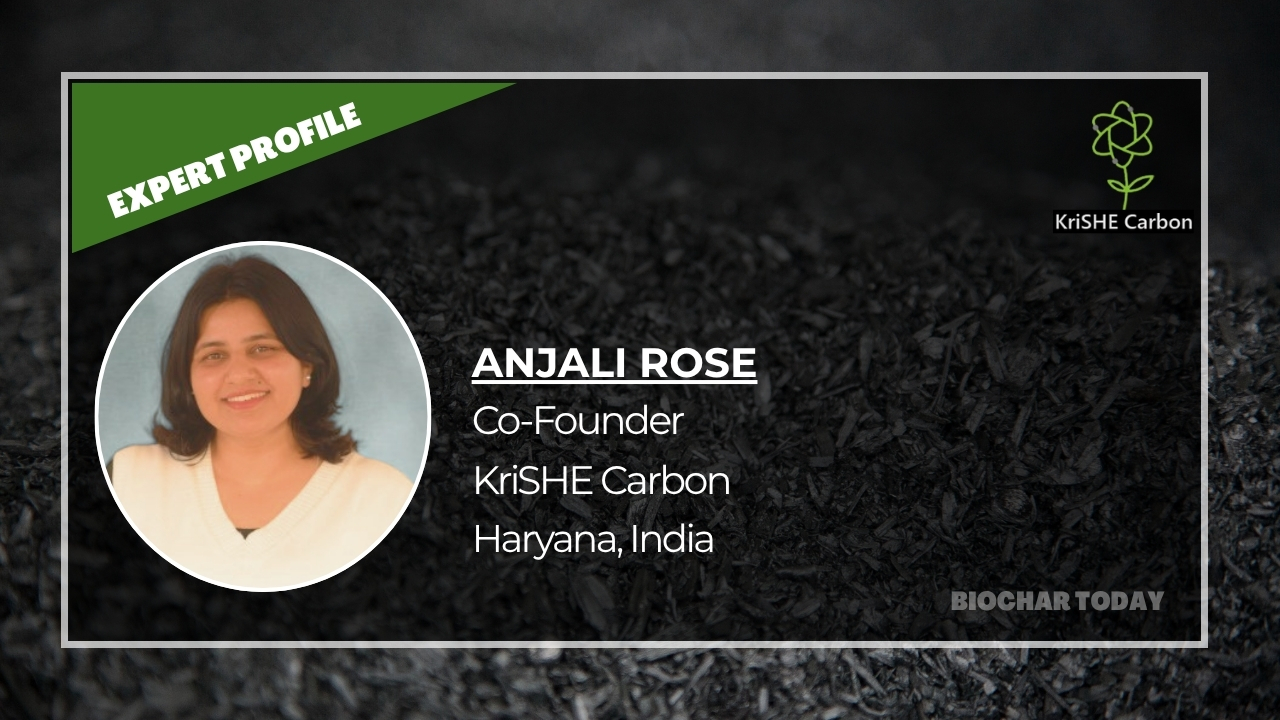
I’d like to begin today’s conversation by introducing our guest, Anjali Rose, Co-founder of KriSHE Carbon. It is a privilege to have this opportunity to speak with someone whose work reflects the growing intersection of biocharBiochar is a carbon-rich material created from biomass decomposition in low-oxygen conditions. It has important applications in environmental remediation, soil improvement, agriculture, carbon sequestration, energy storage, and sustainable materials, promoting efficiency and reducing waste in various contexts while addressing climate change challenges. More, carbon markets, and inclusive rural development.
Anjali’s journey into climate entrepreneurship is particularly interesting because it combines a strong foundation in applied mathematics and modelling with a deep commitment to addressing real-world environmental and social challenges. Through KriSHE Carbon, she has been working to build a farmer-first climate enterprise that enables smallholder farmers and rural entrepreneurs to convert agricultural residues into biochar, transforming a persistent waste management challenge into an opportunity for carbon removal, soil restoration, and additional income generation. Her work has focused not only on developing credible carbon removal projects but also on ensuring that the benefits of these initiatives reach farming communities at the last mile. By promoting decentralized biochar production through village-level “Climapreneurs,” KriSHE Carbon has demonstrated how climate action can be linked with livelihood creation, particularly for rural youth and women-led enterprises. The initiative has already engaged thousands of farmers and contributed to the generation of verified carbon removal credits, highlighting the potential of community-based approaches to climate mitigation.
I am fortunate to have this conversation with Anjali and to explore her perspectives on building trust with farming communities, navigating the realities of measurement, reporting and verification in the Indian context, and creating scalable, credible, and inclusive models for biochar-based carbon removal. I believe her experiences offer valuable insights for researchers, entrepreneurs, policymakers, and everyone interested in the evolving role of biochar in climate and rural development.
Shanthi Prabha: Your journey into climate entrepreneurship began with a background in applied mathematics and modelling. What drew you into biochar and carbon removal, and how did the idea for KriSHE Carbon take shape?
Anjali Rose: I come from Haryana, a state that makes national headlines every winter for stubble burning. I grew up watching it: fields set alight after every harvest, and soil that got a little poorer each season. I studied Applied Mathematics at IIT Mandi and did research for a while, but I kept being pulled toward real problems rather than abstract ones. That took me into the development sector for three years, and it was there that what I had seen as individual struggles started to look like something much bigger. It was a farmer’s problem, a soil problem, a health problem, and at the level of a single village or a single woman, it was exactly what climate change looks like up close.
KriSHE Carbon started from one simple realization: the stubble farmers burn every season is the very organic matter their soil needs. Biochar turns that residue into stable soil carbon and locks it in the ground for over a thousand years, instead of releasing it into the air in a single afternoon. Solve the burning, and you solve for soil, income and climate at the same time. That was the whole idea.
SP: KriSHE Carbon describes itself as a farmer-first climate enterprise. What does that mean in practice, and how has it shaped the way you design your projects?
AR: Farmer-first means we design the whole program around how a farmer actually experiences it, not around what is easiest to scale on a spreadsheet. We did not start with a carbon methodology. We started with farmers who could already see what biochar did for their soil, and built outward from there. When we ask why a smallholder farmer adopts a program like ours or walks away from it, it almost always comes down to two things: can they access it, and can they afford it without taking on risk they cannot absorb.
Every decision, from where we place collection points to how we structure Climapreneur support, starts from those two questions. This is why, for instance, we run mobile pyrolysers that travel from farm to farm rather than asking a farmer to carry residue to a fixed plant. A unit that comes to the field means even the smallest, most scattered landholding can take part, which a centralised facility could never serve. We also build village by village. One village can look nothing like the next in landholding size, existing networks, or trust in outsiders, so we treat that as something to learn on the ground rather than assume from the outset.

SP: Working directly with farming communities brings challenges that are not visible from the outside. What have been your most important lessons in building trust and getting farmers to adopt biochar?
AR:Trust starts with respecting the load farmers already carry. Most of the farmers we work with are women, already stretched thin by household and care work long before residue management enters the picture. If our program asks for one more big behaviour change on top of that, it becomes a burden, not a relief, however good the income or climate case sounds. So our first design rule is simple: ask as little of a farmer’s day as possible, and put as much back into the farm as we can, in yield and soil health. Beyond that, trust in rural India is built through presence, not pitches.
Farmers have watched well-meaning programs arrive with promises and vanish after a season. We earn credibility only by showing up across several cropping cycles, paying on time, and being honest about what carbon markets can and cannot do. And local validation beats any credential. A Climapreneur from the village, who speaks the language and can be found in person, carries more trust than any brochure. Once a few farmers see a neighbor earning steady income from residue they used to burn for free, adoption spreads on its own.
SP: KriSHE Carbon has built its model around the idea of “Climapreneurs.” Could you tell us who they are, how they are selected and trained, and the role they play in a decentralised biochar ecosystem?
AR: Climapreneurs are trained village-level entrepreneurs, from the same villages as the farmers they serve, so they understand those challenges from the inside rather than from a report. We train them to run biochar production as a small business rather than a one-off task. They operate Kon-Tiki kilns, and we select them for standing in the community, willingness to work directly with farmers, and an entrepreneurial streak, then train them on kiln operation, safety, quality control and the record-keeping our MRV needs.
The decentralisation is deliberate. Instead of a few large plants, we spread production across many small, farmer-adjacent units. The Climapreneur becomes the last-mile delivery channel between raw crop residue and a verified credit, and the face of the program in their own community. That is what lets trust-building and scale happen at the same time.
SP: Carbon markets can seem technical and hard to navigate. How do you make carbon credit projects accessible and meaningful for smallholder farmers while keeping them transparent?
AP: We keep the carbon market itself invisible to the farmer and translate it into something concrete: residue has value, biochar has value, and both turn into a predictable payment. Our field teams explain it in plain terms, and we are upfront that issuance and revenue take time, so no one is surprised later. Transparency comes from clear, documented agreements on procurement price and revenue share, and from keeping farmers informed at every stage, from collection to issuance under the Global Artisan C-Sink standard.
The principle underneath all of it is that the carbon revenue is owned by the farmer who grew it. Long-term participation looks after itself once a farmer lives through one full payment cycle and sees that the numbers we quoted actually arrive.
SP: Measuring, reporting and verifying carbon removal is one of the hardest parts of any biochar project. What are the real challenges of doing MRV at scale in the Indian context?
AR:The core challenge is running one rigorous, standardized method across thousands of small, scattered production points that have none of the infrastructure of a single large facility. FeedstockFeedstock refers to the raw organic material used to produce biochar. This can include a wide range of materials, such as wood chips, agricultural residues, and animal manure. More changes by crop and season, Climapreneurs are many rather than centralised, and record-keeping capacity differs from one village to the next. Standardising data at that scale is exactly the kind of problem technology is meant to solve. So we built our MRV around how a Climapreneur actually works. Logging a batch takes minutes, not a training session: feedstock, batch weight, kiln, date, a photo. That record is the foundation the whole credit rests on.
The platform then does the heavy lifting a person cannot do reliably across thousands of batches, flagging anything that looks off, cross-checking against the lab-tested carbon content of the biochar, and keeping a clean batch-level trail that an auditor can follow from a single field to an issued credit. The point is that the burden of proof never lands on the farmer or the Climapreneur at the last mile. The rigor sits in the system, so they can focus on doing the work well.

SP: Your credits are issued under the Global Artisan C-Sink standard. How important are credible certification standards in building confidence among buyers, investors and farming communities?
AR: Certification is the ground everything else stands on. Without a credible, independently verified standard, artisanal biochar has no way to prove its climate impact to a buyer, and without that proof there is no revenue to share back with farmers. Certification under Carbon Standards International’s Global Artisan C-Sink standard gives our credits the scientific and procedural rigor international buyers need. Of our first issuance, close to 70 percent is classed as permanent for over a thousand years.
There is a real paradox on every farm we work with. The same field holds both the source of emissions, residue that would be burned, and the sink, biochar that could lock that carbon into the soil for centuries. What has always stood between the two is affordability. A smallholder farmer cannot be asked to carry the cost of converting residue into biochar just because it is good for the climate. Credible certification is what closes that gap.
Once the biochar is measured, verified and turned into a tradable certificate, the cost of closing the loop no longer falls on the farmer. It is paid by someone outside the system entirely, a buyer purchasing a verified outcome. That, in a real sense, is climate equity. And the more traceable each certificate is, the more every tonne traces back to a specific action on a specific farm, the more a buyer can trust that their money genuinely reached a farmer and genuinely kept carbon out of the air.
SP: Biochar offers environmental and agricultural benefits, but farmers decide on immediate returns. How do you balance climate goals with livelihood improvement, and what impact have you seen?
AR: Every conversation on the ground starts with soil, not climate. Farmers care first about their land, their yield, and a clear answer to how anything we suggest actually helps them. So we introduce biochar as exactly that: a deposit back into the soil that helps the next crop, and we describe burning as its opposite, giving away as smoke the organic matter the soil needs. Put that way, biochar becomes a balance the farmer already understands, long before it becomes a conversation about carbon.
The climate story comes later, and it is real, but it is never the opening line. On impact, we have onboarded more than 3,000 farmers, each committing not to burn their stubble but to convert it into biochar and return it to their own fields. Over 30 Climapreneurs have been trained to run this on the ground, and 2,264 tCO2e have been issued so far. What stays with us is not just the tonnage. In one cluster of 500 farmers, more than 490 carried the practice across their whole production the very next season, usually because of the yield they saw, or simply because of how the first season with us went.
SP: Women and rural youth are central to your work. What potential do you see for biochar to drive inclusive rural entrepreneurship, and what barriers still need solving?
AR: Biochar suits women-led and youth-led enterprises well. It needs no large capital outlay, it can be run close to home, and it creates a visible, ownable business rather than wage labour. We see the Climapreneur role becoming a genuine first step into entrepreneurship for people who have usually been left out of rural business ownership. It already pays.
Our Climapreneurs, many of them rural youth, earn two to three times the baseline rural income, which turns residue management into a real livelihood rather than a side task. Seen at scale, carbon credits can build a parallel economy in these villages, one that pays farms for cutting emissions and moves each farm toward net zero at its own level.
The barriers are the familiar ones: upfront capital for kilns and equipment, mobility constraints that can limit women’s participation in field roles, and the need for steady handholding in the first few months of any small enterprise. Clearing them takes finance built around these constraints rather than a standard entrepreneurship playbook, and support designed for how these businesses actually start. A one-size template will not do it.
SP: India has abundant agricultural biomassBiomass is a complex biological organic or non-organic solid product derived from living or recently living organism and available naturally. Various types of wastes such as animal manure, waste paper, sludge and many industrial wastes are also treated as biomass because like natural biomass these More, yet biochar adoption stays limited. Looking at the decade ahead, what policy measures, financial mechanisms and technology developments would most help scale responsible, community-based biochar removal?
AR: India generates enormous volumes of crop residue every year, and most of it is still burned rather than turned into a stable carbon sink. Closing that gap needs a few things moving together.
On policy and finance: clearer national recognition of biochar within India’s carbon and agricultural frameworks, finance that takes the early risk off a rural entrepreneur’s shoulders so the first kiln is not a gamble they cannot afford, and simpler access to carbon markets for aggregated smallholder producers.
One reality policy has to face is land size. Indian holdings are small and scattered, and history is clear about what actually scales in that setting: decentralized, mobile technology that goes from farm to farm, the way the harvester did. The moment you try to aggregate, cost and logistics climb fast. A centralized biochar plant, however efficient on paper, becomes prohibitively expensive once you add the cost of collecting residue from hundreds of farms and carrying biochar back out to them. That is why our model is built around mobile, village-level infrastructure, and it is exactly where public-private partnerships could do the most good, co-funding village-level units and bio-resource centres that help farmers treat and apply biochar well.
On technology, the two developments I would watch are low-cost, farmer-operable pyrolysers and cheaper purpose built digital MRV to serve last mile, because between them they decide how fast decentralized models can scale without giving up rigour. On the market side, high-integrity standards for community-based removal, and growing buyer appetite for credits with a real livelihood story behind them. If markets and policy keep rewarding projects that combine credible removal with genuine rural income, community-based models move from the edge of the carbon economy to its centre.
SP: Based on your journey across biochar, carbon markets and rural development, what advice would you offer to researchers, startups and policymakers who want to build scalable, impactful biochar initiatives?
AR: Spend time in the field before you spend time on the methodology. This is the one I feel most strongly about, because it is how we started. We did not begin with a carbon method and then look for farmers to fit it. We began with farmers who already believed in what biochar was doing for their soil, and who had made more than a hundred tonnes of it before any project document existed. The certification simply caught up to something they had been living for months. That is the order I am proudest of, and I think it is the right order for anyone serious about this work.
The technical and financial architecture matters enormously, but it only holds if it is grounded in an honest picture of what a farmer’s day, season and year actually look like. A lot of well-designed projects fail not because the science is wrong, but because they were built without that grounding.
For researchers and policymakers, I would add one thing: treat MRV and financing design as seriously as the technology, because those are what decide whether a smallholder can actually take part or get priced out. And for anyone just starting, build trust and consistency first. Scale, credits and revenue all follow once a community believes you will still
For readers interested in learning more about Anjali’s work and her efforts to build farmer-centered biochar and carbon removal initiatives, we encourage you to connect with and follow her on LinkedIn.





Leave a Reply