
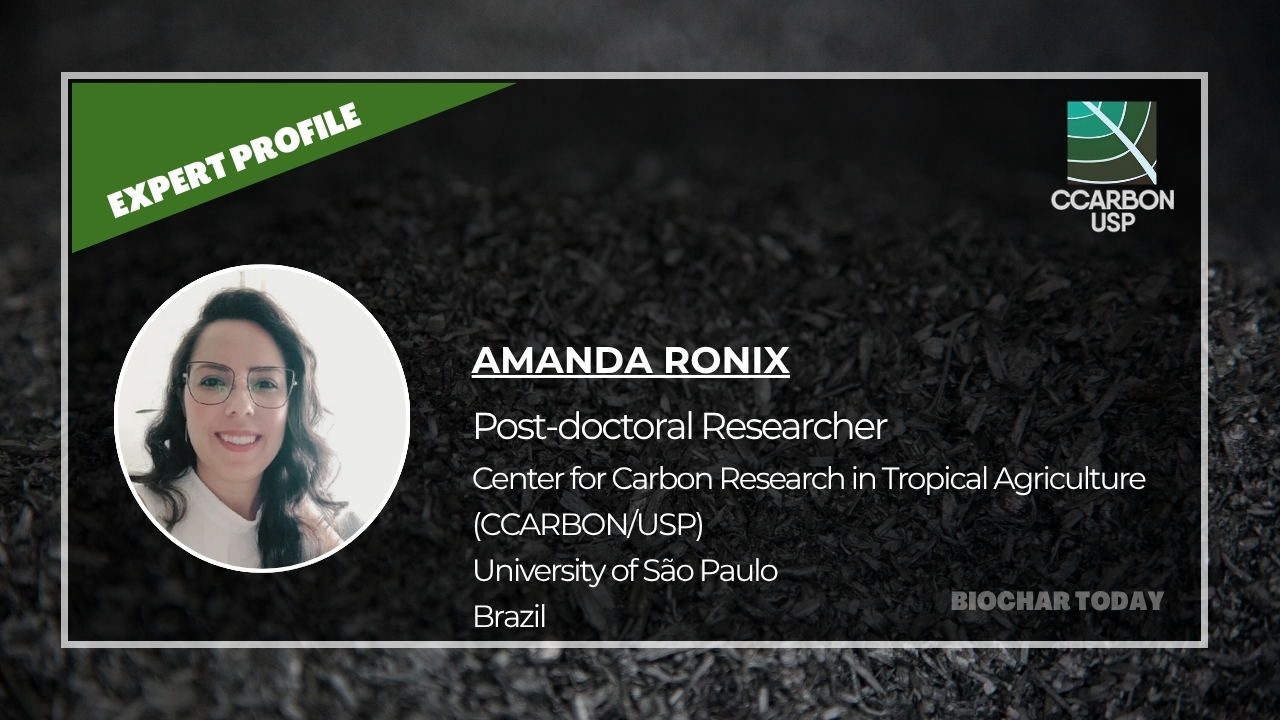
Amanda Ronix Pereira is a researcher specializing in biocharBiochar is a carbon-rich material created from biomass decomposition in low-oxygen conditions. It has important applications in environmental remediation, soil improvement, agriculture, carbon sequestration, energy storage, and sustainable materials, promoting efficiency and reducing waste in various contexts while addressing climate change challenges. More, soil carbon, and carbon market applications, with a strong focus on integrating scientific research into practical climate solutions. Her work combines field-based soil organic carbon measurements with advanced modelling approaches, including RothC and Century models, to support robust carbon accounting and MRV frameworks. She is currently engaged in postdoctoral research and collaborates internationally to strengthen methodologies for scaling soil carbon assessments from local to global contexts.
Previously, she served as a Senior Researcher at the International Institute for Sustainability, where she led interdisciplinary work on soil decarbonization and biochar systems, contributing to the development of technical methodologies and decision-support tools. She has played an active role in advancing the biochar sector in Brazil, including co-founding the Brazilian Biochar Institute and leading the technical translation and national dissemination of key biochar literature. Her experience spans applied research, project development, and stakeholder engagement across science, industry, and policy domains.
For me, it’s a great pleasure to introduce Amanda Ronix Pereira to our readers within the biochar community.
Shanthi Prabha: To begin, Amanda, could you share a bit about your journey into biochar and soil carbon research, and what drew you to this field?”
Amanda Ronix Pereira: My path into biochar started at the lab bench. I was working on the development of carbonaceous materials, but the question that always drove me was not purely scientific. It was practical: how do we make the knowledge produced in academia actually reach the field? That question has guided my entire career.
In biochar, I found the opportunity to take a relatively simple solution beyond the laboratory and apply it at meaningful scales. It is a technology that is at once ancient and cutting-edge, accessible enough for smallholder farmers and complex enough to challenge researchers at the highest level. It is capacity to act simultaneously on climate change, soil health and farm income is what makes this field so compelling, and what has kept me here for more than a decade.
SP: Your work spans field measurements and soil carbon modeling tools like RothC and Century. How do you bridge the gap between real-world soil data and model-based predictions in practice?
AP: Models are, by definition, mathematical approximations of reality, and their accuracy depends directly on the quality of the data that feed them. One of the central limitations in soil carbon modeling is precisely the scarcity of field measurements. Modelers are constantly dependent on reliable observations to support and refine their simulations, and robust field datasets are far less common than we would like.
This is why I have always argued that experimental monitoring and modeling should be treated as two sides of the same effort. Field data calibrate and validate the models; models allow us to extrapolate field observations to spatial and temporal scales that direct experimentation cannot reach.
SP: Biochar is often discussed as a climate solution, but implementation can be complex. What are the most common challenges you’ve seen when moving from research to real-world application?
AP: Among the main challenges currently limiting the broader adoption of biochar, the economic barrier stands out as one of the most critical. Capital costs for efficient production units remain high, which limits access for small and medium-sized producers. There is also a knowledge gap. A large share of farmers still lacks the technical background needed to understand and apply biochar effectively. In my view, addressing these two barriers simultaneously, the economic one and the knowledge dissemination one, will determine how quickly biochar moves from a research topic to a field-level practice. At the same time, there is reason for optimism, since technological development and wider dissemination of knowledge tend to make innovations more accessible over time, opening the way for broader and more inclusive adoption.
SP: You’ve worked extensively on MRV (Measurement, Reporting, and Verification). What are the key limitations today in accurately measuring biochar’s long-term carbon impact?
AP: We are at a genuinely promising moment for biochar MRV. The classical analytical techniques, including recalcitrant carbon fractionation, H:C molar ratios and elemental analysis, are well established and widely accepted by the main voluntary carbon market standards. Newer approaches, such as the use of inertinite as a persistence marker for biochar in soil, are also opening up interesting possibilities for long-term monitoring.
That said, we still need more long-term field experimental data. The soil carbon permanence of biochar is one of its strongest differentiators relative to other sequestration practices, and demonstrating that rigorously, with decades of empirical evidence, is what will ultimately consolidate biochar’s credibility in carbon markets. Building that evidence base is one of the research priorities I find most important right now.
SP: Concepts like additionality and permanence are critical in carbon markets. How do these play out specifically in biochar projects, and where do you see the biggest risks?
AP: Additionality and permanence are fundamental requirements in any carbon project, and biochar has favorable characteristics in relation to both. The recalcitrant carbon fraction of biochar provides exceptional persistence in soil, and the scientific evidence for stability over centuries is well supported. The main challenge lies in developing robust, standardized protocols that can reliably verify and communicate that potential to the market. That is where the most significant technical work still needs to happen.
SP: In your experience, how do farmers and land managers perceive biochar — are they more motivated by soil health benefits or carbon market incentives?
AP: In my field experience, what motivates farmers is what they can observe directly, and the first thing they notice is crop productivity. Yield improvements, better soil water retention and reduced input requirements generate immediate interest because they have a direct effect on farm income. Carbon markets remain largely inaccessible for most Brazilian rural producers, not because of lack of interest, but because of limited access to information, certification mechanisms and financing.
What I have learned is that the most effective entry point for any biochar project is always the agronomic benefit. Once a farmer sees results in the field, the next step of integrating carbon markets and monetizing permanence becomes much more feasible.
SP: You’ve led interdisciplinary teams and worked across science, policy, and industry. What does effective collaboration look like in biochar projects?
AP: Working with biochar requires genuinely interdisciplinary collaboration. When scientists, farmers, investors and policymakers can engage with the same problem while respecting the different forms of knowledge each brings, the resulting solutions are far more robust. That principle is guiding the development of a national biochar network in Brazil, which we are currently building to connect researchers, producers and policymakers around a shared agenda for the sector.
8. Brazil has unique agricultural and climatic conditions. How does this SP: influence the role biochar can play compared to other regions?
AP: Brazil has a distinctive set of conditions that position it as a potential global reference in biochar. We are among the world’s largest food producers and generate substantial volumes of agricultural biomassBiomass is a complex biological organic or non-organic solid product derived from living or recently living organism and available naturally. Various types of wastes such as animal manure, waste paper, sludge and many industrial wastes are also treated as biomass because like natural biomass these More residues, that represent abundant and largely underutilized feedstocks for biochar production.
Add to that the sheer scale of available land. Brazil holds one of the largest agricultural land areas on the planet, with millions of hectares under varying management systems and significant response potential for biochar, particularly in regions with highly weathered and degraded soils.
The institutional framework needed to scale all of this is now being built. Government-led biochar certification initiatives are underway, which is an encouraging development. There is still a long way to go, but for the first time I see Brazil positioning itself to lead in this field, not just participate.
SP: You contributed to launching the Portuguese edition of A Farmer’s Guide to Biochar. What gaps in knowledge or misconceptions were you hoping to address through this effort?
AP: Leading the translation of “A Farmer’s Guide to the Production, Use and Application of Biochar” was one of the initiatives I am most proud of. The original work by Stephen Joseph and Paul Taylor is a complete and accessible resources on the subject, and the generosity of the authors in allowing us to produce this translation was fundamental to the project.
What really motivated it was a very concrete observation. In Brazil, the language barrier still excludes a large share of farmers, agronomists and extension workers from access to knowledge that could genuinely transform their practices. It is not enough for science to advance if it cannot reach the people working in the field. The central objective of this translation was to democratize access to technical knowledge, and that remains, for me, one of the most meaningful expressions of what applied science should be.
SP: From a technical standpoint, how important is biochar characterization (e.g., physicochemical properties) in determining its suitability for different applications?
AP: I often say that “biochar” does not exist as a single material. What exists is “biochars,” in the plural. That distinction may seem semantic, but it is deeply technical. Depending on the feedstockFeedstock refers to the raw organic material used to produce biochar. This can include a wide range of materials, such as wood chips, agricultural residues, and animal manure. More and pyrolysis conditionsThe conditions under which pyrolysis takes place, such as temperature, heating rate, and residence time, can significantly affect the properties of the biochar produced. More, including temperature and residence timeResidence time refers to the duration that the biomass is heated during the pyrolysis process. The residence time can influence the properties of the biochar produced. More, the resulting materials can differ substantially in their physicochemical properties. Specific surface area, pHpH is a measure of how acidic or alkaline a substance is. A pH of 7 is neutral, while lower pH values indicate acidity and higher values indicate alkalinity. Biochars are normally alkaline and can influence soil pH, often increasing it, which can be beneficial More, H:C molar ratio, ashAsh is the non-combustible inorganic residue that remains after organic matter, like wood or biomass, is completely burned. It consists mainly of minerals and is different from biochar, which is produced through incomplete combustion. Ash Ash is the residue that remains after the complete More content, water retention capacity and nutrient concentration each determine which application a given biochar is best suited for. A biochar with high potassium and phosphorus content plays a very different role from a high-surface-area biochar designed for contaminant retention. Characterizing the material before application is not a technical formality. It is what ensures the right tool is being used for the right purpose.
This diversity is one of the greatest strengths of biochar as a technology. It has opened the way for what we call biochar engineering, the deliberate customization of material properties during production to maximize performance for a specific application. Whether the goal is soil carbon sequestration, soil remediation, nutrient retention or contaminant adsorption, it is now possible to design the biochar around the objective rather than adapting the objective to whatever biochar is available. That design capacity represents, in my view, the next significant advance for this technology.
SP: You’ve also worked on business planning for biochar production. What are the key factors that determine whether a biochar project is economically viable?
AP: The economic viability of a biochar project depends on balancing several variables, and a miscalculation in any one of them can undermine the whole enterprise. In my experience, the most critical factors are feedstock availability and cost, which needs to be local, consistent and preferably a residue with no higher-value alternative use; production and distribution logistics, which are frequently underestimated; and the capital and operating costs of the chosen equipment.
The factor that has most shifted the financial equation in recent years, however, is integration with carbon markets. When biochar can be certified and the resulting credits commercialized, carbon revenue can be the differentiator that makes a marginal project economically sound. The challenge is that this pathway remains complex and out of reach for many small producers. Reducing that barrier is one of the most pressing priorities for the sector.
SP: Finally, for readers who want to follow your work or learn more about your projects and interests, where can they find you?
AP: Biochar is a subject I genuinely never tire of, and I believe there are still decades of important discoveries ahead. I am always open to conversations, collaborations and partnerships, whether with researchers, farmers, investors or policymakers. Those who want to follow my work can find me at linkedin: www.linkedin.com/in/amanda-ronix




Leave a Reply