
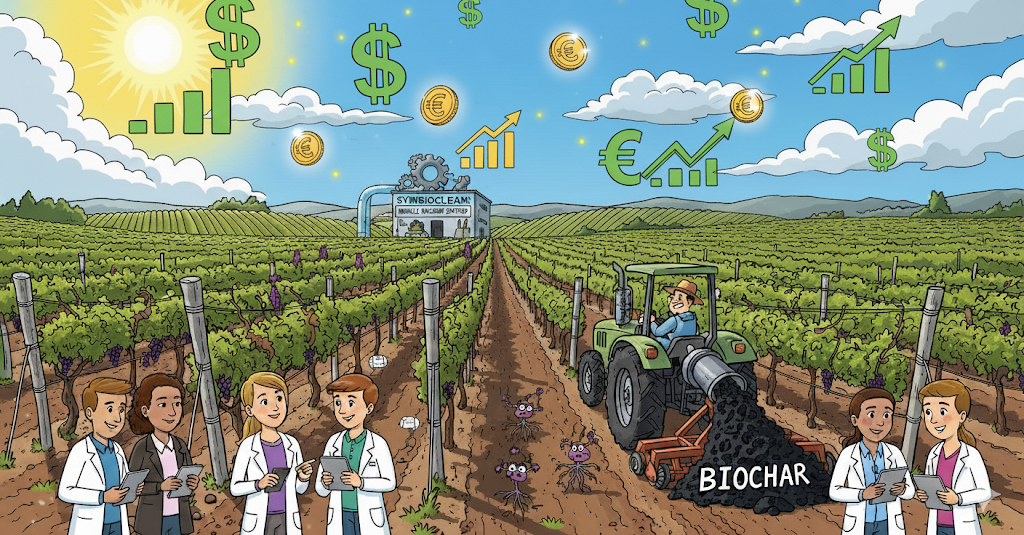
Amid Europe’s two-year climate-driven wine slump, a new normal of erratic weather is forcing the viticulture sector to re-evaluate its future. With 2024 seeing EU wine output fall to 138.3 million hectoliters—the lowest volume this century—the economic stability of winemakers is at risk. While the challenge is clear, so is the opportunity: a chance to invest in climate resilience. As a founder in the carbon climate/agri-tech space, I see a clear path forward for the industry through integrating biocharBiochar is a carbon-rich material created from biomass decomposition in low-oxygen conditions. It has important applications in environmental remediation, soil improvement, agriculture, carbon sequestration, energy storage, and sustainable materials, promoting efficiency and reducing waste in various contexts while addressing climate change challenges. More with other biological tools. However, the path isn’t as simple as selling a product; it requires a new approach that tackles the critical bottlenecks holding back the biochar industry itself.
Overcoming the Biochar Bottleneck
While biochar holds immense promise, its adoption in mainstream viticulture has been stalled by a number of well-known hurdles. First, there’s the high cost and scarce supply. High-grade biochar can run into several hundred euros per tonne, with single production sites often capping out around 100,000 tonnes per year. This makes it a rare and expensive commodity. Transporting this bulky material long distances is also costly and inefficient.
Beyond logistics, efficacy remains a key challenge. Biochar isn’t a one-size-fits-all solution; its properties vary greatly depending on the feedstockFeedstock refers to the raw organic material used to produce biochar. This can include a wide range of materials, such as wood chips, agricultural residues, and animal manure. More. A char that works wonders in a sandy Spanish soil might underperform in a calcareous French terroir. As a result, efficacy can be variable. This combination of cost, supply, logistics, and variable results has kept biochar on the sidelines, waiting for a more sophisticated, holistic solution.
From Product to Service: The Triple-Bio Solution
SymbioVerse was created to address this market gap, shifting the focus from simply selling a product to providing a comprehensive, customized service. Our model combines three “bio” components—biochar, biostimulants, and biofertilizers—into a tailored soil resilience program for each vineyard.
Our process starts with a detailed soil analysis. Based on these diagnostics, we select the right type of biochar (e.g., a high-pH char to buffer acidic soil) and apply it at a moderate, cost-effective dose (1–4 tonnes/ha). This is often pre-blended with compost to inoculate beneficial microbes. We then incorporate targeted biostimulants like kelp or humic acids to enhance root growth and stress tolerance. Finally, we introduce precise biofertilizer inoculants, such as nitrogen-fixing bacteria and mycorrhizal fungiThese are friendly fungi that form a partnership with plant roots. They act like an extension of the root system, helping plants access water and nutrients more effectively. Biochar can create a cozy habitat for these helpful fungi, boosting their growth and improving plant health. More, which colonize the biochar and work in synergy with the vine roots. The biochar acts as a stable habitat and moisture reservoir, while the biostimulants and biofertilizers provide the catalysts and nutrients.
This triple-bio approach turns the soil into a biologically active, water-retaining sponge, enhancing resilience and yield without compromising wine quality. By partnering with growers from design to implementation and monitoring, we ensure the solution is not just applied but actively managed for success.
The Stacking Value Proposition
For the viticulture sector, adopting this model isn’t just an act of environmental stewardship; it’s a sound business decision. Our pilots are designed to de-risk innovation through a shared-value model. By running subsidized field trials, we allow growers to test the approach with minimal financial exposure. This creates a “no-brainer” proposition for vineyards to participate, and the upsides are compelling:
Increased Yield and Quality: A six-year trial in California saw Pinot Noir yields increase by over 30%, translating to an additional $17,600 per acre by the sixth harvest. Similarly, a study in Tuscany found that biochar-amended vines yielded up to 66% more grapes in drought years, with no drop in fruit quality. In Australia, trials achieved a 20% reduction in irrigation water use while improving grape quality. These aren’t isolated results; they point to a direct link between healthier soil and a vineyard’s bottom line.
Carbon Credits and New Revenue Streams: Biochar’s ability to lock away carbon for centuries qualifies it as a permanent carbon removal under the EU’s new Carbon Removal Certification Framework (CRCF). Vineyards using this approach can generate certified carbon credits, transforming climate action into a valuable income source. Demand for these high-quality credits is surging. As of late 2025, 89% of all biochar credits available for the year had been committed, and prices jumped 8% from Q2 to Q3. Forward buyers have even pre-sold 40% of their 2026 credits over a year in advance. This hot market means vineyards can potentially earn hundreds of euros per hectare annually by selling carbon credits.
Operational Savings: Healthier soil biology allows growers to reduce their reliance on synthetic fertilizers, irrigation, and some pesticides, leading to incremental but significant cost savings over time.
For investors, this model creates multiple revenue streams from service fees, product sales, and carbon credits. Beyond private investment, our strategy is also designed to align with and capitalize on emerging policies and grants. We help vineyards secure funding from programs like Horizon Europe and EU Common Agricultural Policy (CAP) eco-schemes. Under the 2023–27 CAP, at least 25% of direct payments—a €96+ billion pool—must be allocated to climate-friendly farming. In the UK, Defra’s new Environmental Land Management (ELM) schemes dedicate £1.8 billion per year to paying farmers for environmental benefits. By stacking these financial benefits, we make regenerative viticulture not just an environmental win but an undeniable economic one.
A Collaborative Movement
To truly scale, the biochar industry must address its supply chain challenges. Rather than shipping bulky biochar long distances, we’re exploring decentralized, mobile pyrolysisPyrolysis is a thermochemical process that converts waste biomass into bio-char, bio-oil, and pyro-gas. It offers significant advantages in waste valorization, turning low-value materials into economically valuable resources. Its versatility allows for tailored products based on operational conditions, presenting itself as a cost-effective and efficient More units that can produce biochar on-site from vineyard prunings and other biomassBiomass is a complex biological organic or non-organic solid product derived from living or recently living organism and available naturally. Various types of wastes such as animal manure, waste paper, sludge and many industrial wastes are also treated as biomass because like natural biomass these More. Advances in small-scale pyrolysis technology are making this feasible. This creates a hyper-local circular economy, slashing transport costs and ensuring the char’s properties are optimized for local conditions.
This isn’t a project one company can undertake alone. It requires a collaborative movement of growers, entrepreneurs, investors, and policymakers working together. We are actively onboarding early-adopter vineyards in the EU and UK for the 2026 growing season and beyond. We are also inviting biochar producers, biostimulant companies, and agronomists to collaborate on creating site-specific formulations.
The Engine of Innovation: Why Startups Matter
Startups are the indispensable catalysts for the biochar industry’s evolution. Unlike established companies, they are agile and can take on the high-risk, high-reward ventures necessary for radical innovation. The large share of new pyrolysis technology patents are being filed by startups, a clear indicator of their role as the primary engine for technological advancement. These innovations aren’t just about efficiency; they’re also about creating new use cases for biochar beyond soil amendmentA soil amendment is any material added to the soil to enhance its physical or chemical properties, improving its suitability for plant growth. Biochar is considered a soil amendment as it can improve soil structure, water retention, nutrient availability, and microbial activity. More, such as its integration into building materials or as a component in water filtration systems.
Furthermore, startups can be the key to unlocking the necessary capital for the industry. They’re uniquely positioned to attract venture capital and private equity because they can promise both environmental impact and significant financial returns. This access to a specialized funding network allows them to scale rapidly, moving from small pilot projects to large-scale commercial operations much faster than traditional enterprises. This dynamic environment of innovation and investment thrives in nascent industries and investment in biochar seems logical and probable with startups.




Leave a Reply