
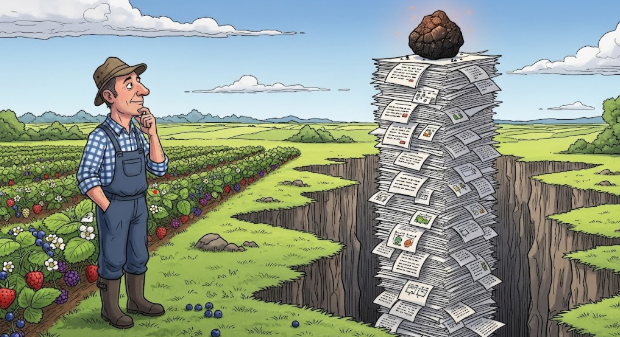
For many in the agricultural sector, the term biocharBiochar is a carbon-rich material created from biomass decomposition in low-oxygen conditions. It has important applications in environmental remediation, soil improvement, agriculture, carbon sequestration, energy storage, and sustainable materials, promoting efficiency and reducing waste in various contexts while addressing climate change challenges. More conjures images of a futuristic farming solution, a kind of “silver bullet” for everything from soil health to climate change. But the reality on the ground is far more complex. While the academic research is extensive, farmers remain cautious, and for good reason. As the business editor for Biochar Today, I spend a lot of time trying to bridge the epistemic gap between scientific promise and on-farm reality. I recently spoke with Cristian Marmandiu, a seasoned soft fruit grower and Lead Technical and Operations Advisor at Haygrove Ltd., whose insights perfectly illustrate the practical concerns and considerations that prevent many growers from embracing biochar.
Initial Perceptions of Biochar as a Farmer
Cristian’s background is deeply rooted in the horticultural industry. He has been in the business since 2005, managing everything from tunnels and irrigation to pest control and operational logistics, not only in the UK but also abroad. His specialty is soft fruits – raspberries, strawberries, blackberries, and blueberries – grown both conventionally and organically. It’s his work with organic crops that first led him to consider biochar, a substance he sees as a potential asset for sustainable farming.
However, his initial investigation a few years ago ended in a decision not to use it. The reason was simple: “insufficient data.” The information he could find at the time was too anecdotal and didn’t provide a clear, convincing economic case. He was particularly put off by the notion that biochar could temporarily “lock up” nutrients in the first year of application. For an annual crop, a slow start is a huge commercial risk. Every season is a new cycle, and if the biochar doesn’t deliver immediate, visible benefits, the investment is wasted. Yes, the soil is reused year on year, but it is redressed so there is a concern that the benefits will not carry over to the next growing season.
This highlights a fundamental problem in the biochar industry: the chasm between academic research and commercial farming. While scientists are meticulous in their studies – testing biochar made from a specific feedstockFeedstock refers to the raw organic material used to produce biochar. This can include a wide range of materials, such as wood chips, agricultural residues, and animal manure. More at a specific pyrolysisPyrolysis is a thermochemical process that converts waste biomass into bio-char, bio-oil, and pyro-gas. It offers significant advantages in waste valorization, turning low-value materials into economically valuable resources. Its versatility allows for tailored products based on operational conditions, presenting itself as a cost-effective and efficient More temperature on a specific plot of land – this data is too narrow to be useful for a farmer who needs to make a decision for an entire field or a whole farm. The industry is currently in a state of flux, caught between cautious scientific claims and the exaggerated promises of some carbon credit providers. This creates a trust deficit that makes farmers wary of what Cristian described as a possible “snake oil” solution. Farmers are often overpromised improvements by experts through innovative solutions, which hinders uptake of emerging technologies like biochar.
What are the Benefits for Growers?
The most compelling, and arguably most straightforward, benefit of biochar is its ability to improve the physical properties of the soil. Because it’s a highly porous material, it can significantly enhance the soil’s water holding capacityWater holding capacity is the amount of water that soil can retain. Biochar can significantly increase the water holding capacity of soil, improving its ability to withstand drought conditions and support plant growth. More. In an era of increasing climate volatility, where heat stress and drought are more common, this can be a game-changer. For soft fruit growers, who are particularly vulnerable to dry conditions, keeping more water in the soil for longer could be the difference between a good harvest and a lost one.
In a world where drought can be followed by flash floods, biochar also offers protection against water runoff. Dry soil struggles to absorb sudden downpours, leading to erosion and nutrient loss. Biochar-amended soil, with its improved structure and water retention, can absorb rainfall more effectively, preventing topsoil erosion and keeping valuable nutrients where they belong.
The second major benefit is nutrient retention within the soil itself. While a farmer may not see an immediate boom in yield from a biochar application, the long-term effect is a healthier, more stable soil. The porous structure of biochar allows it to hold onto nutrients, preventing them from leachingLeaching is the process where nutrients are dissolved and carried away from the soil by water. This can lead to nutrient depletion and environmental pollution. Biochar can help reduce leaching by improving nutrient retention in the soil. More away. This means that with each passing year, the soil becomes more fertile and requires fewer fertilizer inputs, which is a significant economic and environmental benefit, especially for organic growers.
The Elephant in the Room: Cost
Despite all the potential benefits, the single biggest barrier to biochar adoption is its cost. As I told Cristian, a ton of biochar can be expensive and the price is far from stable/predictable, and while a small trial might be manageable, the cost of a large-scale application is prohibitive. This is a classic chicken-and-egg problem: the cost is high because production is small, and production is small because the cost is high.
My view is that the way forward lies in a collaborative, risk-sharing approach. Rather than asking a farmer to gamble on a new product, we can bring in the end-buyers – the supermarkets – as partners. Supermarkets are increasingly focused on improving the sustainability and resilience of their supply chains. A project that uses biochar to make a soft fruit farm more resilient to climate change, while also showcasing a commitment to regenerative practices, is a powerful PR story for them. They may not pay more for the fruit, but they might be willing to fund the trial, minimizing the risk for the grower. Additionally, in the long term, farmers can expect increases in fruit yield, which means the product value may not change but their production capacity may increase with healthier soil.
This kind of partnership is the most sensible way to proceed. It acknowledges that farmers operate on thin margins and can’t afford to take unnecessary risks. It also recognizes that the true value of biochar may not be in a higher price per kilo, but in a more stable and resilient supply of high-quality produce.
Lessons Learned
My conversation with Cristian Marmandiu provided crucial insights into the real-world barriers preventing biochar from reaching its full potential.
- Focus on the Farmer’s Needs: While carbon sequestration is a critical long-term benefit, the conversation needs to center on the immediate, tangible gains for the grower: increased crop resilience, improved water retention, and better nutrient management. Carbon credits generated are an excellent bonus, but projects centred on sequestration can be more tangible elsewhere (e.g. in construction, infrastructure, etc.).
- Bridge the Data Gap: The industry needs to produce more generalized, farm-level data that provides a clear economic case for biochar. This requires moving beyond hyper-specific academic studies to broader, more applicable trials. Farming is itself extremely contextual, but that doesn’t mean each use case can be evidenced, it means we need more generalist displays of benefits.
- Collaborate and Share Risk: The high cost of biochar is a major hurdle. I believe that risk-sharing models – where growers partner with their buyers or with biochar producers – are the most sensible way to make trials feasible and lay the groundwork for a more affordable future.
The story of biochar is not about a silver bullet solution but about a tool with significant potential. Its success will not depend on academic papers or optimistic promises, but on the ability of the industry to listen to the concerns of farmers and build an infrastructure that makes its adoption both economically viable and low-risk.


Leave a Reply