
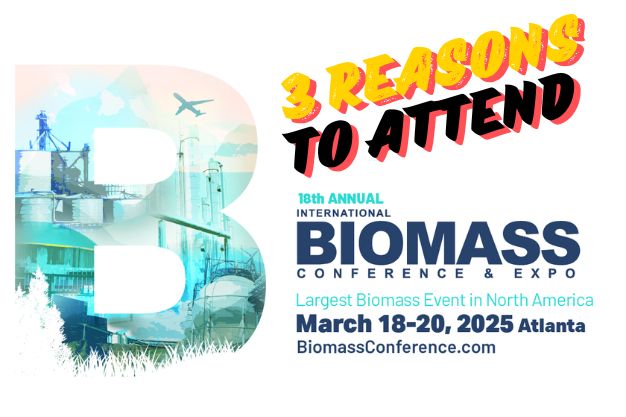
The International Biomass Conference & Expo is the largest, and fasted-growing event in its kind. With a program featuring more than 30 panels, 100 speakers, and 90 technical presentations, the event is likely to draw nearly 1,000 attendees from all over the world. BiocharBiochar is a carbon-rich material created from biomass decomposition in low-oxygen conditions. It has important applications in environmental remediation, soil improvement, agriculture, carbon sequestration, energy storage, and sustainable materials, promoting efficiency and reducing waste in various contexts while addressing climate change challenges. More features prominently in this year’s program.
Why should you consider attending this year’s event in Atlanta, Georgia (besides attractions like the Georgia Aquarium, the World of Coca-Cola, and the National Center for Civil and Human Rights)? Here are three big reasons:
1. There’s a track for you!
Sort of. Although there isn’t an ‘official’ biochar track, there might as well be. Here are 4 must-see sessions for anyone working with Biochar:
State of the Biochar Industry: Technology, Markets and Commercialization Approaches
Focusing on aspects of biochar production and utilization, this panel will include an overview of current biochar technologies, followed by several unique approaches to commercialization, including biochar as a carbon removal strategy, soil amendmentA soil amendment is any material added to the soil to enhance its physical or chemical properties, improving its suitability for plant growth. Biochar is considered a soil amendment as it can improve soil structure, water retention, nutrient availability, and microbial activity. More and fossil fuel substitution.
Moderator: Brendan Jordan, Vice President, Transportation and Fuels, Great Plains Institute
- Jim Doten, Carbon Sequestration Program Manager, City of Minneapolis
- Brett Spigarelli, Metallurgical Engineer, Natural Resources Research Institute
- Matt Aro, Research Program Manager, Forest Products, Natural Resource Research Institute
- Malini Srivastava, Associate Professor, Architecture, University of Minnesota, College of Design
PyrolysisPyrolysis is a thermochemical process that converts waste biomass into bio-char, bio-oil, and pyro-gas. It offers significant advantages in waste valorization, turning low-value materials into economically valuable resources. Its versatility allows for tailored products based on operational conditions, presenting itself as a cost-effective and efficient More to Pellets: Technologies and End Markets for Biochar, Torrefied and Steam-Treated BiomassBiomass is a complex biological organic or non-organic solid product derived from living or recently living organism and available naturally. Various types of wastes such as animal manure, waste paper, sludge and many industrial wastes are also treated as biomass because like natural biomass these More
Interest in carbonized biomass is an all-time high, and potential is vast to replace fossil fuels in new markets such as heavy industry. However, progress can only be furthered with the motivation, expertise and technology required to overcome process challenges, ensure product quality and demonstrate proof of concept to potential customers.
Moderator: Paul DiCarlo, Process Engineer & Project Manager, KESCO, Inc.
- Higher Bulk Density Torrefied Pellets (Josh Gill, Alternative Fuels Sales Manager, CPM)
- Innovation in Bio-based Fuels: A Cross-Industry Perspective (Riki Franco, CEO, Prime 6)
- Steam treated (Exploded) Black Pellets – A Potential Game Changer in SAF Production (Mattias Erixon, Senior Sales Manager, Valmet, Inc.)
- Circular Mining with Biochar (Marshall Mermell, CEO, Advanced Resilient Biocarbon LLC (ARB))
Accelerating Capital for Biochar Innovation: Understanding the Investors, Who They Are, What They’re Looking For In a Project
Jason Dodier, CCO & Co-Founder, Grain Ecosystem
Technical Considerations for Biomass GasificationGasification is a high-temperature, thermochemical process that converts carbon-based materials into a gaseous fuel called syngas and solid by-products. It takes place in an oxygen-deficient environment at temperatures typically above 750°C. Unlike combustion, which fully burns material to produce heat and carbon dioxide (CO2), gasification More as a Low-Risk Pathway
As it is a proven, mature technology, biomass gasification is witnessing substantial growth. This technical panel will begin with expert reviews of in-depth biomass gasification testing data based on low-density feedstocks in the U.S., with subsequent presentations transitioning to gasification bioenergy applications and technology to enhance and optimize gasification processes.
Moderator: Jason Dodier, CCO & Co-Founder, Grain Ecosystem
- Biomass Gasification Optimising to Achieve High Calorific SyngasSyngas, or synthesis gas, is a fuel gas mixture consisting primarily of hydrogen and carbon monoxide. It is produced during gasification and can be used as a fuel source or as a feedstock for producing other chemicals and fuels. More from Low Density High Inert FeedstockFeedstock refers to the raw organic material used to produce biochar. This can include a wide range of materials, such as wood chips, agricultural residues, and animal manure. More (Cornelius Van Tonder (Chief Engineer, Bara Consultants )
- Verification and Technoeconomic Evaluation of a commercial Biomass Gasification Plant (Werner Botha, Director, Bara Consultants)
- Municipal and Industrial Scale Biomass Gasification Systems and Their Bioenergy Applications Including Combined Heat and Power, BioChar/BioCarbon Co-Production and the Removal and Storage of CO2 captured from Flue Gas (Bert Bennett, Senior Engineer/Principal Scientist, ICM, Inc)
- Advanced Control Technologies for Optimizing Biomass Blends in Gasification (Shuchita Patwardhan, Director of Technology, Microbeam Technologies, Inc.)
2. Get Funded at Pitch Day
Let’s get more biochar projects funded! On Thursday, March 20th, the International Biomass Conference & Expo will be hosting two 90-minute pitch sessions for startups in the biomass industry.
Interested in pitching your biochar project? Contact Marla DeFoe at mdefoe@bbiinternational.com by January 31, 2025.
A steering committee will select the six finalists who will be giving their pitches at the International Biomass Conference & Expo in Atlanta, Georgia. Those six finalists will be announced by February 14, 2025.
At Biochar Today, we’re excited to see the list of finalists and are crossing our fingers to see biochar prominently represented. (We’ll be reaching out to interview biochar companies that make the cut).
3. It’s Free for Biochar Producers!
That’s right! Biochar producers attend for free. Producer Registration includes admission to all conference sessions (general sessions and breakout sessions), entry to the Expo, all meal functions, and speaker presentations (available online after the conference).
Note that the event organizers do not maintain a comprehensive list of biochar producers. If you are not given the producer rate when registering, please call 866-746-8385 to be verified. Complimentary passes are only available for plant personnel from facilities currently in operation or under construction.
Biochar Today is proud to be a media sponsor for the 18th Annual International Biomass Conference and Expo. Are you planning to attend? What are you most excited about? Let us know in the comments below.




Leave a Reply