

In a comprehensive review published in BiocharBiochar is a carbon-rich material created from biomass decomposition in low-oxygen conditions. It has important applications in environmental remediation, soil improvement, agriculture, carbon sequestration, energy storage, and sustainable materials, promoting efficiency and reducing waste in various contexts while addressing climate change challenges. More by Zhao et al., the transformative potential of element-doped biochar is brought to light, showcasing its exceptional physical and chemical properties. Biochar, a material rich in carbon and derived from the pyrolysisPyrolysis is a thermochemical process that converts waste biomass into bio-char, bio-oil, and pyro-gas. It offers significant advantages in waste valorization, turning low-value materials into economically valuable resources. Its versatility allows for tailored products based on operational conditions, presenting itself as a cost-effective and efficient More of biowaste, has garnered considerable attention for its environmental benefits. This review delves into innovative preparation methods of element-doped biochar, emphasizing their enhanced functionalities and groundbreaking applications across various fields.
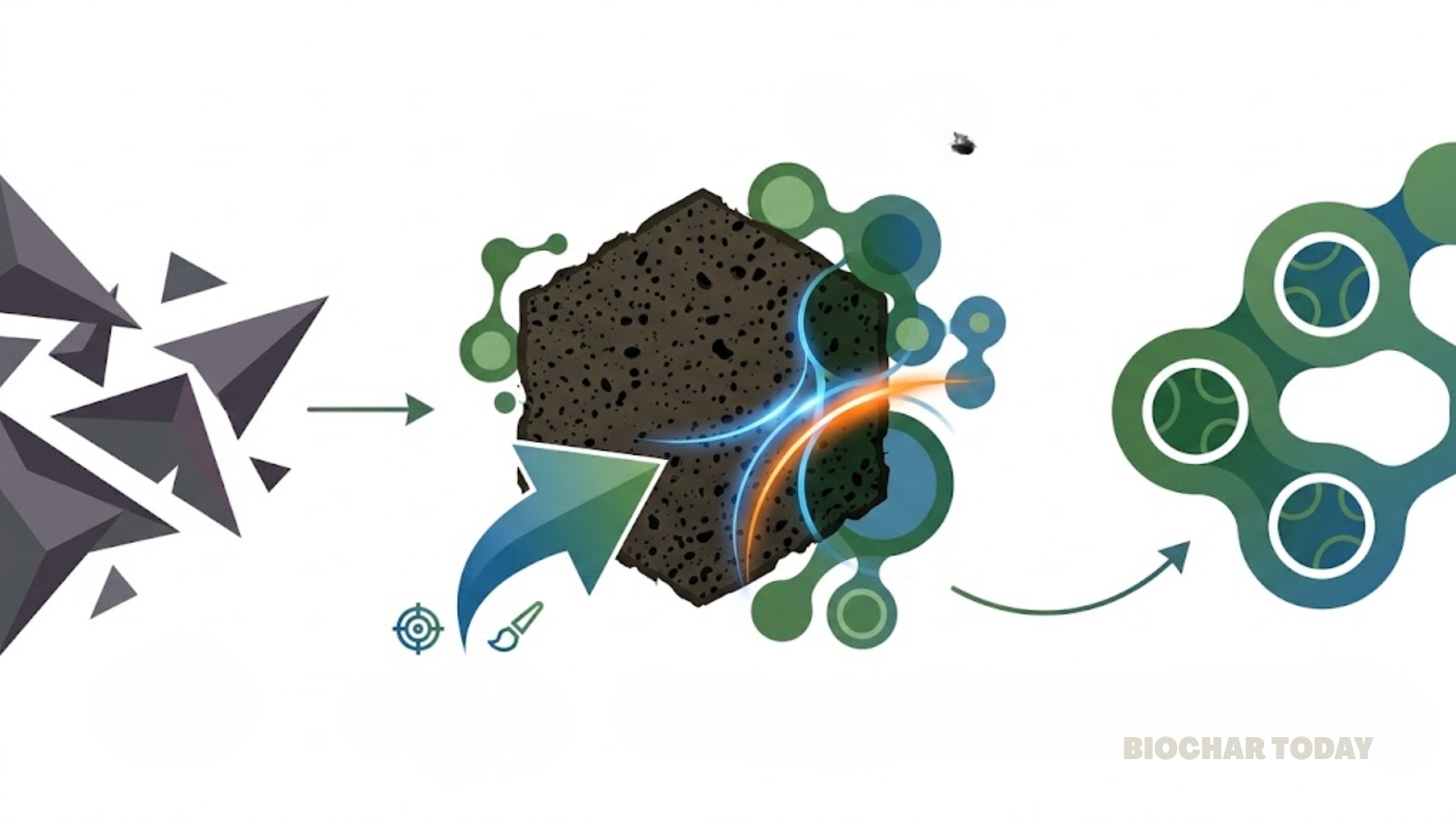
Element doping has emerged as a simple yet effective strategy to functionalize biochar, leading to significant improvements in its structure and properties. This process involves incorporating various elements, which substantially enhances the material’s adsorption capacity, catalytic efficiency, and electrochemical performance. These advancements open doors for its use in environmental remediation, soil enhancement, energy conversion, and even cosmetic applications. The study also introduces a unique “preparation-structure-performance-application” framework, stressing the importance of optimizing doping strategies and element selection to maximize biochar’s versatility.
Two primary methods for element doping are identified: in-situ doping and exogenous doping. In-situ doping, or self-doping, involves directly carbonizing biowaste that naturally contains the desired element. This method facilitates the incorporation of heteroatoms into the biochar matrix, thereby altering its performance, such as specific surface area, functional groups, and active sites. For example, pyrolyzing fish scales, which are naturally rich in nitrogen (N), sulfur (S), and oxygen (O), results in biochar with enriched elemental content. However, a challenge with self-doping is the difficulty in precisely quantifying the type, content, and composition of elements, which can affect reproducibility.
Exogenous doping, on the other hand, involves introducing external dopants to biowastes that have low heteroatom content. This method offers better control and easier quantification of dopant levels compared to in-situ doping. Techniques like chemical vapor deposition (CVD) allow for precise deposition of dopants, offering excellent control over uniformity and concentration. More cost-effective direct contact methods, such as wet impregnation and dry mixing, involve blending biowaste with dopant-containing materials before pyrolysis. For instance, N-doped biochar can be produced by ball milling corn stalk biochar impregnated with urea.
The types of elements used for doping significantly influence biochar’s properties. Nitrogen (N) doping enhances pore structure, specific surface area, catalytic activity, adsorption capacity, energy storage, and electrical conductivity without drastically altering the fundamental structure. Oxygen (O) doping introduces redox-active functional groups like -COOH, -OH, and C=O, which improve reactivity and adsorption capacity for polar pollutants. Sulfur (S) doping can alter the internal structure, potentially reducing pore size but also creating voids that enhance porosityPorosity of biochar is a key factor in its effectiveness as a soil amendment and its ability to retain water and nutrients. Biochar’s porosity is influenced by feedstock type and pyrolysis temperature, and it plays a crucial role in microbial activity and overall soil health. Biochar More and specific surface area. For example, S-doped corn stalk biochar achieved a maximum tetracycline adsorption capacity of 505.68 mg/g. Phosphorus (P) doping, due to its larger atomic size, creates structural defects and additional active sites, optimizing the electronic structure and surface charge distribution. P-doped biochar has shown adsorption capacities over 400 times higher than untreated biochar under simulated flue-gas conditions.
Metal element doping, such as with iron (Fe), cobalt (Co), and nickel (Ni), can significantly alter structural properties, promoting electron transfer rates and forming active substances on the surface. Rare earth elements like lanthanum (La) and cerium (Ce) enhance catalytic properties and adsorption capacity, making them effective for water treatment and nutrient recovery.
Multi-element co-doping is also gaining traction, as combining multiple elements can achieve synergistic effects that surpass the sum of individual components. For example, N-B co-doped biochar reduced the generation of polycyclic aromatic hydrocarbons (PAHs) compared to single-element doping.
Beyond these specific enhancements, element doping has profound impacts on biochar’s surface morphology, pore structure, degree of graphitization, and surface chemical properties. These modifications are crucial for expanding biochar’s applications.
Element-doped biochar is utilized in various fields, including soil improvement, where it can supplement essential nutrients and enhance microbial activity. In carbon sequestration, doping significantly improves carbon stability, with Mg-doped biochar showing the highest carbon sequestration efficiency. P-doped biochar, for instance, demonstrated exceptional thermal stability, with an initial thermal decomposition temperature 100−200∘C higher than untreated biochar. In energy storage, doped biochar enhances specific capacitance, electrical conductivity, and cycling stability for supercapacitors and ion batteries. For example, an N-doped electrode material achieved a specific capacitance of 159 F/g at 1 A/g. Emerging applications include cosmetics, where zinc-doped biochar can adsorb oils and inhibit melanin production, and bio-composites, where N-doped biochar improves mechanical strength and durability.
The continuous advancements in element-doped biochar highlight its role as a versatile and sustainable material poised to address global environmental and energy challenges. Future research aims to develop more efficient, stable, and eco-friendly doping methods, optimize multi-element structures, and explore synergistic mechanisms for even broader applications.
Source: Zhao, J., Jiang, Y., Chen, X., Wang, C., & Nan, H. (2025). Unlocking the potential of element-doped biochar: from tailored synthesis to multifunctional applications in environment and energy. Biochar, 7(1), 77.



Leave a Reply