
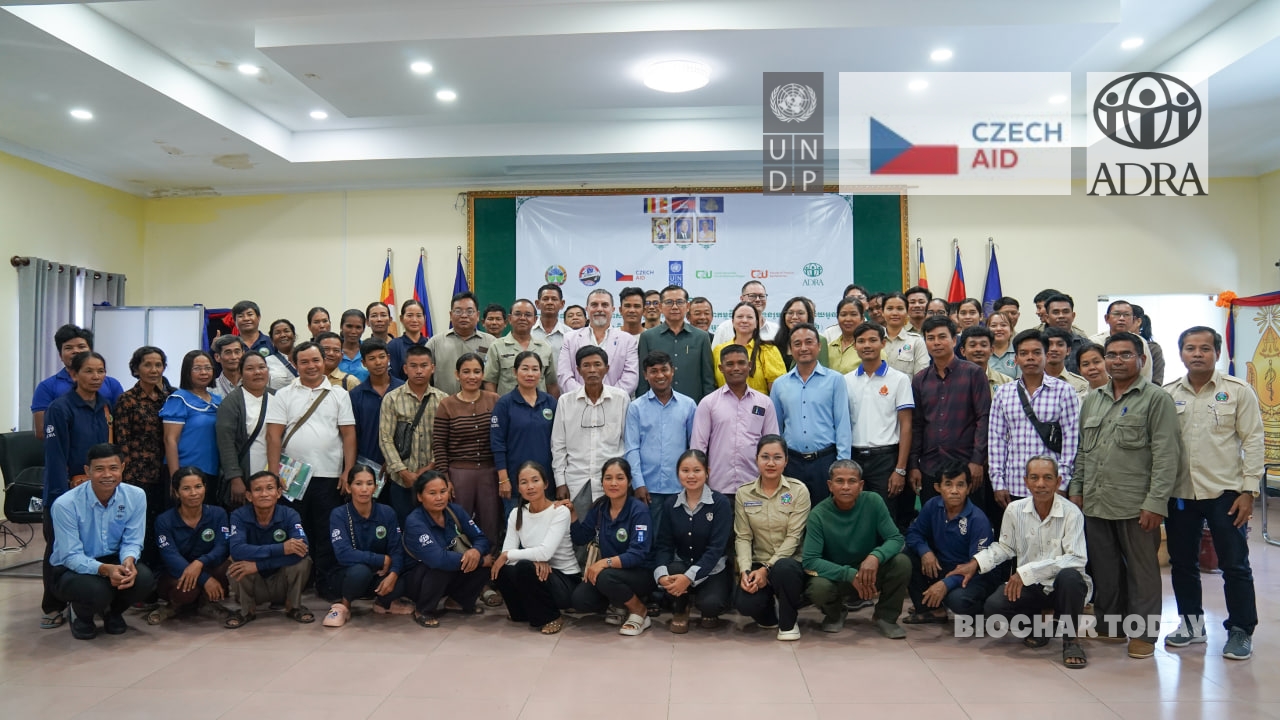
The United Nations Development Programme (UNDP), in collaboration with the Adventist Development and Relief Agency (ADRA) and the Czech University of Life Sciences Prague (CZU), has successfully concluded the V-BIOCHAR project in Pursat province, Cambodia. This 12-month initiative focused on integrating biocharBiochar is a carbon-rich material created from biomass decomposition in low-oxygen conditions. It has important applications in environmental remediation, soil improvement, agriculture, carbon sequestration, energy storage, and sustainable materials, promoting efficiency and reducing waste in various contexts while addressing climate change challenges. More and vermicompost to restore soil fertility and enhance climate resilience among smallholder farmers. By utilizing local agricultural residues such as rice husks and coconut shells, the project established ten demonstration sites and trained hundreds of farmers in sustainable soil management. The official handover in February 2026 marked a transition toward local ownership, with nearly 20 mentor farmers and 12 young entrepreneurs now leading biochar ventures in the region.
The primary challenge addressed by the consortium is Cambodia’s heavy reliance on imported chemical fertilizers, which exceeded 1.4 million tons in a single year. This dependency has led to significant soil degradation and high operational costs for rural smallholders, who often struggle with low crop yields. Furthermore, massive quantities of biomassBiomass is a complex biological organic or non-organic solid product derived from living or recently living organism and available naturally. Various types of wastes such as animal manure, waste paper, sludge and many industrial wastes are also treated as biomass because like natural biomass these More waste are typically burned or left unused, contributing to localized air pollution and greenhouse gas emissions. The project sought to break this cycle by introducing low-cost, decentralized technology that could transform waste streams into valuable agricultural inputs, thereby reducing the financial and environmental burden on local communities.
To resolve these issues, the partners implemented a comprehensive “V-BIOCHAR” strategy centered on pyrolysisPyrolysis is a thermochemical process that converts waste biomass into bio-char, bio-oil, and pyro-gas. It offers significant advantages in waste valorization, turning low-value materials into economically valuable resources. Its versatility allows for tailored products based on operational conditions, presenting itself as a cost-effective and efficient More technology and the creation of a circular bioeconomy. Experts from the Czech University of Life Sciences provided the scientific guidance to develop simple, replicable kilns made from local materials. These units convert crop residues into biochar, which is then blended with nutrient-rich vermicompost to create a high-performance soil enhancer. ADRA Cambodia managed the ground-level implementation, establishing eight demonstration kilns and facilitating study tours to ensure that women and youth leaders gained the technical and business skills necessary to scale the production of this blended fertilizer.
The outcomes of the project demonstrate significant economic and ecological benefits for the participating farmers in Pursat. Trials involving vegetable producers showed a 24 percent increase in crop yields and a 35 percent rise in total income. Crucially, the use of the biochar-vermicompost blend allowed farmers to reduce their chemical fertilizer expenditures by 74 percent. Beyond the financial gains, the initiative produced over 23 tons of biochar through its various demonstration and business sites. These results highlight a scalable model for climate-smart agriculture that simultaneously improves food security, restores soil health, and creates new livelihood opportunities through waste valorization.



Leave a Reply