
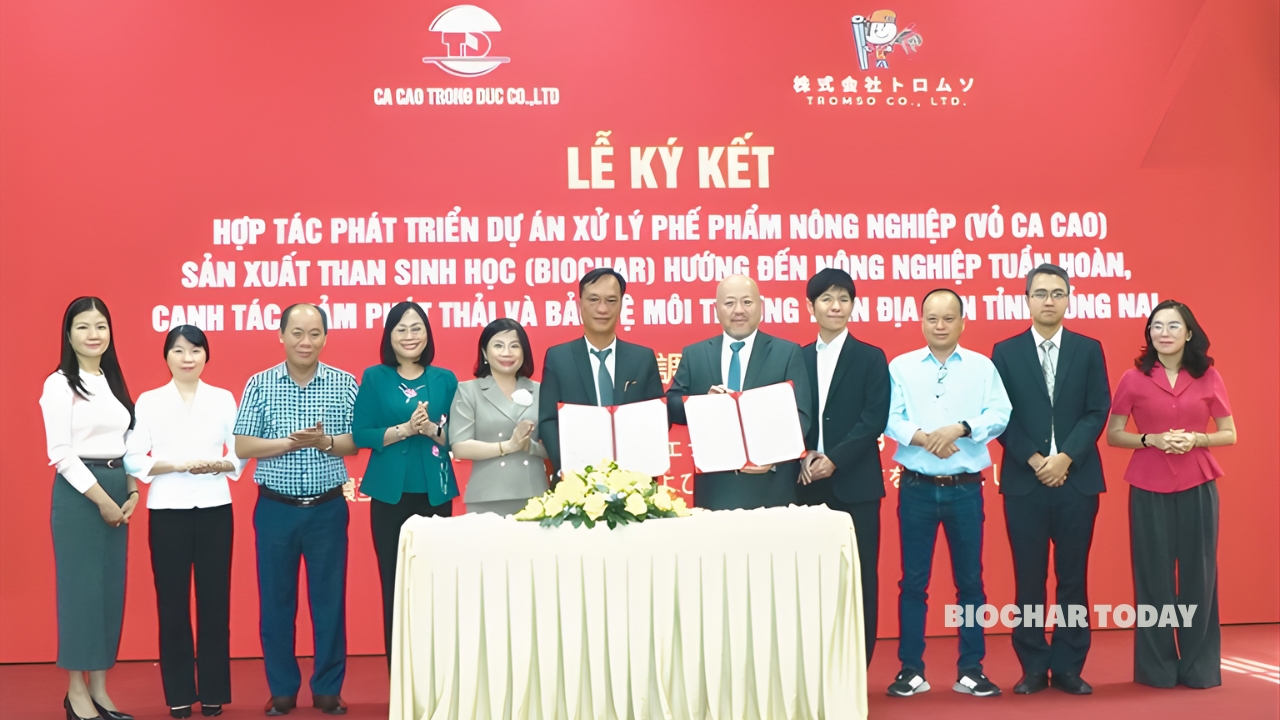
A significant partnership has been established in Vietnam’s Đồng Nai province to convert agricultural waste into high-value resources. The Đồng Nai Department of Agriculture and Environment recently facilitated a cooperation agreement between Japanese firm Tromso Joint Stock Company and local manufacturer Trọng Đức Cacao Company Limited. The collaboration focuses on utilizing Tromso’s specialized carbonization technology to process cocoa husks into biocharBiochar is a carbon-rich material created from biomass decomposition in low-oxygen conditions. It has important applications in environmental remediation, soil improvement, agriculture, carbon sequestration, energy storage, and sustainable materials, promoting efficiency and reducing waste in various contexts while addressing climate change challenges. More. This initiative is designed to support the province’s transition toward a circular economy by integrating waste management with sustainable agricultural practices.
The primary challenge addressed by this project is the environmental burden posed by the massive volume of cocoa processing by-products. Trọng Đức Cacao currently generates over 6,000 tonnes of cocoa husks annually, a figure projected to climb to 10,000 tonnes by 2030 as cultivation areas expand. Traditionally, these husks are discarded or left to decompose, leading to significant waste management hurdles and environmental degradation. For a major industrial and agricultural hub like Đồng Nai, finding an efficient way to handle this biomassBiomass is a complex biological organic or non-organic solid product derived from living or recently living organism and available naturally. Various types of wastes such as animal manure, waste paper, sludge and many industrial wastes are also treated as biomass because like natural biomass these More without increasing greenhouse gas emissions or polluting local land is a critical priority for long-term growth.
To solve this, Tromso and Trọng Đức Cacao are implementing a circular production model that utilizes thermal gasificationGasification is a high-temperature, thermochemical process that converts carbon-based materials into a gaseous fuel called syngas and solid by-products. It takes place in an oxygen-deficient environment at temperatures typically above 750°C. Unlike combustion, which fully burns material to produce heat and carbon dioxide (CO2), gasification More technology. The solution involves shredding and drying the husks before processing them in a gasifier at temperatures reaching up to 770°C. This process effectively converts the biomass into high-quality biochar while capturing the resulting clean heat. A key technical innovation in this model is the dual-use of energy; the heat generated during the biochar production is redirected to dry the cocoa beans, significantly reducing the facility’s reliance on external energy sources and lowering operational costs.
The outcomes of this partnership provide a blueprint for regenerative farming in Southeast Asia. By applying biochar back to the soil, local farmers can improve soil structure and moisture retention, leading to higher cocoa yields and improved crop quality. This systematic reuse of waste not only increases the economic value for Trọng Đức Cacao and its network of farmers but also supports Vietnam’s broader goal of low-emission agriculture. Furthermore, the project strengthens the international cooperation between Vietnamese agricultural enterprises and Japanese technology providers, establishing a scalable model for other biomass-heavy industries in the region.


Leave a Reply