
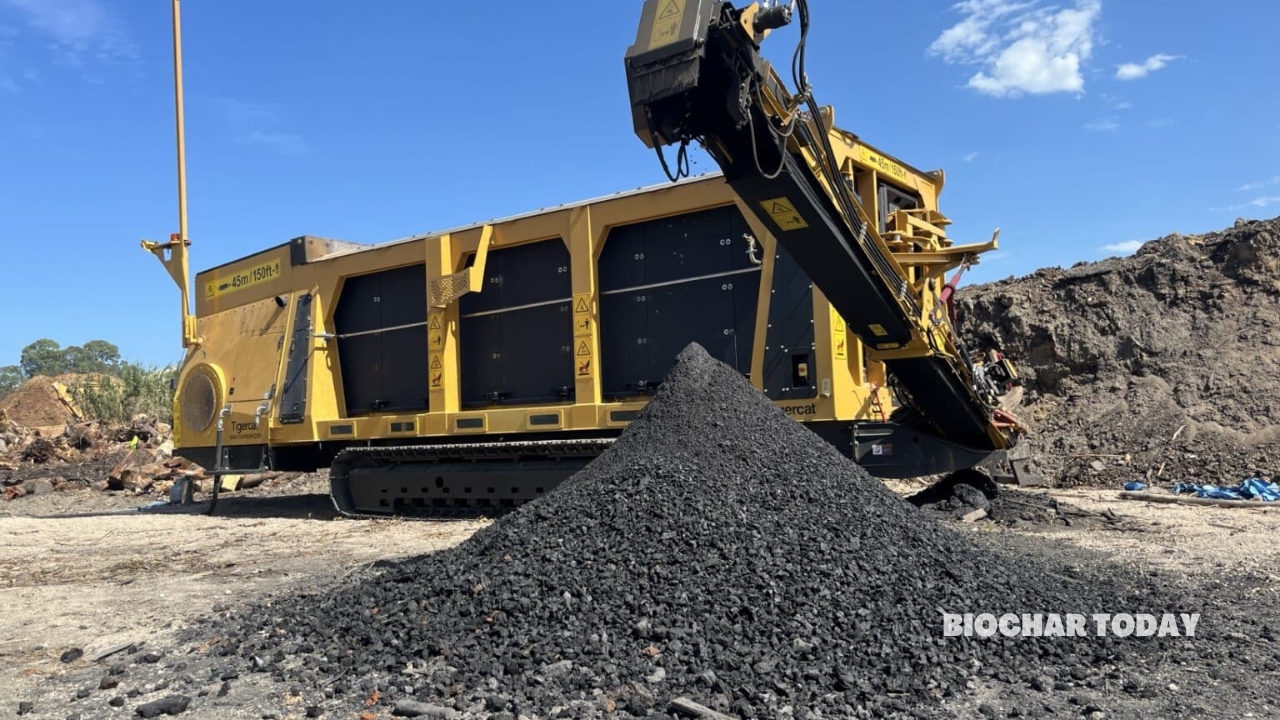
In Australia, the introduction of the Tigercat Industries 6040 Carbonizer, distributed by Onetrak, represents a significant development in the management of organic debris. This mobile wood conversion system is engineered to transform woody biomass—including logging residue and land-clearing waste—into high-quality biocharBiochar is a carbon-rich material created from biomass decomposition in low-oxygen conditions. It has important applications in environmental remediation, soil improvement, agriculture, carbon sequestration, energy storage, and sustainable materials, promoting efficiency and reducing waste in various contexts while addressing climate change challenges. More directly on-site. By providing a technological alternative to traditional disposal methods, the machine serves the forestry and agricultural sectors while aligning with modern environmental standards for carbon sequestration.
The primary challenge addressed by this technology is the inefficient and environmentally hazardous disposal of large volumes of wood waste. Historically, land-clearing and forestry operations have relied on open-air burning, which releases significant particulate matter and greenhouse gases into the atmosphere without capturing any carbon value. Furthermore, the sheer physical bulk of debris creates logistical burdens, necessitating expensive transportation and handling to move material to processing facilities or landfills.
Tigercat’s solution involves a sophisticated on-site carbonization process that utilizes thermal precision and controlled combustion. The 6040 Carbonizer employs a dual airflow system: an under-air supply creates upward pressure while an over-air supply generates a turbulent vortex. This configuration ensures that released gases are held at temperatures reaching 1,095°C, facilitating thorough combustion and minimizing emissions. The resulting carbon drops into a sealed quenching water bath for stabilization before being discharged via an adjustable conveyor. This mobile unit also features a modular design for easier maintenance in remote locations.
The outcomes of implementing the 6040 Carbonizer include a 90 percent reduction in material volume, which drastically lowers transportation costs and site footprints. Environmentally, the system sequesters between 20 and 30 percent of the feedstock’s carbon, preventing it from entering the atmosphere as carbon dioxide. Operationally, the machine’s reduced weight and extended track frames minimize soil compaction on sensitive sites. Ultimately, the process converts a waste liability into a commercial asset, producing stable organic carbon suitable for soil amendmentA soil amendment is any material added to the soil to enhance its physical or chemical properties, improving its suitability for plant growth. Biochar is considered a soil amendment as it can improve soil structure, water retention, nutrient availability, and microbial activity. More and various industrial applications.




Leave a Reply