
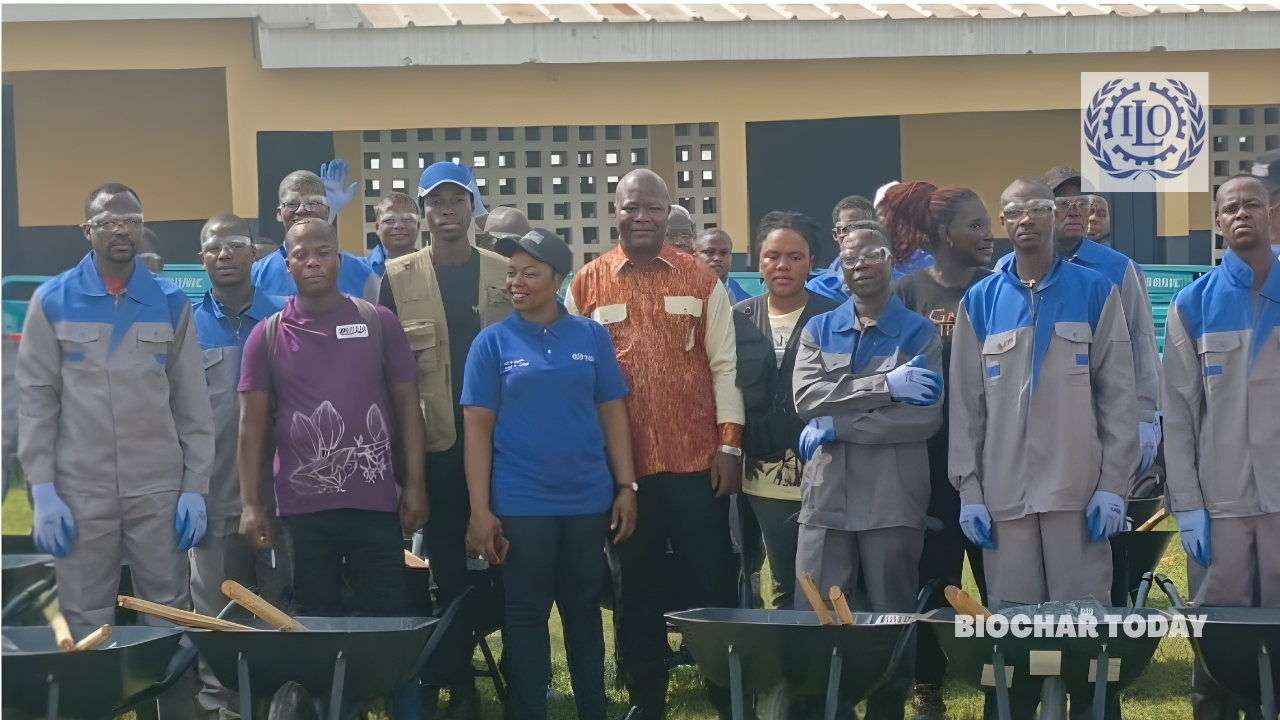
The International Labor Office (ILO), through the ENACTE project, has initiated a series of technical training sessions for cocoa farmers in the Nawa region of Côte d’Ivoire. This program, launched in late January 2026, focuses on the production of biocharBiochar is a carbon-rich material created from biomass decomposition in low-oxygen conditions. It has important applications in environmental remediation, soil improvement, agriculture, carbon sequestration, energy storage, and sustainable materials, promoting efficiency and reducing waste in various contexts while addressing climate change challenges. More from agricultural residues, specifically cocoa pods. By integrating the Yanayi Project for technical oversight and purchasing logistics, the initiative seeks to establish a sustainable secondary industry for farming households in Méagui and Soubré. This effort follows a 2023 value chain analysis that identified the transformation of organic waste into biochar as a viable economic activity compatible with existing cocoa cultivation.
The primary challenge addressed by this initiative is the high level of economic vulnerability among agricultural households, which often serves as a primary driver for child labor. In Côte d’Ivoire, cocoa farmers frequently rely on a single income stream, making them susceptible to market fluctuations and environmental shocks. Furthermore, the accumulation of cocoa pod husks creates a management issue for agricultural waste, which typically remains underutilized. Addressing these economic and environmental pressures requires a systematic approach to income diversification that does not interfere with primary crop production.
In response, the ENACTE project and the Yanayi Project have implemented a dual-phase training curriculum consisting of theoretical instruction and practical exercises. Farmers from 11 local cooperatives are being equipped with specialized production kits that include carbonizers and personal protective equipment. The Yanayi Project facilitates the technical transition by training producers to convert non-wood organic matter into biochar. Crucially, the organization also manages a buy-back system, purchasing the raw biochar from farmers to supply its own processing units, thereby ensuring an immediate and reliable market for the producers.
The outcomes of this project include the training of 107 producers across the Méagui and Soubré regions, directly enhancing their technical skill sets and economic resilience. By converting waste into a marketable commodity, farmers can now generate supplementary revenue while simultaneously producing a soil amendmentA soil amendment is any material added to the soil to enhance its physical or chemical properties, improving its suitability for plant growth. Biochar is considered a soil amendment as it can improve soil structure, water retention, nutrient availability, and microbial activity. More to restore degraded land or a sustainable cooking fuel. This structural change in the local economy is intended to reduce household dependence on cocoa alone, thereby mitigating the financial pressures that lead to child labor. The collaboration establishes a circular economy model that provides both environmental benefits and increased financial stability for Ivorian farming communities.


Leave a Reply