
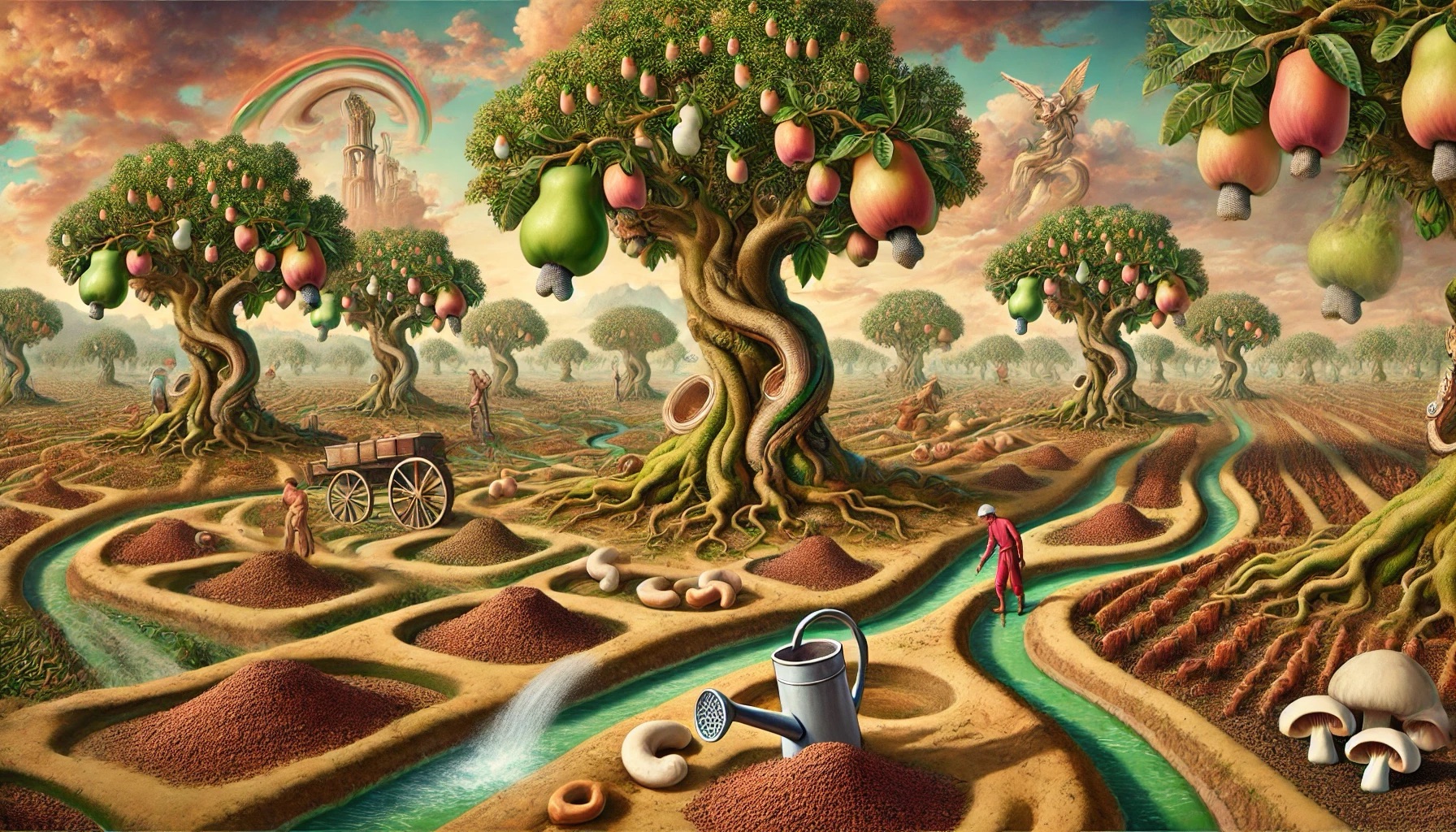
Gondim, et al (2024) Cashew Clones Water Productivity and Production Responses to Different BiocharBiochar is a carbon-rich material created from biomass decomposition in low-oxygen conditions. It has important applications in environmental remediation, soil improvement, agriculture, carbon sequestration, energy storage, and sustainable materials, promoting efficiency and reducing waste in various contexts while addressing climate change challenges. More Levels. AgriEngineering. https://doi.org/10.3390/agriengineering6040215
This study evaluates the impact of biochar application on water productivity, yield, and fruit quality in cashew orchards, specifically comparing two dwarf cashew clones, ‘BRS 226’ and ‘CCP 76’. Biochar, derived from mixed hardwood, was applied at four different rates (0, 1.0, 2.0, and 4.0 kg per plant) to assess its influence on crop performance under irrigation.
The results revealed that biochar improved water productivity, particularly for the ‘BRS 226’ clone. This clone saw enhancements in the individual weight of cashew apples and increased soluble solids, a key indicator of fruit sweetness. The optimal biochar application rates for maximizing water productivity and cashew apple quality varied by clone, with 1.7 kg per plant being the most effective for cashew nuts and 2.1 kg for cashew apples.
However, the study also found that biochar had different effects depending on the cashew variety. While ‘BRS 226’ benefited from biochar in terms of fruit quality and water efficiency, ‘CCP 76’ showed no significant improvements in yield or fruit firmness. This suggests that biochar is more beneficial for drought-tolerant varieties like ‘BRS 226’ and less effective for others like ‘CCP 76’.
In conclusion, biochar can significantly enhance water productivity and fruit quality in cashew orchards, particularly for drought-tolerant clones, offering a sustainable solution for improving cashew production in semi-arid regions.


Leave a Reply