
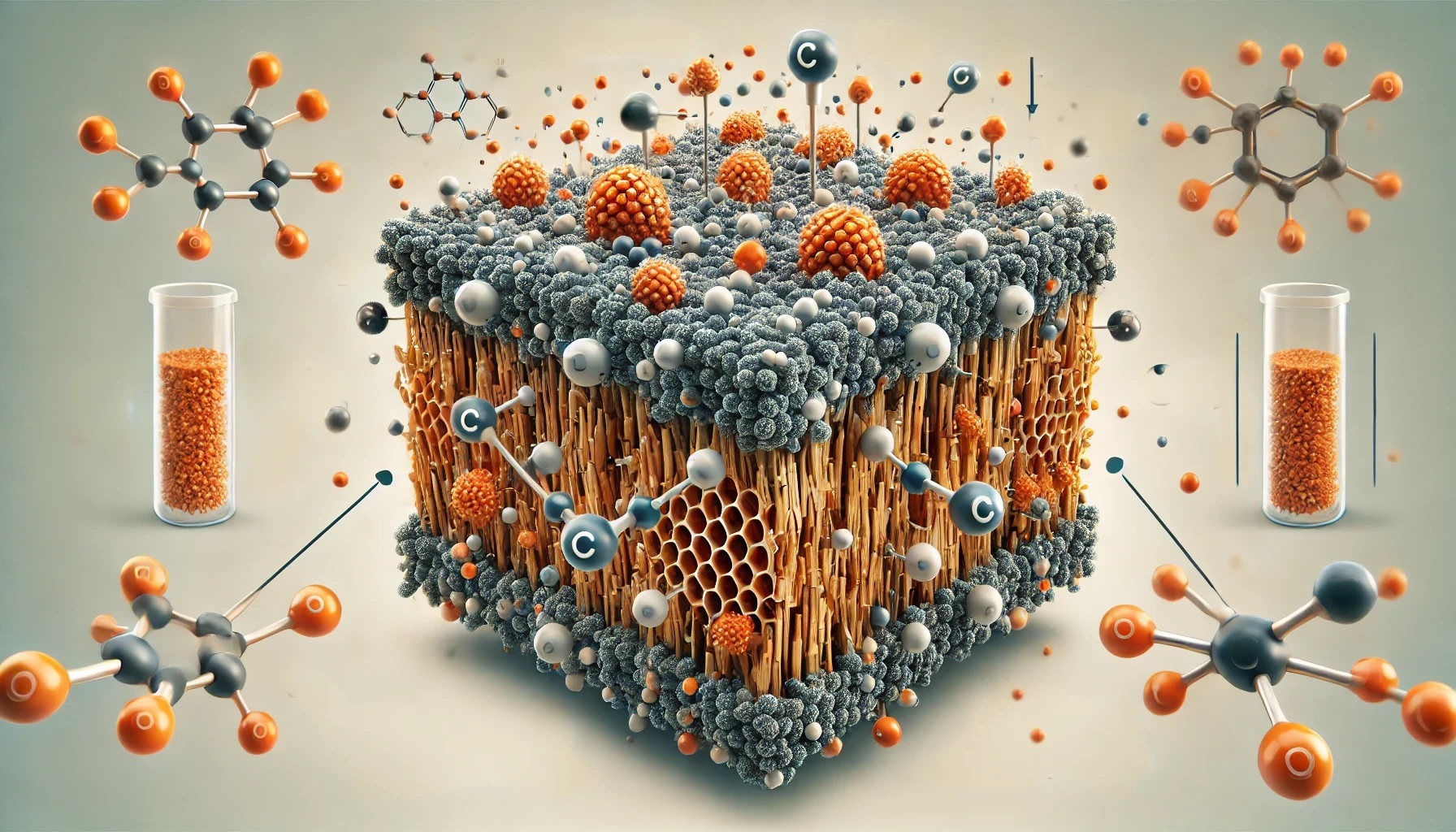

The quest for sustainable and efficient carbon dioxide (CO2) reduction technologies has led researchers to explore innovative materials and methods. One promising approach involves using biochar-Cu-based catalysts, which combine the natural benefits of biocharBiochar is a carbon-rich material created from biomass decomposition in low-oxygen conditions. It has important applications in environmental remediation, soil improvement, agriculture, carbon sequestration, energy storage, and sustainable materials, promoting efficiency and reducing waste in various contexts while addressing climate change challenges. More with the catalytic properties of copper (Cu). This synergy not only enhances the electrochemical reduction of CO2 but also aligns with global carbon reduction goals.
Biochar, a carbon-rich material derived from biomassBiomass is a complex biological organic or non-organic solid product derived from living or recently living organism and available naturally. Various types of wastes such as animal manure, waste paper, sludge and many industrial wastes are also treated as biomass because like natural biomass these More, possesses unique properties such as high specific surface area, rich pore structure, and the ability to support various catalytic elements. These characteristics make biochar an excellent candidate for catalyst support. When combined with copper, a metal known for its moderate CO2 binding energy, the resulting biochar-Cu-based catalysts exhibit improved catalytic performance for CO2 reduction.
In this study, three different biochar-Cu-based catalysts were synthesized using rice husk biochar as the base material. The rice husk was chosen due to its widespread availability, low cost, and self-templating properties that facilitate the creation of a hierarchical pore structure. The synthesis process involved the impregnation of Cu onto the biochar, followed by pyrolysisPyrolysis is a thermochemical process that converts waste biomass into bio-char, bio-oil, and pyro-gas. It offers significant advantages in waste valorization, turning low-value materials into economically valuable resources. Its versatility allows for tailored products based on operational conditions, presenting itself as a cost-effective and efficient More and calcination.
The performance of these catalysts was tested in a flow cell setup using a 0.5 M KHCO3 electrolyte. The results demonstrated that the specific surface area, pore size, and Cu particle size significantly influence the catalytic efficiency. For instance, the catalyst named char-Cu-700, with a Cu particle size of about 20 nm, showed a current density that was 2.08 times higher than that of the basic char-Cu catalyst and 1.45 times higher than char-Cu-N at a reduction potential of -0.45 V vs. RHE. This indicates that smaller Cu particle sizes enhance the reactivity of the catalyst due to lower average coordination of surface atoms.
The study also explored the role of nitrogen doping in biochar, which can further enhance the catalyst’s performance. Nitrogen-doped biochar introduces functional groups that increase conductivity and provide additional active sites for CO2 reduction. For example, the char-Cu-N catalyst, despite having a lower specific surface area than char-Cu, showed a higher current density due to the presence of nitrogen-containing functional groups and highly conductive Cu.
Moreover, the research highlighted the importance of optimizing the structural properties of biochar to maximize its catalytic potential. The adjustable pore structure of biochar allows for tailored catalyst designs that can accommodate different reaction environments and improve overall efficiency. This adaptability is crucial for developing high-performance catalysts that can operate effectively in real-world applications.
The findings of this study offer valuable insights into the design and application of biochar-Cu-based catalysts for electrochemical CO2 reduction. By leveraging the natural advantages of biochar and enhancing it with copper and nitrogen doping, researchers can create efficient, sustainable, and cost-effective catalysts. These advancements contribute to the broader goal of achieving net-zero emissions and addressing the global challenge of climate change.
Overall, the integration of biochar and Cu in catalyst development represents a significant step forward in the field of carbon capture and utilization. As research continues to refine these materials and methods, the potential for scalable and impactful solutions to CO2 reduction becomes increasingly viable. This study not only provides a theoretical foundation for future research but also underscores the practical benefits of using biochar-Cu-based catalysts in the pursuit of a more sustainable future.





Leave a Reply