
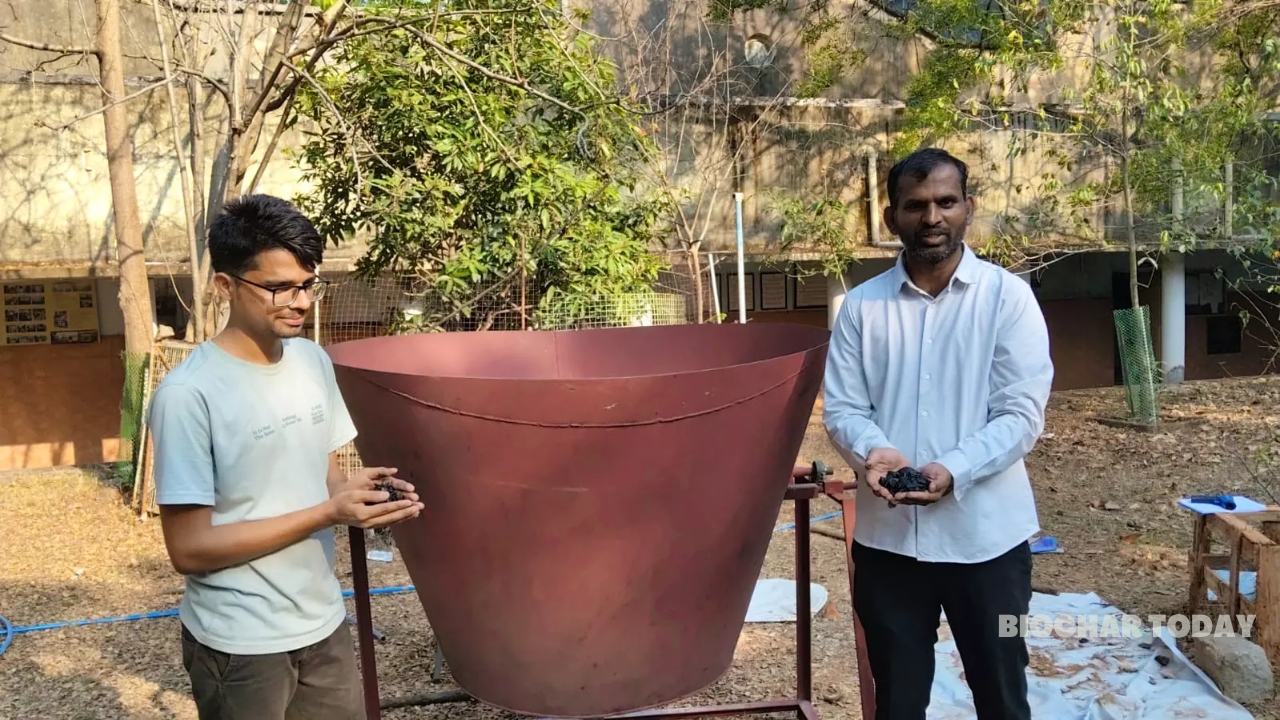
Researchers at Osmania University in India, supported by the Department of Science and Technology (DST), have successfully demonstrated the conversion of coconut shell waste into high-quality biocharBiochar is a carbon-rich material created from biomass decomposition in low-oxygen conditions. It has important applications in environmental remediation, soil improvement, agriculture, carbon sequestration, energy storage, and sustainable materials, promoting efficiency and reducing waste in various contexts while addressing climate change challenges. More. Led by Professor V.B. Chauhan and his team from the Department of Botany, the project focuses on utilizing locally abundant agricultural residues to improve soil health. The study, conducted under the “Waste to Wealth” initiative, illustrates a circular economy model where discarded biomassBiomass is a complex biological organic or non-organic solid product derived from living or recently living organism and available naturally. Various types of wastes such as animal manure, waste paper, sludge and many industrial wastes are also treated as biomass because like natural biomass these More is repurposed into a valuable soil amendmentA soil amendment is any material added to the soil to enhance its physical or chemical properties, improving its suitability for plant growth. Biochar is considered a soil amendment as it can improve soil structure, water retention, nutrient availability, and microbial activity. More. By systematically testing the application of this biochar on various vegetable crops, the university has provided empirical evidence for the viability of small-scale, decentralized biochar production in South Asia.
The primary challenge addressed by this initiative is the dual burden of agricultural waste management and declining soil fertility in India. In many tropical regions, the rapid depletion of soil organic matter leads to reduced water retention and poor nutrient uptake, forcing farmers to rely heavily on chemical fertilizers. Simultaneously, the coconut industry generates significant quantities of hard shells that are often burned in the open or left to decompose slowly in landfills, contributing to environmental pollution and greenhouse gas emissions. The research team identified a critical need for an affordable, accessible method to sequester carbon while simultaneously restoring the physical and chemical properties of the soil.
To address these issues, Osmania University implemented a thermochemical conversion process to transform coconut shells into biochar. The team utilized a specialized kiln to ensure controlled pyrolysisPyrolysis is a thermochemical process that converts waste biomass into bio-char, bio-oil, and pyro-gas. It offers significant advantages in waste valorization, turning low-value materials into economically valuable resources. Its versatility allows for tailored products based on operational conditions, presenting itself as a cost-effective and efficient More, optimizing the carbon content and porosityPorosity of biochar is a key factor in its effectiveness as a soil amendment and its ability to retain water and nutrients. Biochar’s porosity is influenced by feedstock type and pyrolysis temperature, and it plays a crucial role in microbial activity and overall soil health. Biochar More of the resulting material. The solution involved applying specific dosages of the coconut shell biochar to trial plots of tomato, chili, and leafy green vegetables. This localized production model emphasizes the use of existing waste streams, reducing the logistical costs associated with commercial soil conditioners. By tailoring the application rates to the specific needs of the local soil profile, the researchers developed a scalable protocol for smallholder farmers to integrate biochar into their existing horticultural practices.
The outcomes of the project indicate a substantial improvement in both soil structure and agricultural productivity. Trials showed that the application of coconut shell biochar resulted in a 20% to 25% increase in crop yields compared to control groups using traditional methods. Analysis of the soil revealed enhanced moisture retention and a more robust microbial ecosystem, which contributed to healthier plant growth and reduced water requirements. Furthermore, the project demonstrates a successful framework for carbon sequestration at the community level. Based on these results, Osmania University intends to expand its outreach programs to train local farmers in biochar production, potentially transforming regional waste management into a source of economic and environmental resilience.


Leave a Reply