
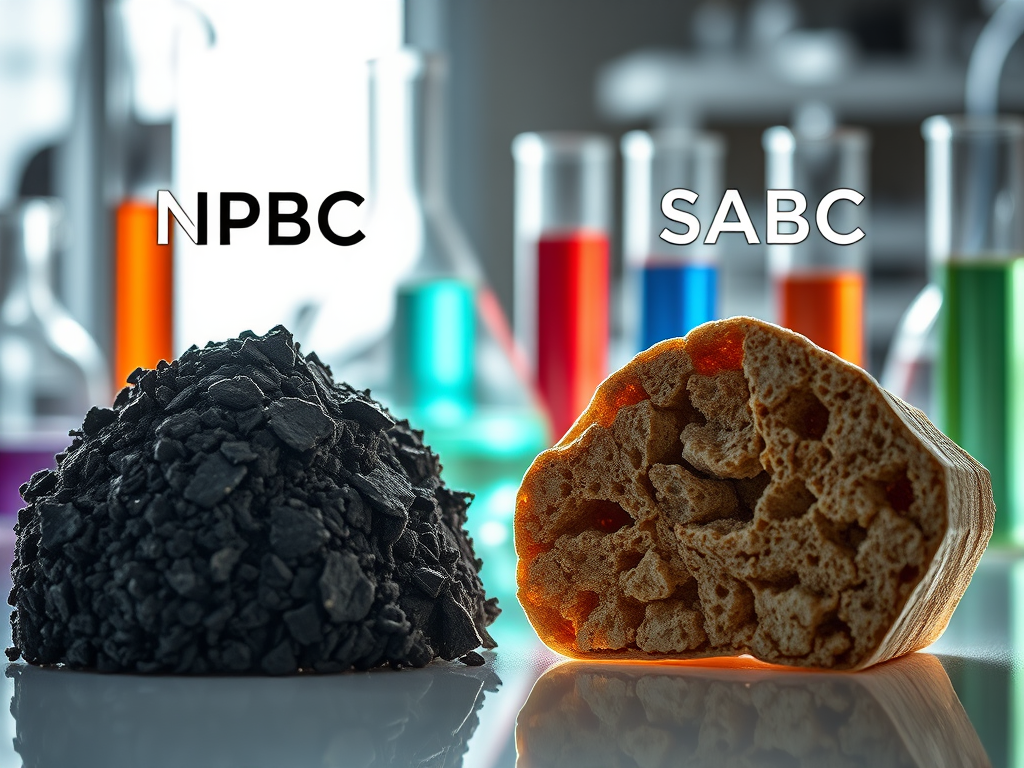
Saha et al., in their research published in Discover Applied Sciences, investigated the use of biocharBiochar is a carbon-rich material created from biomass decomposition in low-oxygen conditions. It has important applications in environmental remediation, soil improvement, agriculture, carbon sequestration, energy storage, and sustainable materials, promoting efficiency and reducing waste in various contexts while addressing climate change challenges. More derived from agricultural waste (wheat straw) for removing lead (Pb) and cadmium (Cd) from wastewater. The researchers synthesized two types of biochar: nitrogen-purged biochar (NPBC) and steam-activated biochar (SABC). They then compared the adsorption capacities of these biochars for Pb(II) and Cd(II) ions.
The study found that SABC, with its higher specific surface area and more porous structure, exhibited better adsorption capacity than NPBC. SABC showed 97% and 80% removal efficiency for Pb(II) and Cd(II), respectively, compared to NPBC’s 87.6% and 69.4% removal efficiency for the same metals. The adsorption process was spontaneous and exothermic for both biochars, with maximum adsorption capacities (qmax) of 452.13 mg/g for NPBC and 1117 mg/g for SABC for Pb(II), and 314.9 mg/g for NPBC and 470.43 mg/g for SABC for Cd(II).
This research highlights the potential of biochar as a sustainable and cost-effective adsorbent for heavy metal removal from wastewater. The study also demonstrates the importance of activation methods in enhancing the adsorption capacity of biochar.
Source: Saha, M., Biswas, P. K., Saha, J. K., Sarkar, A., Mandal, S., Yadav, D. K., Lenka, S., Coumar, M. V., & Basak, B. B. (2025). Synthesis of nitrogen-purged biochar and modification with hydrothermal activation: comparative assessment as adsorbents for effective elimination of Pb(II) and Cd(II) from wastewater. Discover Applied Sciences, 7(1), 144.https://doi.org/10.1007/s42452-025-06589-y



Leave a Reply