
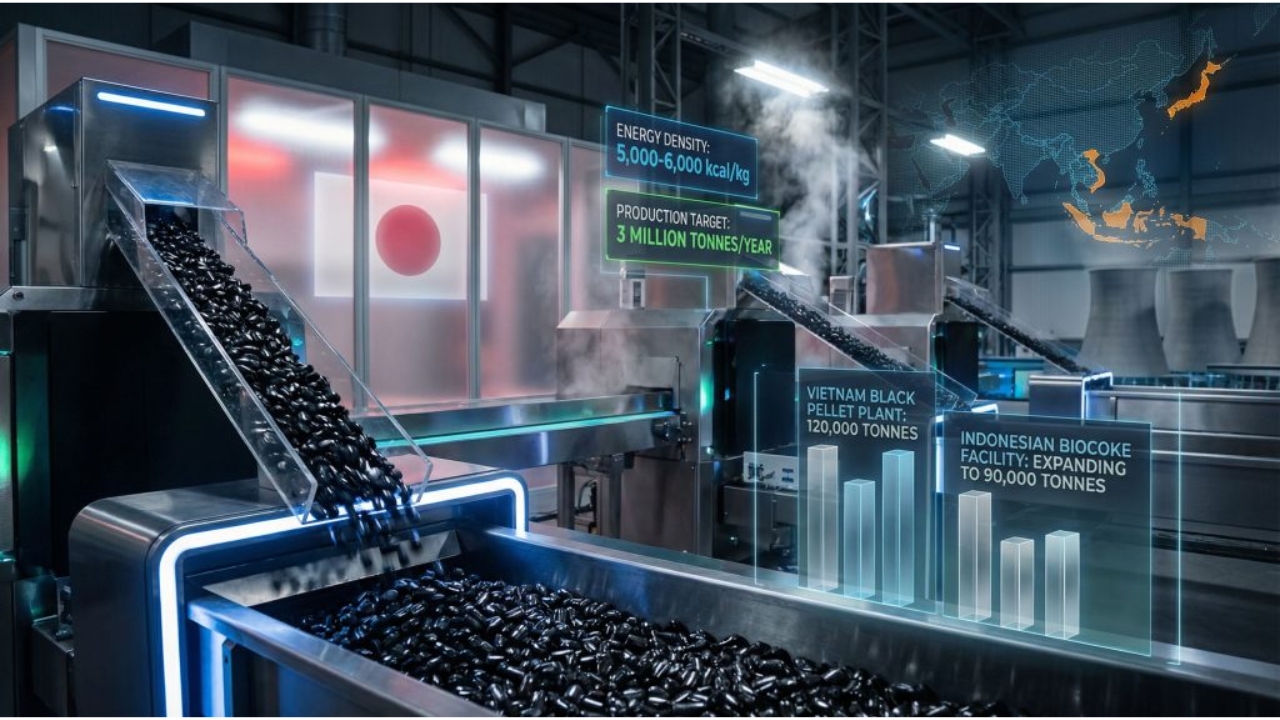
Japan is initiating a strategic expansion of biocarbon utilization to meet a 3 million tonne annual consumption target by 2030. This initiative focuses on the integration of biocarbon—specifically black pellets and biocoke—into thermal power generation and heavy industrial manufacturing. The effort is catalyzed by the upcoming implementation of a mandatory emissions trading system in April 2026, which creates financial incentives for decarbonization. Production is scaling both domestically and internationally, with a significant biocoke facility in Ehime Prefecture scheduled for completion in late 2026 to complement existing supply chains from Vietnam.
The primary challenge addressed by this initiative is the technical and economic difficulty of decarbonizing high-heat industrial sectors like steel and power generation without replacing existing infrastructure. Conventional wood pellets often lack the energy density required for direct coal substitution, leading to operational inefficiencies or the need for costly facility modifications. Furthermore, the volatility of international carbon markets and the necessity for stable, large-scale fuel supplies present significant risks for Japanese utilities and manufacturers seeking to comply with new emission mandates while maintaining grid and production reliability.
The proposed solution involves the deployment of high-performance biocarbon products, such as black pellets with calorific values reaching 5,000–6,000 kcal/kg. These materials provide a coal-equivalent energy density that allows for direct substitution in existing infrastructure. Japanese utilities are adopting a phased approach to co-firing, focusing on substitution rates of 10–20% to manage operational risks, despite laboratory validation supporting ratios up to 35%. Additionally, the development of biocoke—a high-density carbon-neutral fuel—provides a viable alternative for the steel, automotive, and machinery sectors, with commercial sales structures already being established for 2026.
As these biocarbon strategies reach commercial maturity, Japan expects a significant reduction in industrial carbon footprints and improved regulatory compliance for sectors under the 2026 emissions trading mandate. Domestic production capacity is projected to reach 165,000 tonnes annually following the completion of the Ehime facility, reducing import dependency. By establishing a robust supply chain and achieving the 3 million tonne target, the initiative positions Japan as a leader in sustainable thermal fuel adoption, providing a scalable model for industrial decarbonization that leverages existing technological assets.




Leave a Reply