
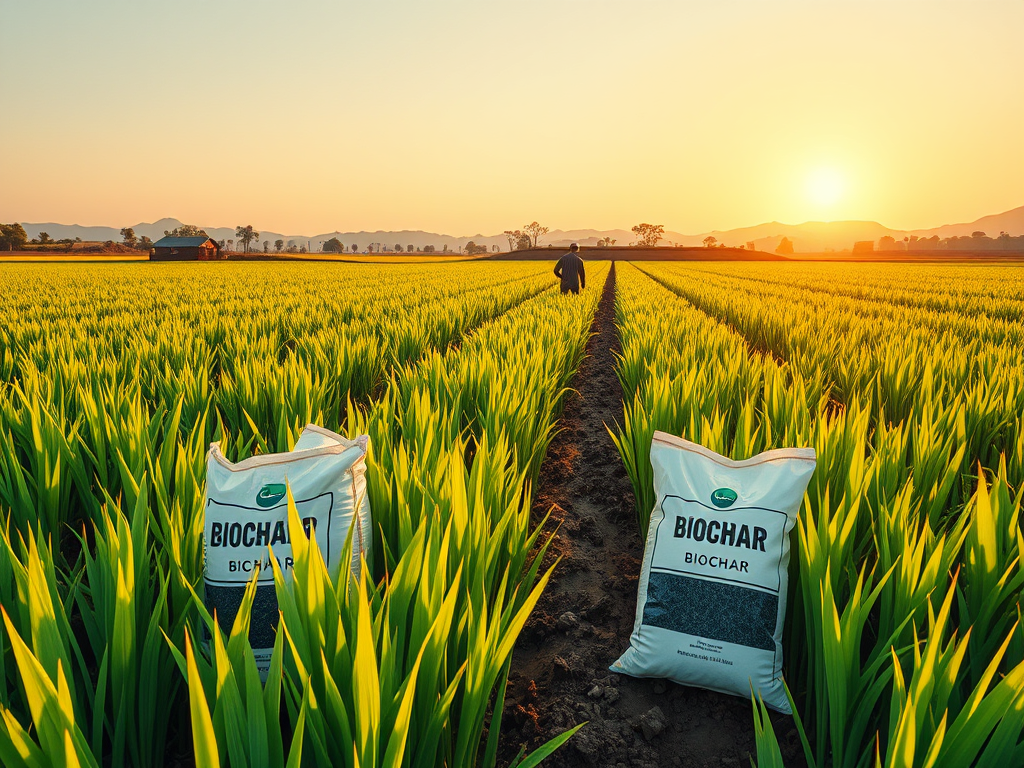
In a recent study published in Advanced Sustainable Systems, José Lugo-Arias, Jose Villa-Parejo, Guido Escorcia, Julia González-Álvarez, Aymer Maturana, Sonia Aguirre-Forero, Nelson Piraneque-Gambasica, and Carlos Barraza-Heras explored the environmental impacts of producing and applying magnesium-impregnated biocharBiochar is a carbon-rich material created from biomass decomposition in low-oxygen conditions. It has important applications in environmental remediation, soil improvement, agriculture, carbon sequestration, energy storage, and sustainable materials, promoting efficiency and reducing waste in various contexts while addressing climate change challenges. More (RHB-Mg) in rice cultivation. Their life cycle assessment (LCA) provides valuable insights into how this innovative approach compares to traditional rice husk incineration for energy generation.
Rice, a staple food for nearly half the world’s population, presents a significant environmental challenge due to its byproducts. Rice husks, accounting for about 20% of total rice production weight, are often mismanaged through unsustainable practices like uncontrolled burning, which harms the environment. While direct combustion of rice husks for energy is a common waste management method, offering benefits like zero net carbon dioxide emissions during combustion and lower hazardous emissions compared to fossil fuels, it still carries environmental costs. This study investigates an alternative: transforming rice husks into biochar.
Biochar holds promise for improving soil properties, sequestering carbon, and recovering essential nutrients from wastewater. The researchers conducted an LCA using OpenLCA 2.2.0 and the IMPACT2002+ method to assess the environmental impacts of RHB-Mg production, its use as a nutrient adsorbent in water treatment, and its subsequent application to land in rice cultivation, comparing it to direct incineration for energy generation.
The findings indicate that the biomassBiomass is a complex biological organic or non-organic solid product derived from living or recently living organism and available naturally. Various types of wastes such as animal manure, waste paper, sludge and many industrial wastes are also treated as biomass because like natural biomass these More preparation process for biochar production generates the most substantial environmental burdens, primarily due to intensive energy consumption and the use of reagents like magnesium chloride (MgCl2). It exhibited considerably higher values in aquatic and terrestrial ecotoxicity, carcinogens, non-carcinogens, ionizing radiation, mineral extraction, and non-renewable energy consumption.
However, the application of biochar to soil offers significant environmental benefits, acting as a carbon sink and a sustainable alternative for agriculture. The soil application stage contributed negative values in several impact categories, including a substantial 50% reduction in GWP, indicating its potential for climate change mitigation. This is attributed to biochar’s ability to reduce fertilizer requirements, capture carbon dioxide, and decrease irrigation water usage.
The sensitivity analysis further highlighted key factors influencing the biochar system’s environmental performance. The choice of energy source is crucial; wind energy emerged as the most favorable option, demonstrating the lowest environmental impacts across most categories compared to hydroelectric power and waste incineration. Conversely, higher concentrations of magnesium chloride (MgCl2) used for biochar impregnation led to a proportional increase in environmental impacts. For instance, GWP varied from a negative value of −1.69E+04 at low MgCl2 concentrations to 2.63E+05 at 5M, suggesting that optimizing the dosage is essential. The study also found that varying the biochar dose applied to the soil did not lead to significant changes in most impact categories, with the initial dose of 18 tons per hectare being considered optimal for the evaluated system.
In conclusion, while the production of magnesium-impregnated biochar currently presents notable environmental burdens, its subsequent application to soil offers significant benefits, particularly in mitigating greenhouse gas emissions and improving soil health. The study underscores the importance of optimizing production processes, especially by utilizing renewable energy sources and carefully managing reagent concentrations, to enhance the overall environmental sustainability of this promising agro-industrial waste management strategy.
Source: Lugo-Arias, J., Villa-Parejo, J., Escorcia, G., González-Álvarez, J., Maturana, A., Aguirre-Forero, S., Piraneque-Gambasica, N., & Barraza-Heras, C. (2025). Life Cycle Assessment of Magnesium-Impregnated Biochar Production and its Application for Nutrient Removal and Soil Improvement in Rice Cultivation. Advanced Sustainable Systems, 8(7), e00326.



Leave a Reply