
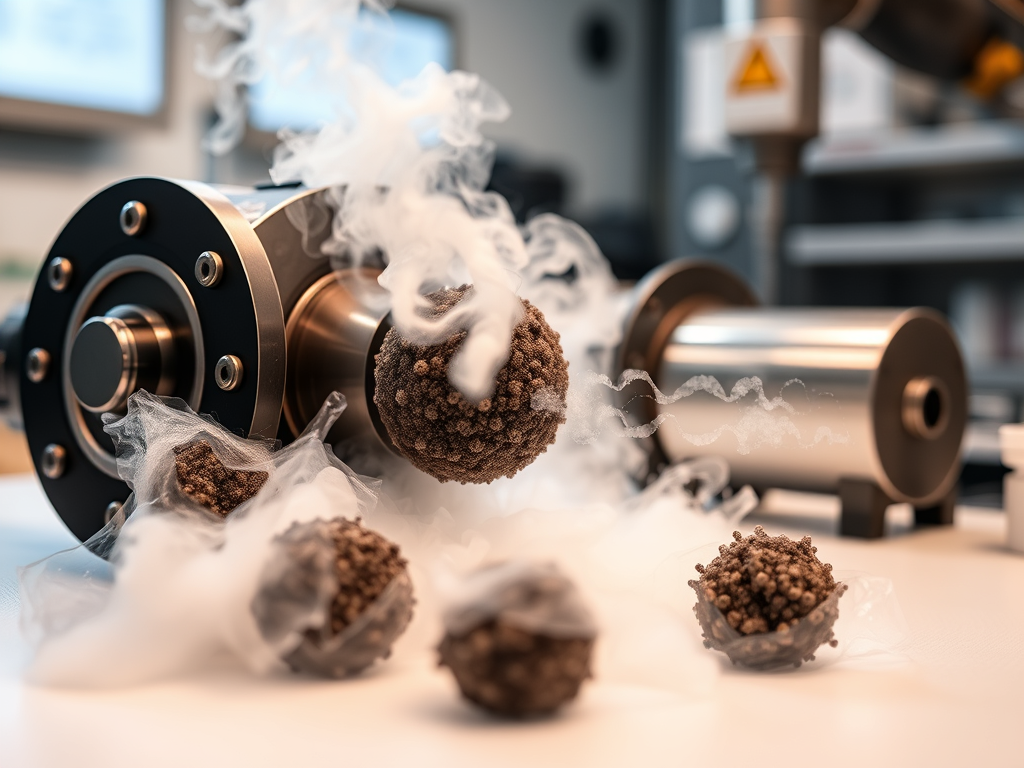
High-energy ball milling is a proven technique for modifying nanomaterials for water purification, but the impact of the milling atmosphere has been underexplored. A study by Hui Zhang and colleagues, published in the journal BiocharBiochar is a carbon-rich material created from biomass decomposition in low-oxygen conditions. It has important applications in environmental remediation, soil improvement, agriculture, carbon sequestration, energy storage, and sustainable materials, promoting efficiency and reducing waste in various contexts while addressing climate change challenges. More, systematically investigated how different atmospheres—air, nitrogen, and vacuum—affect the properties and catalytic performance of siderite/biochar composites. The researchers’ findings reveal that the milling atmosphere is a critical variable that can be fine-tuned to create high-performance materials for environmental applications, such as degrading persistent organic pollutants like phenol.
The study focused on preparing siderite/biochar composites (BM-SD/BC) and testing their catalytic ability to activate persulfate (PS) for phenol degradation. The results showed a remarkable difference in performance based on the milling atmosphere. The composite prepared under a nitrogen atmosphere (N/BM-SD/BC) demonstrated the highest efficiency, achieving a phenol removal rate of 90.3%. This was significantly higher than the 73.8% removal rate of the air-milled composite (A/BM-SD/BC) and the 81.3% removal rate of the vacuum-milled composite (V/BM-SD/BC).
The enhanced performance of the nitrogen-milled composite was directly linked to its superior physicochemical properties. Characterization analysis revealed that the nitrogen atmosphere was more effective at promoting particle fracture and exposing active sites. The N/BM-SD/BC composite had the smallest average particle size (3.02 µm) and the largest specific surface area, which increased dramatically from 27.0 to 187.6 m2g−1. This provided more active sites for the catalytic reaction. The study also found that the nitrogen atmosphere helped to better preserve the Fe(II) content in the composite. XPS analysis showed that the N/BM-SD/BC composite had the highest Fe(II) content (73.4%), followed by the vacuum-milled (67.0%) and air-milled (62.8%) composites. Since Fe(II) is an efficient electron donor, this high content significantly improved the electron transfer efficiency and facilitated the activation of PS.
The research also delved into the degradation mechanism, identifying the reactive species responsible for breaking down phenol. Quenching experiments determined that hydroxyl radicals (·OH) and superoxide radicals (O2−) were the primary contributors to the degradation process. Specifically, in the N/BM-SD/BC/PS system, ·OH and
O2− were responsible for 50.7% and 25.3% of the phenol removal, respectively. The composite also showed excellent adaptability across a wide pHpH is a measure of how acidic or alkaline a substance is. A pH of 7 is neutral, while lower pH values indicate acidity and higher values indicate alkalinity. Biochars are normally alkaline and can influence soil pH, often increasing it, which can be beneficial More spectrum, making it highly suitable for treating real-world wastewater. The iron leachingLeaching is the process where nutrients are dissolved and carried away from the soil by water. This can lead to nutrient depletion and environmental pollution. Biochar can help reduce leaching by improving nutrient retention in the soil. More from the composite was minimal, remaining below the EU’s discharge standards. This study provides a new direction for designing and optimizing highly efficient environmental catalysts by highlighting the critical role of the ball milling atmosphere.
Source: Zhang, H., Cheng, Z., Hu, K., Shen, B., Lyu, H., & Tang, J. (2025). Atmosphere regulation: unraveling effective strategies for creating high-performance iron ore/biochar composite nanomaterials in ball milling processes. Biochar, 7(82).



Leave a Reply