

A recent review paper by Dengkui Zhang and Erastus Mak-Mensah, published in Environmental Geochemistry and Health, provides a comprehensive scientometric analysis of biocharBiochar is a carbon-rich material created from biomass decomposition in low-oxygen conditions. It has important applications in environmental remediation, soil improvement, agriculture, carbon sequestration, energy storage, and sustainable materials, promoting efficiency and reducing waste in various contexts while addressing climate change challenges. More applications for soil remediation in mining-affected environments. This study offers critical insights into the evolution, intellectual structure, and emerging themes in this vital field.
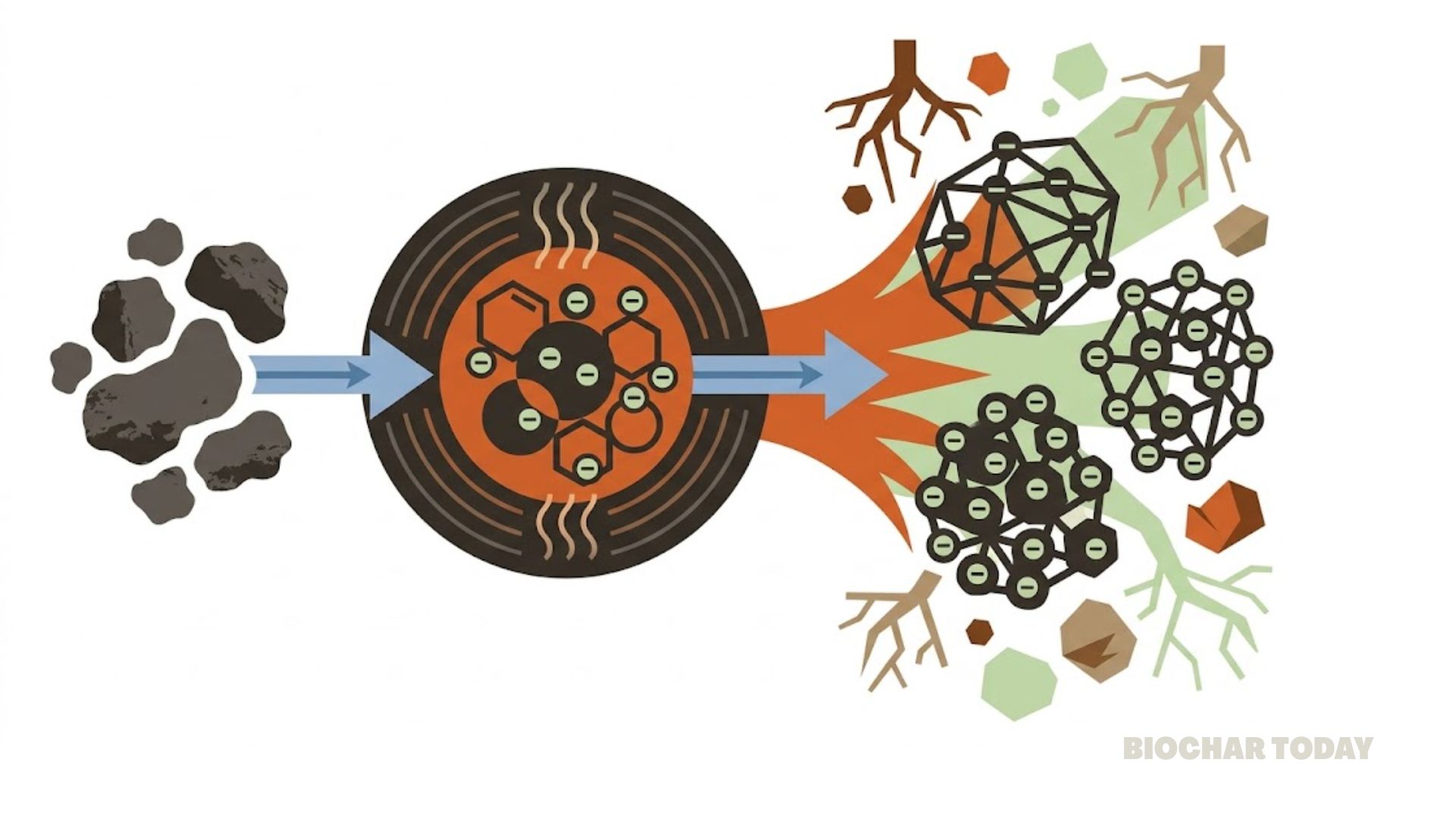
Soil contamination in areas affected by mining presents a significant challenge to both the environment and public health. This contamination often involves heavy metal pollution, a decline in soil fertility, and general ecosystem degradation. Rare earth elements (REEs), for instance, are a particular concern due to their widespread use in advanced technologies and the ecological risks they pose when they leach into the environment. They are persistent and can be toxic, disrupting soil ecosystems and groundwater quality. Biochar, a carbon-rich material produced from biomassBiomass is a complex biological organic or non-organic solid product derived from living or recently living organism and available naturally. Various types of wastes such as animal manure, waste paper, sludge and many industrial wastes are also treated as biomass because like natural biomass these More through thermal decomposition, has emerged as a promising solution. Its high surface area, porosityPorosity of biochar is a key factor in its effectiveness as a soil amendment and its ability to retain water and nutrients. Biochar’s porosity is influenced by feedstock type and pyrolysis temperature, and it plays a crucial role in microbial activity and overall soil health. Biochar More, and cation exchange capacity allow it to adsorb REEs and other heavy metals, immobilize contaminants, and boost soil microbial activity. Additionally, biochar production is a cost-effective and environmentally sustainable approach compared to many traditional remediation methods.
The analysis revealed a significant surge in biochar research after 2018. This growth is largely driven by the increasing recognition of biochar’s effectiveness in stabilizing heavy metals and improving overall soil quality. The study analyzed a dataset of 6093 unique peer-reviewed articles from Scopus and Web of Science Core Collection, providing a robust overview of the field.
Co-citation cluster analysis identified several key thematic areas. The largest cluster, “mine soil” (88 documents, silhouette value 0.653), emphasizes biochar’s role in remediating soils contaminated by heavy metals, especially in acidic conditions. The “cadmium-contaminated soil” cluster (52 documents, silhouette value 0.735) highlights biochar’s importance in remediating cadmium, particularly in agricultural settings and acidic environments. Another cluster, “former mine technosol” (52 documents, silhouette value 0.672), focuses on artificially modified soils resulting from mining activities and how biochar can be effectively combined with other amendments, like compost, for improved remediation. The “dynamic redox condition” cluster (47 documents, silhouette value 0.707) points to biochar’s influence on soil redox dynamics, crucial for managing toxic elements like arsenic and chromium. Furthermore, the “microbial community structure” cluster (30 documents, silhouette value 0.797) showcases biochar’s dual benefits in remediation and ecological restoration by enhancing microbial activity and diversity. The smallest but highly focused cluster, “metal mobility” (11 documents, silhouette value 0.981), centers on biochar’s ability to reduce the mobility and toxicity of heavy metals in soil.
Highly cited publications in this field include Ahmad et al. with 152 citations, which extensively reviews biochar as a sorbent for contaminant management. Park et al., with 124 citations, highlights biochar’s ability to reduce the bioavailability and phytotoxicity of heavy metals. Kabata-Pendias (2010), cited 109 times, is a foundational work on trace elements in soils and plants. These seminal contributions emphasize biochar’s physicochemical properties and its interactions with heavy metals and microbial communities.
Emerging trends in biochar research indicate a growing interest in ecological restoration, microbial dynamics, and innovative approaches. This includes the development of nanobiochar and the application of machine learning for optimizing biochar formulations. There’s also an increasing integration of biochar into broader sustainability and climate mitigation strategies, with a focus on its role in carbon sequestration. The research landscape is shifting from foundational studies on heavy metal stabilization to exploring biochar’s broader impacts on soil biodiversity and climate resilience.
This study provides crucial insights for advancing biochar applications in soil remediation and sustainable land management. Future research directions include optimizing biochar formulations for various contaminants, integrating computational tools for predictive modeling, and investigating its long-term ecological impacts to fully realize its transformative potential for environmental sustainability. The analysis also highlights the importance of interdisciplinary collaboration, combining soil science, microbiology, and environmental engineering to address complex contamination scenarios.
Source: Zhang, D., & Mak-Mensah, E. (2025). A scientometric analysis of biochar applications for soil remediation in mining-affected environments: research trends, intellectual structure, and emerging themes. Environ Geochem Health, 47(272).



Leave a Reply