
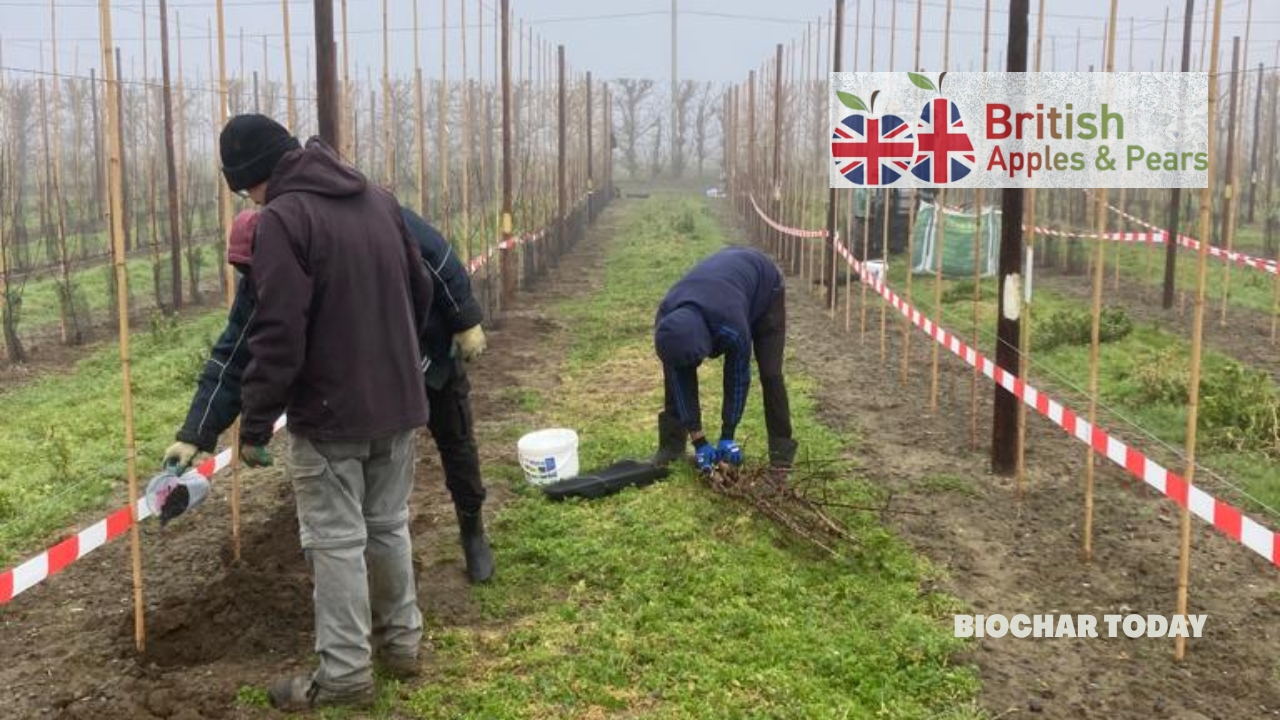
British Apples & Pears Limited (BAPL) has launched a strategic industry initiative to transform orchard management through circular biocharBiochar is a carbon-rich material created from biomass decomposition in low-oxygen conditions. It has important applications in environmental remediation, soil improvement, agriculture, carbon sequestration, energy storage, and sustainable materials, promoting efficiency and reducing waste in various contexts while addressing climate change challenges. More production. Funded by Innovate UK, the project investigates a shift away from traditional orchard clearance methods toward a system that locks carbon back into the soil. This collaborative effort involves commercial growers, researchers, and technical specialists who are working to establish the UK top fruit sector as a leader in sustainable, low-carbon food production.
The central challenge identified by BAPL is the “grub and burn” cycle traditionally used when orchards reach the end of their productive lives. When old trees are removed and burned, decades of accumulated carbon are released back into the atmosphere as greenhouse gases. Furthermore, UK growers face a critical need for climate-resilient orchards that can maintain high productivity while reducing reliance on synthetic nitrogen fertilizers, which contribute significantly to the industry’s wider carbon footprint.
To address these issues, the consortium has developed a solution utilizing pyrolysisPyrolysis is a thermochemical process that converts waste biomass into bio-char, bio-oil, and pyro-gas. It offers significant advantages in waste valorization, turning low-value materials into economically valuable resources. Its versatility allows for tailored products based on operational conditions, presenting itself as a cost-effective and efficient More technology to convert orchard wood into biochar right at the point of removal. This process stabilizes the biomassBiomass is a complex biological organic or non-organic solid product derived from living or recently living organism and available naturally. Various types of wastes such as animal manure, waste paper, sludge and many industrial wastes are also treated as biomass because like natural biomass these More, creating a “solid residue of at least 80% elemental carbon” that can be applied to new plantings. Recently, BAPL secured an additional £200,000 in ADOPT project funding to move beyond feasibility studies into field-scale trials, testing the impact of “charged” biochar on tree establishment and its ability to potentially replace conventional foliar fertilizers.
The outcomes of this initiative represent one of the most detailed lifecycle carbon analyses in the UK top fruit sector. By turning end-of-life trees into stable on-farm carbon storage, the project creates a circular economy that directly supports the UK’s goal of reaching Net Zero. Early findings suggest that while packaging accounts for roughly 60% of emissions, integrating biochar into orchard systems offers the potential for British apples to become a carbon-sequestering crop. These efforts provide growers with practical, evidence-based tools to shorten the time it takes for new orchards to reach full production while permanently sequestering carbon for centuries.



Leave a Reply