
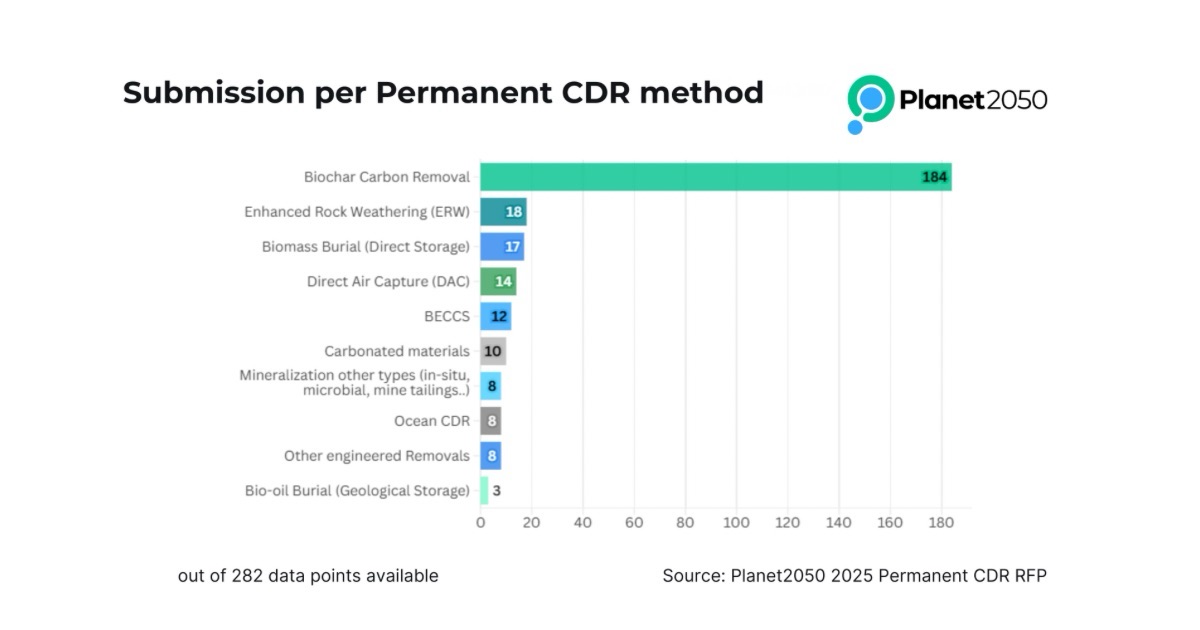
Planet2050 recently concluded the first phase of its Request for Proposals (RFP) for Permanent Carbon Dioxide Removal (CDR), attracting a robust pool of 282 project applications from 255 organizations globally. This overwhelming response highlights the burgeoning innovation within the carbon removal sector and the critical need for pre-financing solutions to scale climate action.
A significant insight from the submitted proposals is the prominent role of biocharBiochar is a carbon-rich material created from biomass decomposition in low-oxygen conditions. It has important applications in environmental remediation, soil improvement, agriculture, carbon sequestration, energy storage, and sustainable materials, promoting efficiency and reducing waste in various contexts while addressing climate change challenges. More, with 65% of applicants utilizing it as their primary durable carbon removal method. This indicates biochar’s recognized maturity and replicability as a scalable solution for carbon sequestration. Beyond its climate benefits, many projects also emphasized biochar’s localized advantages, such as addressing biomassBiomass is a complex biological organic or non-organic solid product derived from living or recently living organism and available naturally. Various types of wastes such as animal manure, waste paper, sludge and many industrial wastes are also treated as biomass because like natural biomass these More decomposition, mitigating field burning and forest fires, improving soil health, and enhancing crop resilience. The strong preference for biochar underscores its versatile applications and its potential to deliver multiple co-benefits alongside carbon removal.
The applicant pool also revealed a diverse range of organizational maturity. While many new climate-tech startups have emerged in recent years, a substantial portion (32%) of applications came from organizations established over five years ago, including some incorporated before 2000. This suggests a growing engagement from traditional sectors like forestry, construction, timber, and energy, indicating a broader industry shift towards incorporating CDR into their operations.
Geographically, the RFP garnered global interest, with projects spanning 66 different countries. Notably, 53% of the submitted projects are based in Africa or Asia, with India, the USA, and Kenya leading in the number of proposals. This wide geographical spread demonstrates the global reach and diverse applications of carbon removal technologies, including those involving biochar, in various environmental and economic contexts.
Project development stages were evenly distributed, with approximately half in early stages like feasibility studies and the other half in later stages, including those already seeking expansion funding. A significant majority of projects plan to obtain certification through leading CDR-focused standards, with Puro.earth being the most frequently cited. This commitment to third-party verification reinforces the industry’s focus on transparency and accountability in carbon removal efforts.
Looking at credit issuance, almost a third of applicants have either already issued credits or anticipate doing so within the next six months, with the majority targeting 2026. Furthermore, 65% of projects are strategically planning for multiple revenue streams beyond carbon credits, often including sustainable materials like biochar, energy production, and other valuable byproducts. This diversification strengthens financial viability and accelerates the transition towards a more circular and sustainable economy.
Planet2050 is evaluating these submissions, with shortlisted projects advancing to the second phase in August and partnerships expected to begin in Q4 2025. The strong response to this RFP, particularly the dominance of biochar-based solutions, reinforces the belief that the carbon removal sector is poised to play a crucial role in achieving a net-zero future.
READ MORE: Permanent Carbon Removal RFP: Phase 1 concludes with strong applicant pool





Leave a Reply