
Key Takeaways
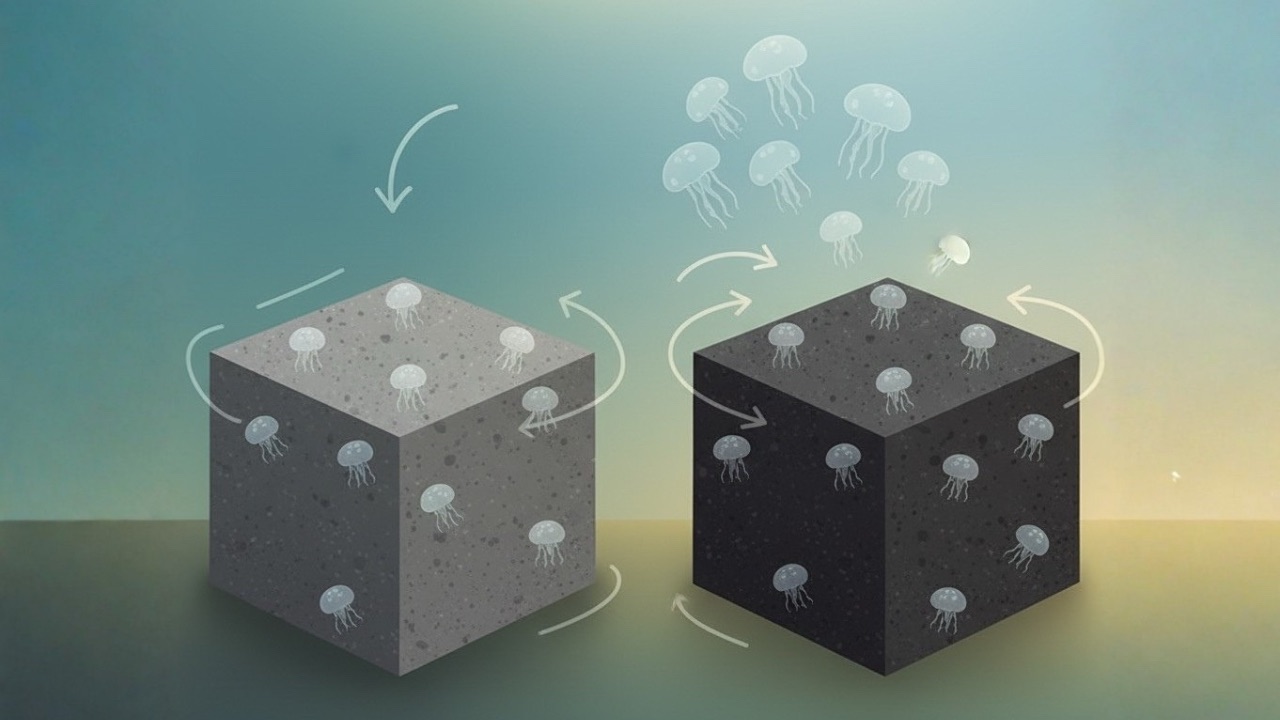
- Ocean Sprawl is a Problem: The increasing use of conventional concrete for artificial marine structures (like sea walls) is leading to an environmental issue called “ocean sprawl” and is linked to the increased number of nuisance species like jellyfish.
- A “Green” Concrete Alternative: Scientists are testing a more sustainable building material for marine use: concrete mixed with biocharBiochar is a carbon-rich material created from biomass decomposition in low-oxygen conditions. It has important applications in environmental remediation, soil improvement, agriculture, carbon sequestration, energy storage, and sustainable materials, promoting efficiency and reducing waste in various contexts while addressing climate change challenges. More. This is a promising way to reduce the construction industry’s carbon footprint.
- Jellyfish Aren’t Favored: The study’s main finding is that this new biochar concrete did not encourage the settlement or survival of jellyfish polyps any more than regular concrete. Settlement and survival percentages were statistically similar across all materials tested.
- Low Toxicity Confirmed: Tests on the jellyfish larvae showed that the biochar extract was not acutely toxic, with very low mortality observed, suggesting it is a safe material for the marine environment.
- A Win-Win for Sustainability: Since biochar concrete reduces carbon emissions and does not increase the threat of nuisance species like jellyfish, the findings support its use as a promising and biocompatible solution for future marine construction.
A study in Marine Environmental Research by Manuela Piccardo, Gregorio Motta, Verdiana Vellani, Massimo Avian, Manja Rogelja, and Stanislao Bevilacqua investigated a key ecological concern surrounding the development of sustainable materials for marine construction: does biochar-based concrete inadvertently create a super-substrate for problematic species? This pilot study focused on the settlement and survival of Chrysaora hysoscella, a bloom-forming jellyfish common in European seas, providing important preliminary evidence for the environmental compatibility of this promising new material.
The motivation for this research is clear: human activity is rapidly accelerating “ocean sprawl,” the global proliferation of artificial structures like jetties, seawalls, and breakwaters, which are predominantly made of concrete. This sprawl is projected to increase by at least 23% (or roughly 7300 km2) globally, posing threats like habitat fragmentation and the propagation of opportunistic species. A growing concern is the proposed relationship between this hard substrate proliferation and the increase in problematic jellyfish blooms.
The construction industry is exploring biochar as a sustainable additive to cement mixtures. The use of biochar-based concrete can enhance structural properties while drastically reducing the industry’s carbon footprint. Biochar is recognized by the IPCC as a promising approach for carbon sequestration because it is formed by recalcitrant organic carbon, with mean residence times in soil ranging from 10 to 100 years. Moreover, it’s estimated that using biochar in concrete production can lead to a net decrease of global warming potential ranging from ∼500 to 1500 kgCO2-eq per ton of biochar used. Given that the global physical footprint of marine artificial structures is already expected to increase significantly, using biochar-based concrete offers a significant opportunity to mitigate carbon emissions from maritime infrastructures.
The study addressed the critical question of whether this new material might inadvertently favor nuisance species like jellyfish. The life cycle of the Chrysaora hysoscella involves free-swimming planula larvae that must settle on a hard substrate and metamorphose into sessile polyps before releasing new medusae—a life stage that is amplified by the presence of artificial structures. The researchers conducted a pilot test using concrete tiles made of conventional marine-grade concrete (Control, C) and concrete containing 5% (B) and 10% (BB) by weight of a commercial wood-residue biochar.
Key findings from the laboratory experiments include: Planulae of C. hysoscella showed very low sensitivity to the aqueous biochar extract, with no mortality after 24 hours and only minimal mortality (5%) after 48 hours. This suggests the absence of acute toxicity under the tested conditions, a finding consistent with the already established low toxicity of plant biomassBiomass is a complex biological organic or non-organic solid product derived from living or recently living organism and available naturally. Various types of wastes such as animal manure, waste paper, sludge and many industrial wastes are also treated as biomass because like natural biomass these More biochar for a wide range of aquatic organisms. After both 7 and 14 days, the average number of settled polyps did not differ significantly among the substrata tested (C, B, and BB). This demonstrated a neutral effect of biochar addition on polyp settlement.Once the polyps had settled, they exhibited comparable survival probabilities across all substrates. The mean survival rates after an additional week of feeding ranged from 68% (C) to 77% (BB), with no statistically significant differences found.
The results suggest that biochar-based concrete does not favor the invasiveness of C. hysoscella compared to traditional concrete. While the biochar likely alters the substrate’s properties—such as porosityPorosity of biochar is a key factor in its effectiveness as a soil amendment and its ability to retain water and nutrients. Biochar’s porosity is influenced by feedstock type and pyrolysis temperature, and it plays a crucial role in microbial activity and overall soil health. Biochar More or chemical composition—the researchers hypothesize that these changes did not significantly impact the structure and composition of the biofilm that developed on the tiles, which is the primary factor influencing larval settlement.
The neutral ecological impact observed here, combined with the material’s inherent advantages in waste recycling and carbon storage, supports the vision of biochar-based concrete as a practicable and biocompatible solution for enhancing the sustainability of future marine artificial structures. The study encourages future research on a wider range of biochar types and other potentially nuisance or invasive marine species to enable broader implementation of these sustainable building materials.
Source: Piccardo, M., Motta, G., Vellani, V., Avian, M., Rogelja, M., & Bevilacqua, S. (2026). Can nuisance species profit from new materials for marine artificial structures? A pilot study on settlement of Chrysaora hysoscella on biochar-based concrete. Marine Environmental Research, 213, 107623.




Leave a Reply