
Key Takeaways
- Cement production is a massive source of pollution, accounting for about 8% of all global CO2 emissions.
- BiocharBiochar is a carbon-rich material created from biomass decomposition in low-oxygen conditions. It has important applications in environmental remediation, soil improvement, agriculture, carbon sequestration, energy storage, and sustainable materials, promoting efficiency and reducing waste in various contexts while addressing climate change challenges. More can be used to replace some of the cement in building materials.
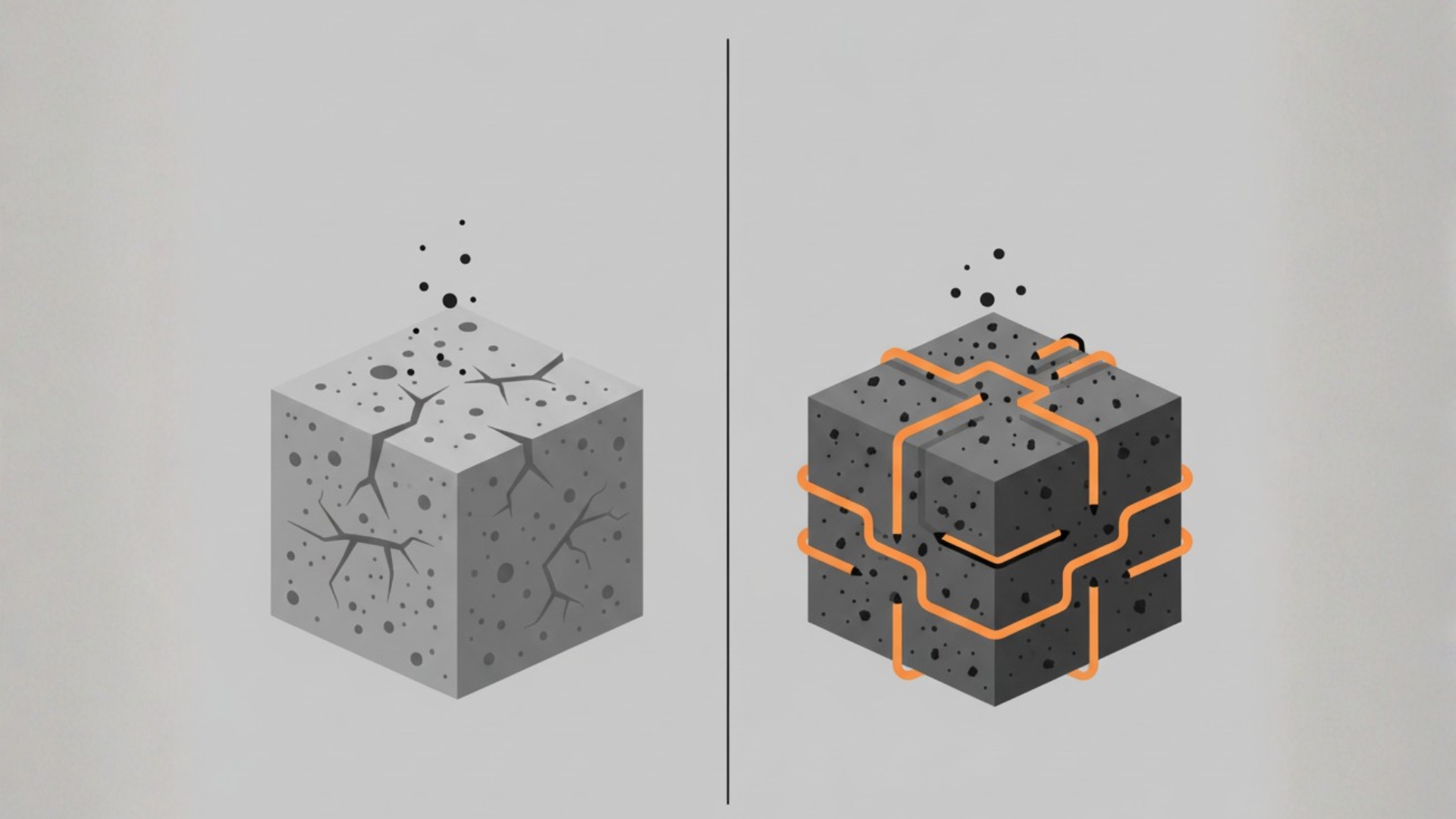
- This research found that replacing 8% of cement with biochar in fiber cement composites was the optimal amount.
- This 8% mix didn’t weaken the material; it actually made it 40% stronger (flexural strength) while simultaneously reducing its global warming potential by 18%.
- A completely cement-free “geopolymer” binder made from biochar and a clay-based material (metakaolin) was even more impressive, achieving strong performance with a ~95% lower carbon footprint than commercial fiber cement
Cement is the backbone of modern construction, but it comes at a steep environmental cost. The production of ordinary Portland cement (OPC) is incredibly energy-intensive and is responsible for about 8% of global carbon dioxide emissions. As the world builds, this CO2 footprint becomes a critical problem to solve. In a doctoral thesis submitted to The University of British Columbia, Dr. Sreenath Raghunath tackles this challenge head-on. His research provides a comprehensive roadmap for developing sustainable fiber cement composites by replacing conventional, high-carbon ingredients with renewable, biobased materials.
Dr. Raghunath’s work pursued two main strategies. The first involved replacing petrochemical-based chemical additives with tiny, refined “nano- and micro-scale” materials derived from cellulose. These additives, like cellulose nanocrystals (CNCs), improved workability and early strength, proving that biobased materials could outperform their synthetic counterparts. But the bigger climate win lay in the second strategy: tackling the cement binder itself. This is where biochar, a humble material with powerful properties, enters the picture.
Biochar is a stable, porous, carbon-rich material produced by heating waste biomassBiomass is a complex biological organic or non-organic solid product derived from living or recently living organism and available naturally. Various types of wastes such as animal manure, waste paper, sludge and many industrial wastes are also treated as biomass because like natural biomass these More (like forestry residues) in a low-oxygen environment. It is effectively a form of charcoalCharcoal is a black, brittle, and porous material produced by heating wood or other organic substances in a low-oxygen environment. It is primarily used as a fuel source for cooking and heating. More that locks carbon away for long periods. Dr. Raghunath investigated using this “green carbon” as a partial substitute for cement. He found a “sweet spot” for this mixture: replacing 8 wt.% of the cement with biochar. The results were remarkable. This biochar-blended cement didn’t just maintain its strength; it increased its flexural strength by 40% compared to the control. At the same time, a cradle-to-gate life cycle assessment (LCA) revealed this 8% blend reduced the global warming potential (GWP) by 18%.
This “double win” of higher strength and lower carbon stems from biochar’s unique structure. The thesis explains that biochar is not just an inert filler. Its porous morphology and reactive surface help it retain water , which is then released back into the mix over time, promoting “internal curing” that helps the cement continue to hydrate and gain strength. Furthermore, the fine biochar particles act as nucleation sites—points where the cement hydration products can form and grow, leading to a denser, stronger, and more refined microstructure.
Building on this success, the research took an even bolder step: creating a completely cement-free binder. This “geopolymer” composite was made by blending biochar with metakaolin, a reactive clay-based material. Instead of relying on a traditional cement reaction, this blend is activated by an alkaline solution, which triggers a chemical process that forms a strong, inorganic polymer binder. This novel, fiber-reinforced geopolymer achieved impressive flexural strengths of 13-15 MPa—significantly higher than the 6-10 MPa range of the conventional cement composites developed in the study.
The environmental payoff of this cement-free system was profound. The LCA showed that replacing some of the metakaolin with biochar (at 10 wt.%) reduced the geopolymer’s own GWP by 19%, thanks to biochar’s carbon sequestration. More strikingly, when compared to a commercial, OPC-based fiber cement board, Dr. Raghunath’s biochar-metakaolin geopolymer demonstrated a ~95% reduction in global warming potential. This research proves that biochar is a multifunctional powerhouse. It is a waste-valorization product that actively sequesters carbon, and it simultaneously improves the workability, strength, and durability of building materials. This work provides a clear, data-driven pathway to engineering high-performance, low-carbon materials that can help build our future more sustainably.
Source: Raghunath, S. (2025). Development of sustainable cement composites: understanding the effect of cellulosic additives and waste biomass [Doctoral dissertation, The University of British Columbia (Vancouver)].


Leave a Reply