
Key Takeaways
- BiocharBiochar is a carbon-rich material created from biomass decomposition in low-oxygen conditions. It has important applications in environmental remediation, soil improvement, agriculture, carbon sequestration, energy storage, and sustainable materials, promoting efficiency and reducing waste in various contexts while addressing climate change challenges. More helps reduce harmful greenhouse gas emissions in dry upland soils better than traditional lime treatments.
- Adding biochar to flooded rice paddies can backfire, causing a massive increase in nitrous oxide release.
- In dry soils, biochar works by suppressing certain fungi and bacteria that normally produce greenhouse gases.
- The effectiveness of biochar as an environmental tool depends entirely on whether the soil is dry or waterlogged.
- Farmers and researchers must carefully match biochar use to specific land types to avoid unintended environmental damage.
The research published in the journal Nitrogen Cycling, led by Cheng Chu, Ahmed S. Elrys, and their team, provides a detailed look at how biochar interacts with different agricultural environments. While biochar is often hailed as a miracle tool for capturing carbon and improving soil, this study reveals a complex and sometimes contradictory reality. By testing biochar in both acidic upland soils used for crops like peanuts and flooded paddy soils used for rice, the researchers discovered that the same material can have opposite effects on the atmosphere depending on how the land is managed. This highlights the danger of assuming that a single environmental solution will work the same way across all types of farming systems.
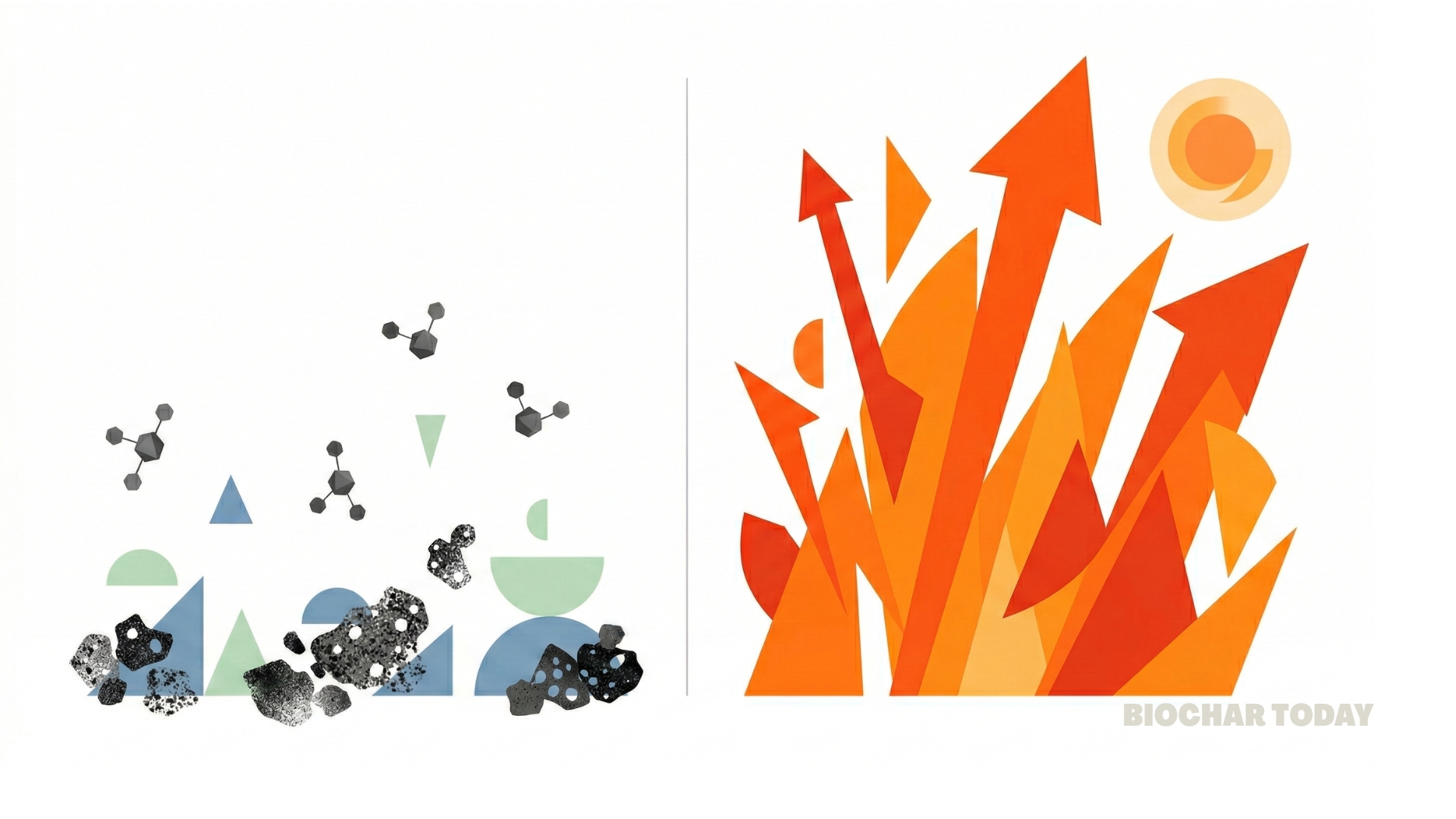
In dry upland soils, the application of biochar proved highly effective at mitigating the release of nitrous oxide, a potent greenhouse gas that contributes significantly to global warming and ozone depletion. In fact, biochar outperformed quicklime, a common agricultural additive used to neutralize soil acidity. The study found that biochar achieved this reduction by fundamentally altering the soil’s microbial community. It suppressed a specific genus of high-producing fungi and encouraged the growth of bacteria capable of converting nitrous oxide into harmless nitrogen gas. By facilitating this final step in the nitrogen cycle, biochar acted as an environmental filter, cleaning up gases before they could escape the soil and enter the atmosphere.
However, the results took a dramatic turn when the researchers looked at flooded paddy soils. In these waterlogged environments, adding biochar actually stimulated a massive surge in nitrous oxide emissions. At the highest application rates, cumulative emissions were more than fourteen times higher than those in untreated soil. This unexpected boost was caused by biochar activating multiple biological pathways simultaneously. Unlike the dry soil, where biochar helped finish the nitrogen cycle, the flooded conditions and the presence of biochar seemed to create a perfect storm where nitrous oxide production was ramped up across the board, but its conversion into harmless gas was not fast enough to keep up.
The study also clarified that the benefits of biochar are not just about changing the soil’s pHpH is a measure of how acidic or alkaline a substance is. A pH of 7 is neutral, while lower pH values indicate acidity and higher values indicate alkalinity. Biochars are normally alkaline and can influence soil pH, often increasing it, which can be beneficial More level. While biochar does reduce soil acidity, its unique chemical properties, such as its ability to act as an electron shuttle for microbes, play a much larger role in gas mitigation in dry soils. In the rice paddies, the influx of carbon from the biochar appeared to provide an energy source that fueled various microbial processes, leading to the observed surge in emissions. This suggests that the chemical makeup of the soil and the specific water management practices are the real controllers of whether biochar helps or hurts the environment.
Understanding these divergent outcomes is essential for developing effective climate strategies. If biochar is used on a large scale without considering the local land-use type, it could inadvertently lead to higher greenhouse gas levels in certain regions. The researchers emphasize that before making broad recommendations, more studies are needed to see how these mechanisms work under real-world field conditions over longer periods. For now, the takeaway is clear: biochar is a powerful tool for sustainable agriculture, but it must be applied with surgical precision to ensure it actually delivers on its promise of a cooler planet.
Source: Chu, C., Elrys, A. S., Dai, S., Wen, T., Xu, J., et al. (2026). Biochar’s contrasting effects on N2O emissions in acidic upland and flooded paddy soils. Nitrogen Cycling, 2, e009.



Leave a Reply