

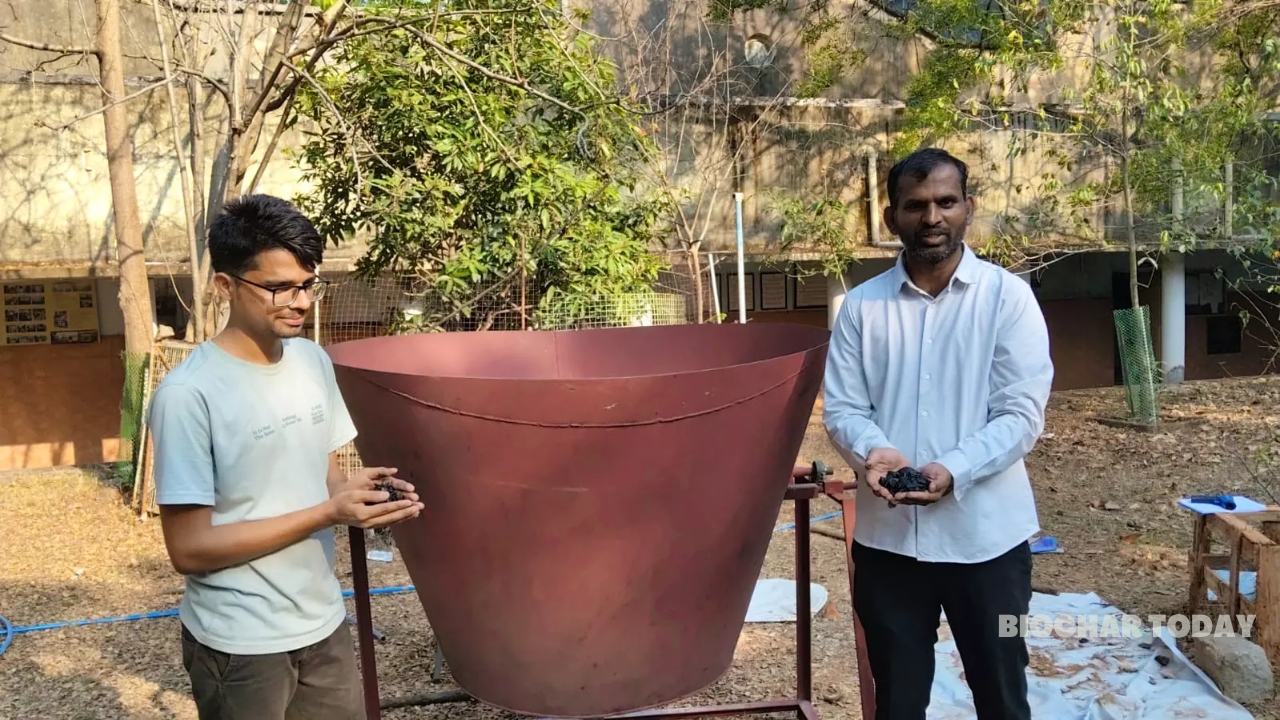
Researchers at the Bangladesh Institute of Nuclear Agriculture (BINA) have introduced a new biocharBiochar is a carbon-rich material created from biomass decomposition in low-oxygen conditions. It has important applications in environmental remediation, soil improvement, agriculture, carbon sequestration, energy storage, and sustainable materials, promoting efficiency and reducing waste in various contexts while addressing climate change challenges. More production machine aimed at advancing sustainable agriculture in Bangladesh.
Developed by the Agricultural Engineering Division under the leadership of Md. Akhtarul Islam, the “BINA Biochar” machine is designed to convert agricultural residues like jute sticks, rice straw, and mustard stalks into biochar through controlled pyrolysisPyrolysis is a thermochemical process that converts waste biomass into bio-char, bio-oil, and pyro-gas. It offers significant advantages in waste valorization, turning low-value materials into economically valuable resources. Its versatility allows for tailored products based on operational conditions, presenting itself as a cost-effective and efficient More.
Pyrolysis involves decomposing biomassBiomass is a complex biological organic or non-organic solid product derived from living or recently living organism and available naturally. Various types of wastes such as animal manure, waste paper, sludge and many industrial wastes are also treated as biomass because like natural biomass these More at high temperatures in the absence of oxygen, offering a cleaner alternative to open burning, which contributes to greenhouse gas emissions. The BINA Biochar machine incorporates a dual-chamber system insulated with glass wool to minimize heat loss and is powered by a 3000-watt electric coil. It operates at temperatures up to 900°C and can produce between 100 and 150 kilograms of biochar daily.
This machine allows for precise temperature control based on the type of feedstock—300°C for rice straw and 400°C for jute sticks—making it versatile for different agricultural byproducts. It is currently being manufactured and distributed by two local engineering workshops in Mymensingh and Rangpur.
With over three years of research behind it, including academic evaluation, the innovation represents a practical step forward in reducing reliance on chemical fertilizers. By enhancing soil properties such as acidity balance, organic carbon content, and nutrient retention, the machine supports improved crop productivity and long-term soil health. The BINA Biochar machine presents a scalable, low-emission solution to meet the country’s sustainable farming goals.


Leave a Reply