
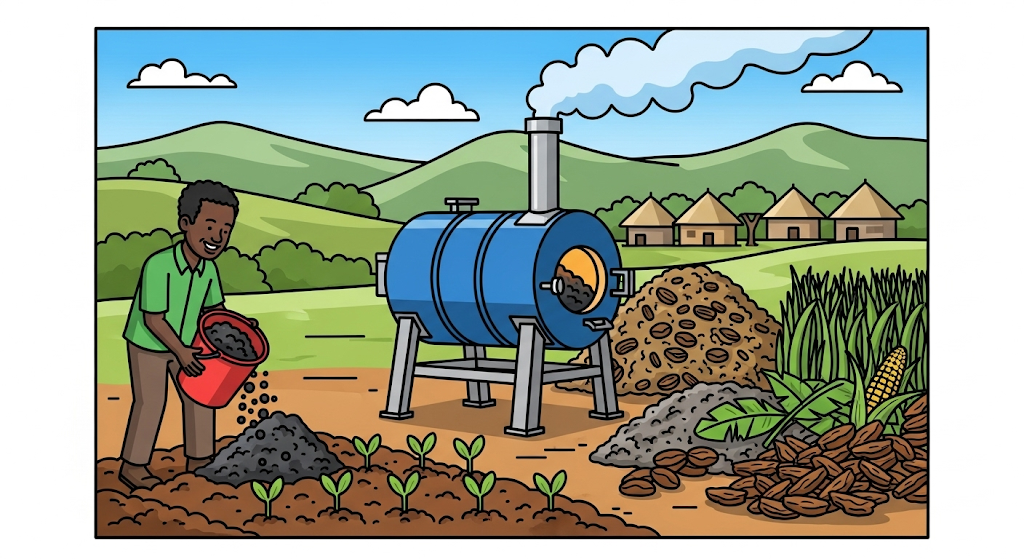
A new review examines the designs and performance of small-scale biocharBiochar is a carbon-rich material created from biomass decomposition in low-oxygen conditions. It has important applications in environmental remediation, soil improvement, agriculture, carbon sequestration, energy storage, and sustainable materials, promoting efficiency and reducing waste in various contexts while addressing climate change challenges. More production kilns, focusing on their suitability for use in low-to-middle-income countries. The research, published in Bioresource Technology Reports, categorizes kilns into five main types: flame curtain, drum, pyrolytic top-lit-updraft (TLUD) cookstoves, retort, and masonry kilns. The paper highlights a fundamental trade-off: a kiln’s cost and simplicity often inversely correlates with its performance, efficiency, and emissions control.
The review, which was able to make only a qualitative comparison due to inconsistent data across different studies, found that open pile burning and open pit kilns are the simplest and cheapest options, with zero investment cost. However, these methods are highly inefficient, with yields of less than 15% on a dry weight basis , and result in significant air pollution, including high emissions of fine particulate matter (PM 2.5) (4–18 g/kg) and carbon monoxide (CO).
At the other end of the spectrum, advanced automated retort kilns offer high efficiency and quality but are costly (up to US$100,000) and require skilled operators and a power source, making them impractical for many rural areas.
The most promising options identified in the study are retort kilns, especially those with forced drafts. These designs demonstrate high efficiency, with biochar yields up to 46% , and produce high-quality biochar (fixed carbon content up to 87%) with significantly lower emissions compared to simpler kilns. Furthermore, retort kilns can produce valuable co-products like wood vinegar, which can reduce emissions and provide an additional income stream. The average thermal efficiency of retort kilns can reach 85%.
The research highlights the drum retort kiln as particularly well-suited for adoption in low-to-middle-income countries. These kilns are portable, relatively affordable (costing US$13–100), and strike a balance between simplicity and performance. To further enhance their potential, the study recommends future research to incorporate features from other designs, such as recirculating hot firebox flue gases, to improve efficiency and biochar quality without increasing cost or complexity. The goal is for these improved kilns to approach a theoretical maximum efficiency of 50-80%.





Leave a Reply