
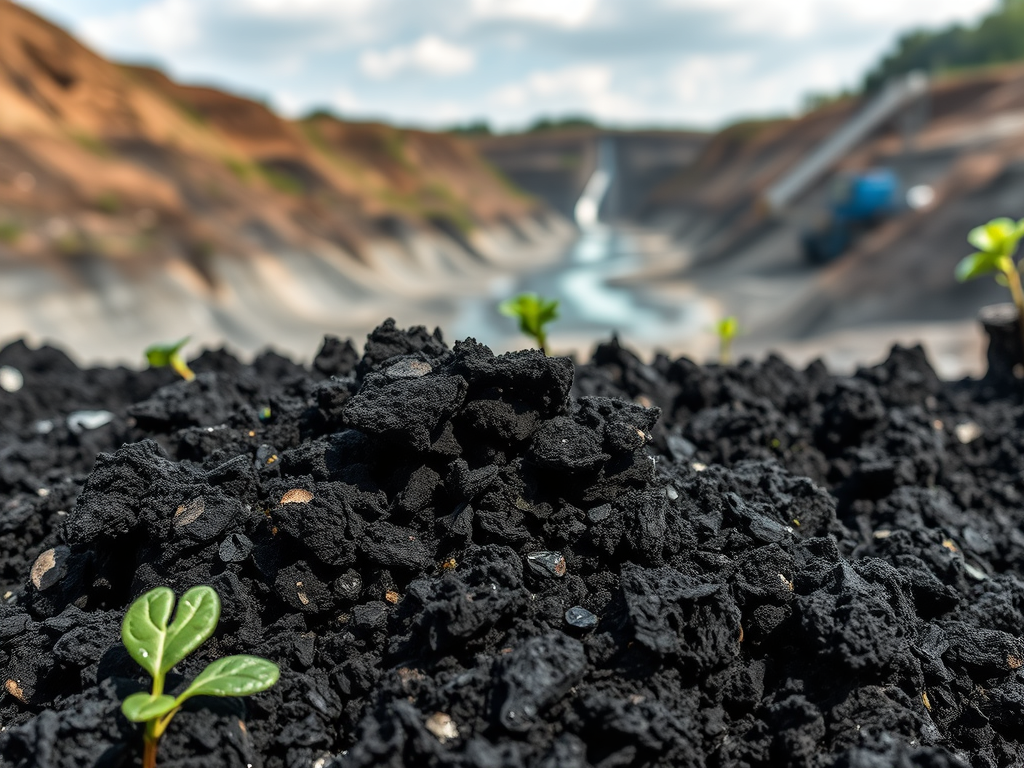
Feng et al., in Scientific Reports, explored a novel approach to remediate heavy metal pollution using biocharBiochar is a carbon-rich material created from biomass decomposition in low-oxygen conditions. It has important applications in environmental remediation, soil improvement, agriculture, carbon sequestration, energy storage, and sustainable materials, promoting efficiency and reducing waste in various contexts while addressing climate change challenges. More derived from a plant that thrives in mining areas. The researchers utilized Dicranopteris pedata, a hyperaccumulator plant known for its ability to absorb high levels of rare earth elements (REEs), to create biochar that effectively removes lead (Pb) from wastewater. The study investigated the effects of different carbonization temperatures on the biochar’s properties and its lead removal efficiency. Biochar produced at 400 °C (REEs/C-4) and 800 °C (REEs/C-8) demonstrated the highest lead removal capabilities, reaching 85.1% and 84.0%, respectively.
The superior performance of REEs/C-4 was attributed to its rich functional groups, such as aromatic, hydroxyl, and C=C/C-C, which provided ample chelation sites for effective complexation with Pb(II). On the other hand, REEs/C-8 excelled due to the enrichment of REEs and its abundant pore structure, further enhancing its adsorption capacity. The research highlighted the significant role of chemisorption, including ion exchange and chelation, in the adsorption process.
This study provides a new perspective on utilizing hyperaccumulator biomassBiomass is a complex biological organic or non-organic solid product derived from living or recently living organism and available naturally. Various types of wastes such as animal manure, waste paper, sludge and many industrial wastes are also treated as biomass because like natural biomass these More for environmental remediation. By converting Dicranopteris pedata into biochar, the researchers demonstrated a sustainable and efficient method for removing lead from wastewater, offering a promising solution for heavy metal pollution in mining areas.
SOURCE: Feng, L., Chen, Z., Wang, H., Chen, Z., Chen, Z., Liu, J., & Zeng, Y. (2025). A study of rare earth elements enriched carbonisation material prepared from Dicranopteris pedata biomass grown in mining area. Scientific Reports, 15(1), Article 6486. https://doi.org/10.1038/s41598-025-86067-y




Leave a Reply