
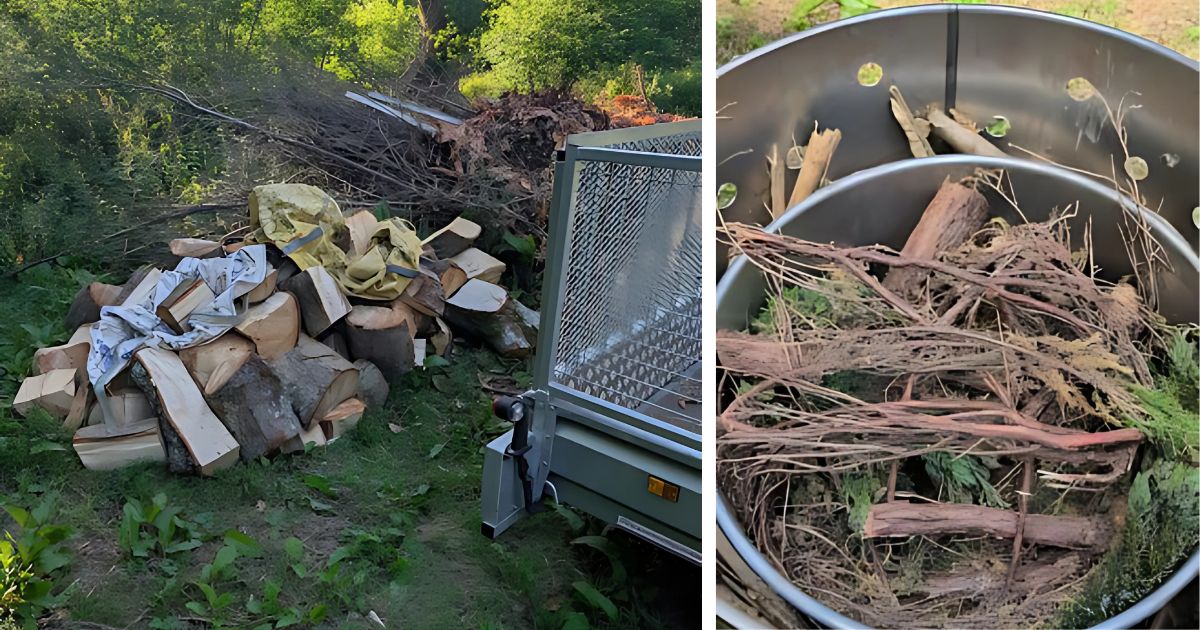
When it comes to producing biocharBiochar is a carbon-rich material created from biomass decomposition in low-oxygen conditions. It has important applications in environmental remediation, soil improvement, agriculture, carbon sequestration, energy storage, and sustainable materials, promoting efficiency and reducing waste in various contexts while addressing climate change challenges. More, most people tend to focus on the how. And as I’ve discussed in earlier posts, the burner system you use is undeniably important. The design, airflow, and control you have over the burn will directly influence the quality of your char. But just as I’ve emphasized the importance of context in this process, there’s another factor that often sits quietly in the background – until it becomes a real obstacle. That’s feedstockFeedstock refers to the raw organic material used to produce biochar. This can include a wide range of materials, such as wood chips, agricultural residues, and animal manure. More.
The type of material you use, where it comes from, how it’s stored, and what condition it’s in, all have a profound impact not just on the final product, but on the entire process. It’s not as simple as “waste in, biochar out”. There’s a chain of logistics, timing, and material behavior that needs to be respected.
From a technical standpoint, we know that feedstock characteristics – species, size, moisture content, and density – play a significant role in determining the chemical and physical qualities of the resulting biochar. Research shows marked differences in pHpH is a measure of how acidic or alkaline a substance is. A pH of 7 is neutral, while lower pH values indicate acidity and higher values indicate alkalinity. Biochars are normally alkaline and can influence soil pH, often increasing it, which can be beneficial More, surface area, and nutrient retention depending on whether you’re charring wood, manure, or crop residue (Novak et al., 2013). With research, typically, finding that hardwoods tend to yield more structurally stable char; while softwoods, straw, and leafy materials often have improved water holding capacities.
That’s valuable knowledge. But what many of these studies fail to address is the practicality of working with these materials, especially in woodland or mobile settings, where many of us are operating. With forestry operations generating over 1 billion tonnes of organic waste globally in 2018 (Yu et al., 2021), these challenges are not niche – they’re central to biochar’s potential as a sustainable solution to both waste and climate change.
In my own practice, moisture content is the most persistent challenge. Forestry waste – brash, offcuts, and storm-felled limbs – is rarely in a “ready-to-burn” state. It’s often green, damp, or heavily sappy. While pyrolysisPyrolysis is a thermochemical process that converts waste biomass into bio-char, bio-oil, and pyro-gas. It offers significant advantages in waste valorization, turning low-value materials into economically valuable resources. Its versatility allows for tailored products based on operational conditions, presenting itself as a cost-effective and efficient More can technically occur with higher-moisture feedstocks, it’s wildly inefficient, produces excessive smoke, and often ends in disappointment. I’ve returned to burns hours later to find half-cooked material and minimal usable char – something that’s both frustrating and wasteful.

More advanced systems can overcome this issue. One study found that gasificationGasification is a high-temperature, thermochemical process that converts carbon-based materials into a gaseous fuel called syngas and solid by-products. It takes place in an oxygen-deficient environment at temperatures typically above 750°C. Unlike combustion, which fully burns material to produce heat and carbon dioxide (CO2), gasification More remains economically feasible even at 0%, 20%, and 40% moisture content (Zsinka et al., 2023). But small-scale, low-tech burners like mine can’t handle those conditions without compromise. In my experience and much of the literature, it’s best to keep moisture levels below 20%. Freshly felled wood often sits between 40–60%, so unless you’re dealing with pre-seasoned stock, that moisture has to go somewhere – either before or during the burn.
This creates a whole set of logistical concerns: you need dry storage, shelter, ventilation, and time. You also need patience. Burns have to be timed with good weather, and often delayed because of it. These aren’t just technical challenges – they directly impact the economic and practical feasibility of biochar production in woodland settings.
Then there’s the physical structure of the feedstock. My double-barrel system (see previous post for my honest review) works well, but it has its limits. Large pieces need to be split down. Sappy materials like laurel or young conifers can clog airflow or burn too aggressively. Leafy branches often combust too fast, flaring before pyrolysis has had a chance to stabilise. These issues rarely make it into academic studies, but they make a huge difference in real-world applications.

I’ve had better results with consistent, drier materials – seasoned ashAsh is the non-combustible inorganic residue that remains after organic matter, like wood or biomass, is completely burned. It consists mainly of minerals and is different from biochar, which is produced through incomplete combustion. Ash Ash is the residue that remains after the complete More, small-diameter hardwoods, and kiln-dried timber offcuts. My brother’s gardening business provides access to another waste stream – shrub trimmings, hedge offcuts, and compostable debris – but it’s irregular and varied. You can’t simply dump a random pile of clippings into a barrel and expect usable char. Sorting, sizing, and pre-selecting materials has become one of the most time-intensive and impactful parts of my process.
This all leads to a bigger question: how scalable is small-scale biochar production, especially in forestry and conservation contexts? I love the idea of deploying mobile burners to woodland sites – diverting brash and coppicing waste into usable char – but we need systems that genuinely work with the material available. From what I’ve seen, if it doesn’t integrate smoothly into existing forestry workflows, it won’t be adopted at scale.


So, what’s the alternative? Could we create regional or cooperative pyrolysis hubs – shared facilities where local landowners deliver brash on rotation? A seasonal processing site, perhaps tied into woodland groups or estate networks, that could process higher-moisture or mixed feedstocks using more robust systems? It’s possible. But it would require investment, coordination, and a shift in how we view forest waste – not as a nuisance, but as a resource with untapped potential.
In an ideal world, we can engineer mobile units that are so effective that they can handle wetter feedstocks and harsher terrains. But without an engineering degree, I can only focus on what I can do, with what I’ve got to hand. Learning which materials are worth storing, which require more time to dry, and which are just not worth the hassle has saved me a lot of time and frustration. The more I pay attention to my feedstock, the better my results.
Because at the end of the day, producing biochar isn’t just about what you burn – it’s about how well you know what you’re burning.
References
- Novak, J.M., et al. (2013). Impact of biochar on soil fertility and crop productivity. Agronomy.
- Yu, S. et al. (2021). Nanocellulose from various biomassBiomass is a complex biological organic or non-organic solid product derived from living or recently living organism and available naturally. Various types of wastes such as animal manure, waste paper, sludge and many industrial wastes are also treated as biomass because like natural biomass these More wastes: Its preparation and potential usages towards the high value-added products, Environmental Science and Ecotechnology 5 (100077). DOI: https://doi.org/10.1016/j.ese.2020.100077
- Zsinka V., Tomasek S., Miskolczi N. (2023). Feasibility and Economic Issues of Biomass Pyrolysis-Gasification: the Effect of Moisture Content of Raw Material, Chemical Engineering Transactions 99, pp. 73-78.


Leave a Reply