
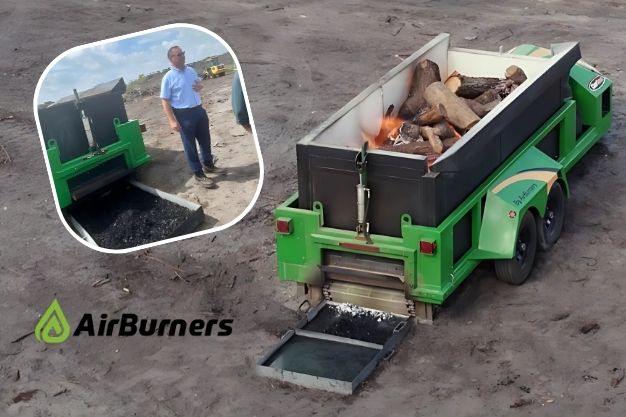
BiocharBiochar is a carbon-rich material created from biomass decomposition in low-oxygen conditions. It has important applications in environmental remediation, soil improvement, agriculture, carbon sequestration, energy storage, and sustainable materials, promoting efficiency and reducing waste in various contexts while addressing climate change challenges. More Today had the good fortune to attend a demonstration of leading-edge biochar burner equipment coupled with electric energy production from Air Burners, Inc. in Stuart, Florida on March 5, 2025.

Air burner technology has emerged as a promising method for creating biochar, a carbon-rich material that can significantly enhance soil health and contribute to carbon sequestration. Biochar is produced through the pyrolysisPyrolysis is a thermochemical process that converts waste biomass into bio-char, bio-oil, and pyro-gas. It offers significant advantages in waste valorization, turning low-value materials into economically valuable resources. Its versatility allows for tailored products based on operational conditions, presenting itself as a cost-effective and efficient More of organic materials, such as wood and agricultural waste, in the absence of oxygen. This process not only reduces waste but also creates a valuable product that can improve soil fertility, water retention, and microbial activity.

One of the leading innovations in this field is the CharBoss, developed by Air Burners in collaboration with the US Forest Service. The CharBoss is a mobile air curtain burner designed to produce biochar from wood and vegetative waste. This technology was initially developed to manage forests and prevent wildfires, but its applications have expanded to include agriculture and construction.

The CharBoss operates by burning biomassBiomass is a complex biological organic or non-organic solid product derived from living or recently living organism and available naturally. Various types of wastes such as animal manure, waste paper, sludge and many industrial wastes are also treated as biomass because like natural biomass these More waste in a refractory-lined burn container. The air curtain created by the burner helps to contain the fire and reduce emissions. As the waste material burns, the biochar system is activated, and biochar begins to fall onto an internal conveyor system. The biochar is then collected in a quenching pan, which minimizes water usage and ensures the biochar is properly cooled and sized.
One of the key advantages of the CharBoss is its mobility. The unit is self-contained and fully assembled, making it easy to transport to different locations. It can be towed with a heavy-duty pickup truck and is equipped with all necessary lighting, reflectors, and trailer VIN for licensing. This mobility allows for on-site biochar production, which is particularly beneficial for logging roads, vineyards, and other remote areas.
The CharBoss is also highly efficient. It can burn up to one ton of biomass waste per hour, producing up to 500 pounds of biochar. This rapid production rate is achieved through the use of a small U.S. EPA Tier 4 diesel engine, which powers the system and consumes about 1.1 gallons of diesel fuel per hour. The biochar produced can be spread locally to enhance forest growth or collected and sold on the market. In 2023, customers were receiving $125 per cubic yard for biochar.
In addition to its environmental benefits, the CharBoss offers economic advantages. By converting unwanted wood and vegetative waste into biochar, businesses can reduce disposal costs and potentially generate revenue from biochar sales. Some customers may also be eligible to create carbon credits, further enhancing the financial viability of this technology.
The use of air burner technology to create biochar is not limited to the CharBoss. Other air curtain burners offer similar benefits, helping to reduce smoke and particulates from burning operations, more fully burn biomass residues compared to pile burning, and eliminate the direct and intense fire contact that can harm soil beneath the slash pile3. These burners are particularly useful in forest management, where they can help to reduce the risk of wildfires and improve soil health.
Overall, air burner technology represents a significant advancement in biochar production. By providing a mobile, efficient, and environmentally friendly solution for converting biomass waste into biochar, technologies like the CharBoss are helping to address some of the most pressing challenges in forest management, agriculture, and construction. As the demand for sustainable practices continues to grow, the use of air burner technology to create biochar is likely to become increasingly important.




Leave a Reply