
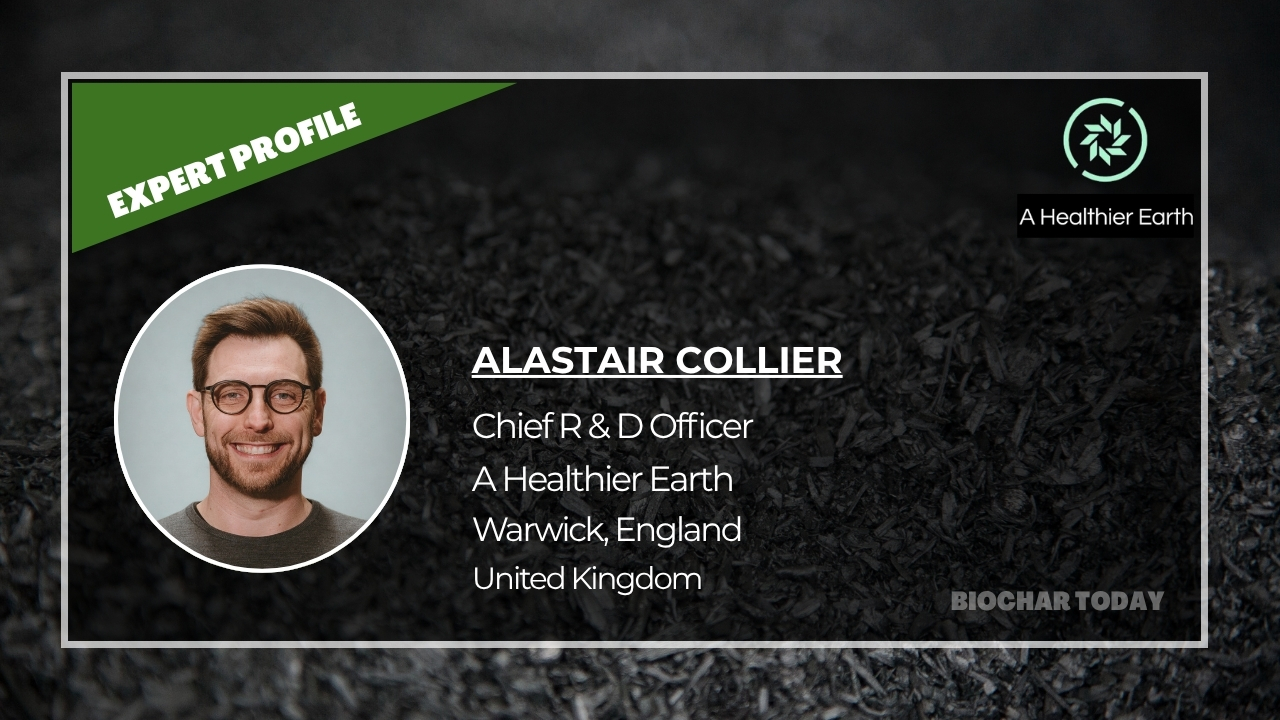
Alastair Collier is Chief R&D Officer at A Healthier Earth, where he leads the development and deployment of net-negative carbon solutions for hard-to-abate sectors. He founded the company in 2021 and oversees the integration of its research, technology development, and operational activities. His work includes advancing biocharBiochar is a carbon-rich material created from biomass decomposition in low-oxygen conditions. It has important applications in environmental remediation, soil improvement, agriculture, carbon sequestration, energy storage, and sustainable materials, promoting efficiency and reducing waste in various contexts while addressing climate change challenges. More production and its integration across applications such as agriculture, materials, and carbon markets, with a focus on scalable, commercially viable systems. He is also involved in the development of synthetic-biological CO₂ capture pathways designed for industrial-scale implementation. Alastair has over 10 years of experience in strategy, innovation, and operations within capital-intensive and investment-focused organisations. He holds an MBA from the University of Oxford and is a Chartered Management Accountant and Lean Six Sigma Master Black Belt.
In this interview, he shares his perspectives on scaling biochar and delivering practical carbon removal solutions.
Shanthi Prabha: Your career bridges innovation leadership, operations, and climate technology. What first drew you to carbon removal solutions, and where does biochar fit within your broader decarbonisation strategy?
Alastair Collier: When I first stepped into the sustainability industry, there was a real sense of momentum; people genuinely believed we could reshape industries for the better. That energy drew me in, alongside the clear scientific reality that emissions cuts alone won’t restore climate stability. It was clear that we need to remove legacy CO₂ at a pace far beyond what natural systems can achieve.
Even as the global mood has shifted, that purpose has stayed, but now it is as much about building future‑focused supply chains, enabling responsible growth, and delivering climate solutions that create genuine value. When we evaluated viable carbon removal pathways, biochar was the only approach that matched our investment profile, technology readiness, and ability to act immediately. Its scalability and multiple value streams reduce risk while delivering real climate impact. That combination made biochar a natural foundation to work with.
SP: A Healthier Earth focuses on net-negative solutions for hard-to-abate sectors. From your perspective, which industries present the most urgent opportunity for biochar-based integration, and why?
AC: Biochar’s versality across multiple industries is very exciting to me. Agriculture stands out, because beyond carbon storage, biochar delivers genuinely meaningful solutions to challenges that farmers face daily. For example, we are developing a biochar‑based fertiliser that improves soil function, boosts water and nutrient retention, and helps farmers cut nitrogen use, unlocking income opportunities through nitrogen avoidance credits.
A very different sector, the data centre industry, also presents a major opportunity. Hyperscaler customers are the largest buyers of durable carbon dioxide removal (CDR) credits. Integrated approaches with CDR providers can help accelerate meaningful decarbonisation while supporting responsible growth. As the R&D subsidiary of Pure Data Centres Group, we combine our capabilities to expand this opportunity and drive a more responsible tech industry. Importantly, the biochar sector cannot scale without committed carbon‑credit customers, and the data‑centre ecosystem is uniquely positioned to help drive that scale.
SP: You lead the development of synthetic-biological CO₂ capture pathways alongside operational technology. How do you evaluate where biological, thermochemical, and hybrid approaches — including biochar — are most effective?
AC: We begin by assessing whether a technology is genuinely investable: can it scale, reach sound unit economics, and compete without relying on a green premium that prices it out of the market? A technology might be great in theory, but if it can’t get investment, it can’t scale to deliver the impact we need.
Biochar hits the sweet spot: it’s Technology Readiness Level 9 (TRL9), manufacturable today, and able to enhance the performance of products it’s integrated into. Those qualities make it one of the most attractive pathways available. While we remain process-agnostic in terms of which approaches we take, we find that biological first steps often win out. They tend to be efficient, and lower-energy, because evolution has done much of the optimisation for us.
SP: Handling around 100 tonnes of CO₂ per day is a significant operational benchmark. What are the key technical and logistical challenges in scaling carbon removal systems from pilot to industrial relevance?
AC: Many engineered CDR approaches run into the practical challenge of handling vast quantities of liquefied CO₂ – BECCS plants, for instance, may produce hundreds of tonnes each day that must be transported or injected.
Biochar avoids this constraint by storing carbon in a stable solid form that can be incorporated into valuable products. The real challenge becomes meeting demand once biochar-enhanced products go mainstream. Moving 100 tonnes of solid material a day is routine across manufacturing; the key is designing products that outperform alternatives at competitive pricing.
SP: Many promising climate technologies struggle to move beyond demonstration. What operational, financial, or partnership models have you found most effective in moving projects from R&D into real-world deployment?
AC: Partnerships are essential. We often begin with own‑cost agreements, which give both sides the freedom to test ideas, share data, and explore feasibility without early financial commitments. These arrangements help de‑risk innovation by allowing teams to validate performance and understand operational constraints before moving toward commercial terms.
From there, successful collaborations typically transition into supply agreements, joint ventures, or co‑development models, depending on the scale and maturity of the opportunity. What matters most is creating a structured pathway from experimentation to bankability, something many climate technologies lack.
SP: Biochar often sits at the intersection of waste management, agriculture, materials, and carbon markets. How important is systems thinking when designing projects that deliver both emissions reduction and commercial value?
AC: Systems thinking is absolutely fundamental, and underpins how A Healthier Earth designs, builds, and deploys our projects. It shapes every stage of development, ensuring we’re not solving problems in isolation but creating solutions that strengthen the wider ecosystem they sit within.
In practice, this means prioritising projects that unlock multiple, reinforcing value streams rather than depending on a single output or revenue source. Equally important is the ability to look both upstream and downstream in the value chain. By understanding feedstockFeedstock refers to the raw organic material used to produce biochar. This can include a wide range of materials, such as wood chips, agricultural residues, and animal manure. More availability, production constraints, product-market fit, distribution pathways, and end‑of‑life impacts, we can design solutions that are resilient, scalable, and aligned with how industries actually function.
SP: Could you share examples of completed and ongoing projects at A Healthier Earth that demonstrate practical carbon-negative outcomes? What have been the most important lessons so far?
AC: At full-capacity, our Royal Wootton Bassett biochar facility will produce 11,500 tonnes of biochar each year, removing up to 18,500 tonnes of carbon dioxide equivalent annually.
We’ve also secured a £1.4m grant from UK’s Department for Environment, Food & Rural Affairs (DEFRA) and Innovate UK for our biochar-based fertiliser that replaces synthetic fertiliser and generates nitrogen avoidance credits. Meanwhile, we’ve pioneered ForestFactory® in partnership with Blenheim Palace, a first-of-its-kind solution that uses vertical farming, tailored growing recipes and biochar to grow trees four times faster than their nursery grown equivalents, with improved characteristics for survivability and future sequestration. Together, they demonstrate how near‑term carbon removal and long‑term ecosystem benefits reinforce each other.
SP: Looking ahead, what types of future projects or sectors are you prioritising, and how do you assess readiness for large-scale deployment?
AC: We’re continuing to invest in R&D on scalable biochar use‑cases, essential for the growth of the biochar market. This ranges from exploring how it can strengthen food security in Indonesia to assessing its potential role in lower‑carbon building materials to further support the digital infrastructure industry.
This underscores our systems-thinking approach that will allow us to build a platform-type model, where biochar is integrated across multiple, durable markets rather than dependent on a single outlet. For carbon‑credit offtakers, that breadth matters: it signals that there will be a long‑term, resilient market for the biochar itself. And when the underlying product is secure, diversified, and in sustained demand, confidence in the credits strengthens too.
SP: Measurement, reporting, and verification remain central to trust in carbon removal. What advances are still needed to strengthen confidence in durable sequestration pathways such as biochar?
AC: Improved measurement, reporting and verification (MRV), across both production‑site monitoring and in permanence, should enhance integrity, trust, and safety without constraining real‑world feasibility and the need for deployment, now.
At Healthier Earth, we are taking an elevated approach at site level, using continuous environment monitoring systems (CEMS) to monitor and track emissions in real time. We also insist on daily product testing, which is far more robust than annual sampling, to maintain credit integrity. Soil‑carbon permanence science continues to evolve, but it remains a perceived barrier for many, and insistence on millennial‑scale certainty before deployment risks paralysing the very solutions needed for large scale CDR.
In reality, biochar already provides more than 300 years of proven stable carbon storage, offering a meaningful and scientifically grounded permanence window. The climate crisis is immediate; a verified 300‑year storage pathway gives society 300 years to address a problem that has only accelerated over the past 120. Supported by rigorous MRV, it will help to unlock real atmospheric carbon removal and accelerate progress toward net zero.
SP: You’ve worked in capital-intensive, investment-focused environments. What do investors still misunderstand about biochar and engineered-biological carbon removal solutions?
AC: Generalist investors often need help understanding carbon markets and financial additionality. Immaturity in credit markets, biochar offtake, and feedstock supply can also make long‑term contracts difficult.
Specialist investors understand biochar well, but are hindered by the small scale of most projects. They are simply too small to finance. Among developers, the biggest barrier we see is ambition: projects seeking £5m sit in an investment “dead zone.” They should aim higher: £20m+ projects attract the kind of institutional capital that enables real deployment.
SP: Cross-sector collaboration appears central to your work. How do partnerships between industry, researchers, and policymakers accelerate innovation while managing risk?
AC: Researchers, policymakers, and commercial operators each bring distinct strengths, but the real progress happens when those strengths are combined. It’s in this collaboration that full‑system solutions emerge, with partnerships reducing risk by aligning complementary capabilities and incentives.
When we align around a shared “North Star,” research moves faster into commercial reality, and policy becomes grounded in what actually works. It’s how ambitious ideas become deployable solutions.
SP: As a global leader in carbon-negative innovation, what advice would you offer to newcomers entering the biochar and carbon removal space? In your experience, what most determines whether projects succeed or fail?
AC: This is a question we cover in our whitepaper, The Biochar Blueprint: A Developers Guide to Scale, which uncovers the major barriers faced by developers, and distils the learnings of A Healthier Earth and our partner organisations into practical guidance to tackle these. Hurdles span from financing and contract structure, to technology selection and risk management, to navigating the complex regulatory landscape.
Attracting investment means wearing many hats, and we’d advise developers to think l SP: ike a financier, pitch like an engineer, negotiate like a buyer and prepare like an auditor.
SP: Your guide, “The Biochar Blueprint: A Developer’s Guide to Scale,” calls for moving biochar from pilot projects to bankable, infrastructure-grade solutions. What motivated this publication, and what key gap were you aiming to address for developers and investors?
AC: A Healthier Earth is unusual as being a climate tech company with institutional private‑equity ownership. This gives us insight into what large‑scaleinvestors actually require.
Over four years, we’ve learned how to structure capital, prepare projects for infrastructure‑grade scrutiny, and communicate in a way investors understand. The Biochar Blueprint shares these lessons, alongside insights from the sharpest minds in the biochar industry. Ultimately, it’s designed to help developers avoid common pitfalls and accelerate the maturity of the entire sector.
SP: Based on your experience, what gives financiers and carbon credit buyers confidence that a biochar project is credible, investable, and ready to scale?
AC: Financiers and carbon credit buyers gain confidence when a biochar project demonstrates the fundamentals of bankability. Tight, well‑structured offtake contracts, using formats investors already understand, provide early assurance of revenue stability. Equally important is securing multiple, complementary revenue streams so the project is not dependent on a single market or buyer. Investors also look for clear risk‑mitigation measures across feedstock, operations, contracting, and delivery.
Above all, credible projects plan for scale from the outset; institutional capital flows to opportunities that are structured to grow, not remain pilot‑sized. Finally, effective monitoring and reporting, grounded in robust MRV, signals operational maturity and builds the trust required for long‑term investment.
SP: For readers who would like to follow your work more closely, where can they learn more about your projects, research, and long-term vision?
AC: Our website includes information on projects, partnerships, and publications, including the Biochar Blueprint. We welcome conversations with organisations interested in collaboration, research, or investment; many of our best partnerships have begun with a simple outreach message. If this is you, please don’t hesitate to contact us.


Leave a Reply