
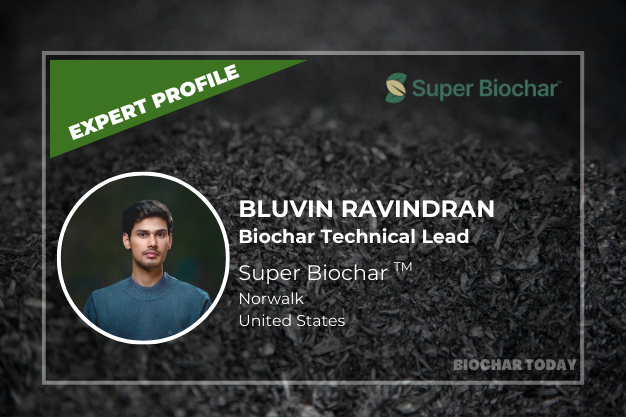
For our readers, I am delighted to introduce Bluvin Ravindran, a leading voice in thermal conversion technologies and a true pioneer in biocharBiochar is a carbon-rich material created from biomass decomposition in low-oxygen conditions. It has important applications in environmental remediation, soil improvement, agriculture, carbon sequestration, energy storage, and sustainable materials, promoting efficiency and reducing waste in various contexts while addressing climate change challenges. More innovation. With a career spanning over a decade, Bluvin has consistently bridged the gap between complex engineering principles and practical climate solutions. His journey began as a mechanical engineer, but his perspective was fundamentally morphed when he recognized that optimizing pyrolysisPyrolysis is a thermochemical process that converts waste biomass into bio-char, bio-oil, and pyro-gas. It offers significant advantages in waste valorization, turning low-value materials into economically valuable resources. Its versatility allows for tailored products based on operational conditions, presenting itself as a cost-effective and efficient More could create a stable carbon sink—not just a fuel source. This pivotal insight catalyzed his transition from traditional engineering to a full-time commitment to climate technology.
Bluvin’s expertise is both deep and wide-ranging. He has led the conversion of over 300,000 tons of biomassBiomass is a complex biological organic or non-organic solid product derived from living or recently living organism and available naturally. Various types of wastes such as animal manure, waste paper, sludge and many industrial wastes are also treated as biomass because like natural biomass these More across multiple continents, from traditional wood and agri-waste to surprising feedstocks like municipal sludge. His work as an Associate Director at Suracsh Filters gave him a microscopic understanding of biochar as a functional material, exploring its potential for water filtration, air purification, and industrial remediation far beyond its use in agriculture. This technical precision is complemented by his strategic vision, honed as Managing Director at C Zero, where he focused on making carbon removal projects economically viable and scalable through carbon credit integration.
As a Biochar Tech-Leader of Super Biochar, Bluvin combines ancient biochar practices with modern AI and IoT soil sensors. He’s engineering a new era of “intelligent biochar” that uses data to create tailored blends for specific soil and crop needs, turning a passive soil amendmentA soil amendment is any material added to the soil to enhance its physical or chemical properties, improving its suitability for plant growth. Biochar is considered a soil amendment as it can improve soil structure, water retention, nutrient availability, and microbial activity. More into an active, data-driven climate solution. His experience in diverse roles—from leading R&D innovation at Suracsh, to strategy at C Zero, to material innovation at Green Builders & Interiors—has given him a unique, holistic view of biochar, from the molecular level to its role as a tangible material for sustainable design. Bluvin embodies the future of biochar: a convergence of technical expertise, strategic insight, and a passion for creating a climate-positive world.
Shanthi Praba : Could you walk us through the moment you first grasped the distinction between biochar and regular charcoalCharcoal is a black, brittle, and porous material produced by heating wood or other organic substances in a low-oxygen environment. It is primarily used as a fuel source for cooking and heating. More, and explain how that specific insight catalyzed your transition from a traditional engineering role to co-founding a climate-tech venture?
Bluvin Ravindran: After completing my Mechanical Engineering Degree from University of Calicut, India , the journey began at Active Char Products Pvt Ltd, India -an activated carbonActivated carbon is a form of carbon that has been processed to create a vast network of tiny pores, increasing its surface area significantly. This extensive surface area makes activated carbon exceptionally effective at trapping and holding impurities, like a molecular sponge. It is commonly More company , where coconut shell charcoal was the raw material for activated carbon. At first, charcoal was just a “feedstockFeedstock refers to the raw organic material used to produce biochar. This can include a wide range of materials, such as wood chips, agricultural residues, and animal manure. More” to me. But as I worked on erecting and commissioning a charcoal plant, I discovered something deeper. By redesigning screws, burners, and cooling towers on an imported machine, I realized that optimizing pyrolysis wasn’t only about energy—it shaped the carbon structure itself. That was the “aha” moment: charcoal could be fuel, but biochar was a stable carbon sink. That difference transformed me from a mechanical engineer solving bottlenecks into someone building climate solutions. That was the seed for everything that followed.
SP: You developed multi-zone clean pyrolysis technologies. Can you share the engineering philosophy behind this with us? How does it differ from traditional designs, and what was the most rewarding performance metric you achieved with it?
BR: At Suracsh Filters , I saw the limits of the “one-big-fire” approach of old kilns. You’d load biomass, light it, and hope it behaved. I wanted precision. So we built multi-zone kilns: each zone with independent airflow, combustion, and pressure control. Instead of guessing, we could run a recipe-driven process, recycling pyro-gases back into the system. The result? 35% yield consistency, near-zero visible emissions, and community acceptance. That moment proved that clean, repeatable biochar production at scale was not a dream—it was achievable engineering.
SP: You’ve led the conversion of over 300,000 tons of biomass across various continents. Which of these feedstocks—from wood and agri-waste to municipal solid waste and sludge—imparted the most surprising properties to the final biochar, and what did you learn from that experience
BR:I’ve worked across wood in Canada, MSW in the US, sludge in Europe, olive pomace in Spain (Amata Green), and cashew shells in Africa (GECA projects). The most surprising? Sludge. I expected poor quality, but under the right thermal window it produced a porous char with fascinating binding properties. It reminded me that every feedstock has a hidden personality, waiting for the right process to unlock it.
SP: You’ve also developed value-added carbons with Shell. What did that involve?
BP: In 2024, at Shell Bangalore, India we upgraded wood-based carbons for gas adsorption applications. Through activation and metal oxide impregnation, we tailored carbons to capture specific gases. Watching an agricultural byproduct turn into a high-performance industrial adsorbent was eye-opening. It proved biochar’s value beyond soil—into air purification, energy systems, and industrial resilience.
SP: Your new venture, Super Biochar, combines ancient biochar practices with modern AI. If biochar were a wise, old wizard, what spell or technique would AI be adding to its toolkit to make it a modern-day defender?
BR: If traditional biochar is a wise old wizard, AI is the spell of foresight—predicting what the soil will need before it even shows symptoms. Biochar brings stability, but AI turns it into a living system, tailoring blends, adjusting dosage, and verifying carbon sequestration. Together, they transform biochar from a passive amendment into an active soil defender.
SP: You’ve led global projects across five different countries. What is one cultural or logistical challenge you encountered that made you question everything you thought you knew about biochar, and what was the lesson learned?
BR: In Africa, during a 25,000-ton project, I assumed farmers would view biochar as a valuable soil amendment. Instead, many saw it as “black waste.” That forced me to rethink communication—not as an engineer but as a storyteller. The lesson I learnt is that success in biochar is 50% technology, 50% culture. You must adapt language, context, and even metrics to local realities.
SP: The carbon removal market is often described as an ambiguous environment. What’s one hilarious learning moment or mishap you’ve experienced while navigating regulatory hurdles or technical unknowns?
BR: Once while preparing a regulatory submission, I proudly wrote that our system “captures and locks away CO₂ forever.” The reviewer circled “forever” and wrote: “Are you God?” It reminded me that while we chase permanence, regulators want precision, not poetry. Since then, I phrase it as “100+ year storage.”
SP: Given your extensive involvement with different firms and projects, it’s clear you’ve seen biochar from multiple angles—from a technical product to a strategic climate solution to a material for sustainable design. How have your ideas and understanding of biochar morphed as you’ve moved between these different roles? Did your work in filtration at Suracsh change how you saw its potential for purification? Did the high-level consulting at C Zero give you a different perspective on the business of carbon credits? And how does your role at Green Builders & Interiors force you to think about biochar in a completely new way—not just as an abstract climate-tech solution, but as a tangible material for buildings and landscapes?
BR: At Suracsh Filters, I was immersed in purification at the microscopic level. We weren’t just filtering out contaminants—we were working at the level of pore structure, surface chemistry, and adsorption kinetics. That experience made me realize that biochar isn’t “just” an agricultural input. When you look at it as an adsorbent, suddenly it becomes part of a much broader technological toolkit. You start thinking about water filtration, air purification, remediation of industrial effluents—not just soil fertility. That atomic-level mindset made me appreciate biochar’s precision and versatility as a functional material.
At C Zero, the perspective shifted from technology to systems and scalability. I began to understand that even the most promising material won’t go anywhere unless it aligns with larger business models and financial mechanisms. Biochar only becomes a real climate solution when it fits into verified carbon credit schemes, supply chains, and market incentives. So, my focus moved from “does this technically work?” to “will it scale, who pays for it, and how does it plug into the carbon economy?” That was a critical shift—from science to strategy.
Green Builders & Interiors took me in yet another direction. Here I had to think of biochar not as a chemical or a line-item in a carbon model, but as a physical material that goes into buildings, bricks, composite panels, or landscaping. You’re literally touching it, blending it into cement, designing with it. It forces you to think about durability, aesthetics, texture—things that hardly come up in climate-tech consulting. It grounded the concept for me. Biochar became something you could build with, not just talk about in a sustainability report.
SuperBiochar, in many ways, is a synthesis of all of that. It’s where the technical potential, the financial logic, and the practical material use all converge. It’s a platform that brings together technology, business, and design—and that, I think, is what makes biochar truly powerful.
SP: Super Biochar plans to tailor blends for “crop-specific” needs. Could you walk us through a hypothetical example? What would a biochar blend for a vineyard look like compared to one for a regenerative farm, and what specific metrics (e.g., pHpH is a measure of how acidic or alkaline a substance is. A pH of 7 is neutral, while lower pH values indicate acidity and higher values indicate alkalinity. Biochars are normally alkaline and can influence soil pH, often increasing it, which can be beneficial More, surface area, etc.) would be prioritized for each
BR: Absolutely — let’s imagine two very different landscapes, a vineyard on a sunny hillside and aregenerative mixed farm in a valley.
In the vineyard, the goal isn’t just to grow grapes — it’s to produce grapes that express the terroir. That means the biochar blend needs to subtly enhance the mineral signature of the soil and support long-lived perennial vines. In this case, we’d design a slightly alkaline biochar (around pH 8) to counteract soil acidification and help nutrient uptake. We’d also bump up the surface area, giving the material more adsorption sites for micronutrientsThese are essential nutrients that plants need in small amounts, kind of like vitamins for humans. They include things like iron, zinc, and copper. Biochar can help hold onto these micronutrients in the soil, making them more available to plants. More. Then we would charge it with potassium, magnesium, and a touch of zinc — the elements that support vine metabolism and influence grape flavour development. Basically, the blend becomes a kind of “soil amplifier,” helping the vines translate the underlying geology into flavour.
For a regenerative farm, the design principles shift. Here the priority is soil biology — you want a living, breathing soil that recycles nutrients and builds carbon. So instead of chasing high alkalinity, we’d choose a moderate pH biochar and focus on high cation-exchange capacity (CEC) to support nutrient cycling. We’d inoculate it with compost teas and microbial consortia, so that when it enters the soil it becomes a kind of microbial apartment complex. The goal here isn’t just nutrient supplementation — it’s the creation of a biological engine beneath the soil surface. So while both blends use the same core material (biochar), the priorities shift.
SP: As a technical lead who works with IoT soil sensors, what specific data points are most critical for verifying carbon sequestration? How do you ensure the integrity of this data for frameworks like Puro.earth or Verra?
BR: Great question — this is where the technical layer really comes alive.
When we deploy IoT soil sensors for carbon projects, we’re not just collecting random soil metrics — we’re capturing the specific signals that tell us whether carbon is actually being stored in the ground and staying there.
The most important data points includes:
- soil moisture – because water is the medium through which biochar interacts with the soil. Too dry and nothing happens; too wet and you might suppress microbial activity. Moisture gives us the context in which carbon dynamics happen.
- pH and electrical conductivity (EC) – these tell us whether the nutrient environment is balanced and suitable for long-term carbon stabilization.
- microbial respiration (CO₂ flux) – this is one of the most direct indicators of carbon turnover. If respiration spikes, you might be losing carbon. Stable, low respiration suggests long-term sequestration.
- bulk density and soil organic carbon (SOC) – this is the hard data. It tells us, quantitatively, how much carbon is actually stored in the soil matrix.
But data alone isn’t enough — it has to be trustworthy. That’s why we use blockchain-linked QR traceability systems. Every batch of biochar is tagged, every sensor reading is time-stamped, and everything is linked to an immutable ledger. On top of that, we follow calibration protocols that are aligned with standards like Puro.earth and Verra. So if an auditor wants to check our claim, they can literally trace it back to the device, the timestamp, and the field location.
In other words, the data tells the story, and the traceability proves it.
As for the next breakthrough, I don’t think it’s a single feedstock or reactor. I think it’s going to be the integration of biochar with other carbon-storing systems — for example, combining pyrolysis with biological inoculants, or coupling biochar with precision agronomy tools so that every hectare becomes its own hyper-optimized carbon engine. The real breakthrough will come when biochar is not a stand-alone product, but part of an intelligent carbon-management ecosystem.
SP: Looking ahead, what do you see as the next breakthrough in biochar technology, beyond what we are currently discussing? Is it a new feedstock, a novel pyrolysis process, or something else entirely?
BR: I believe it will be functionalized biochars—engineered with coatings, microbes, or nanostructures to go beyond carbon storage. Think of biochar not just as a climate solution but as a platform for fertilizer carriers, green composites, and even electronic materials. I’ve seen this first-hand—from Indian Space Research Organisation’s (ISRO)Lithium Hydroxide pellets for CO₂ adsorption in space, to Shell’s gas adsorption carbons, to defense carbons in submarines. Biochar will evolve into a platform material for fertilizers, composites, even electronics.
SP: As a mechanical engineer, you must appreciate good machinery. What would it be like if you could give a personality to a piece of biochar equipment? Is it a grumpy old boiler, a hyperactive spinning wheel, or perhaps a wise, matronly furnace that has seen it all? And to take that a step further, how would you personify biochar?
BR: If I had to personify a biochar kiln, it’s a stoic matronly furnace: patient, nurturing, but firm—turning chaos into order. Biochar itself is the quiet guardian, never loud, never flashy, but silently protecting soil, water, and climate for centuries.
SP: For the readers of Biochar Today and others in the community who want to follow your work, what is the best way to track your progress?
BR: The best way is through LinkedIn (linkedin.com/in/bluvin) and via updates from Super Biochar, Suracsh, CZero. I also collaborate through scientific networks, and I’m always open to knowledge exchange with peers in the biochar community.


Leave a Reply